

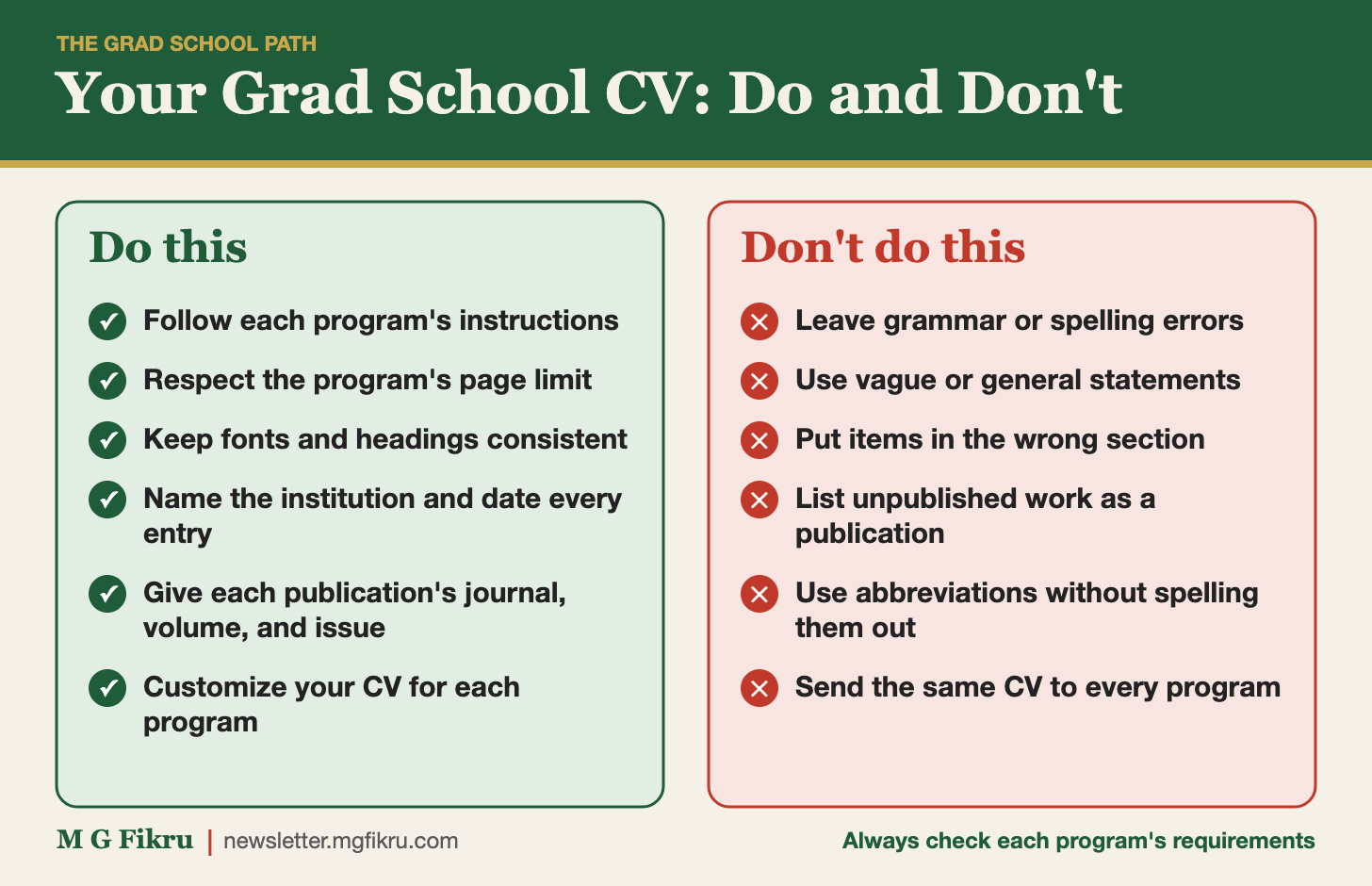
The short answer: A strong graduate school CV is two pages, starts with education, follows with research and publications, and lets a reviewer find what matters within 30 seconds. Read each program’s instructions first. Then place work experience, honors, and skills after your research, make every entry specific and dated, and put each item in the right section. Customize your CV for every program instead of sending one generic version.
Who is this for? Students preparing master's or PhD applications. The rules can be different for internships or jobs. If you are earlier in the process, start with Grad School Application 101, Part 1: How to Plan and Build Your Profile Before You Apply.
Key takeaways
Follow each program’s instructions before anything else
Education first, then research and publications
Two pages is the target; avoid going beyond three
Be specific: who, what, and when for every entry
Certificates are training, not honors
Research is your strongest asset for grad school; put it near the top
Cut what reviewers already assume, such as basic software skills
Customize the CV for each program
What do reviewers look for in a grad school CV?
A reviewer reading your CV is asking three questions:
Is the applicant eligible?
Are they well prepared?
Do they stand out?
Everything on your CV should help a reviewer answer those questions quickly. Reviewers have limited time, so clarity, relevance, and customization matter more than length.
What should a grad school CV include? Things to consider
1. Read the program’s instructions first
Some programs, particularly in Europe, require a specific format, font, or personal information such as a passport number or home address. If the program gives instructions, follow them. They take priority over any general advice, including mine.
2. Put your sections in the right order
For graduate school, I recommend this order, with the most recent entries first in each section:
Education
Research projects and publications
Work experience, including teaching
Honors and awards
Skills and certifications
If you want the reviewer to pay attention to it, include your CGPA and undergraduate thesis (if any) under the education section.
3. Keep it to two pages
Respect any page limit the program sets. If there is none, aim for two pages and avoid going beyond three. Fewer headings and subheadings make a CV easier to read.
4. Make the key information easy to find
A reviewer should be able to locate your most important information within 30 seconds. Use the same fonts, formatting, and heading style throughout. Leave white space between major sections, and use that space efficiently rather than letting it break up the page.
5. Be specific in every entry
Avoid vague or general statements. Every entry should be clearly attributed and dated:
Institutions: name, city, and country. Website links are not necessary.
Honors and awards: who gave the award and when.
Certificates: the topic, the conferring institution, and the year. Spell out abbreviations.
Publications: the journal name, volume, and issue.
One missing date breaks the consistency of the whole section.
6. Put each item in the right section
A certificate is a form of training, not an honor. Place certificates after your education section under a heading such as “Certificates” or “Other Trainings.” Honors and awards are for recognitions that set you apart from others, such as scholarships or competitive awards.
If an honor or medal came with a degree, place it directly under that degree entry in a smaller font. It will be seen early and in context, and you do not need to repeat it in a separate honors section.
If what you listed as certificates are actually recognitions, merge them with your honors under a heading such as “Awards and Recognitions.” A presentation does not belong under honors.
7. Lead with your research
For graduate school, research experience is usually your strongest asset. Position it prominently near the top. Prioritize research projects and technical skills over descriptions of communication and leadership. (If you are also applying for a research assistantship, I explain what professors look for in What Professors Actually Look for in a Research Assistant.)
Work experience and leadership are valuable, but trim each entry to the advanced tasks and skills that set you apart. Commas or colons can help reduce line count.
8. Format your publications consistently
Use APA or other recognized citation style with hyperlinks. It is concise and credits your co-authors. Highlighting your own name in co-authored work is helpful, but do so for every entry. Do not list unpublished work under publications. If you include a manuscript in progress, give its expected publication date.
9. Cut what reviewers already assume
Some content takes space without strengthening your application:
Basic software skills such as Word, Excel, PowerPoint, or email. These are expected of any degree holder.
Language tables. One line listing your languages is enough. If you have published in English, a language section is often redundant.
Course listings under your degree should be limited and relevant.
A photo, unless the program asks for one.
A PO box unless requested.
Hobbies, volunteering, and extracurricular activities, unless they are directly relevant to the program. If space is tight, keep one or two.
Social media skills are worth including only if the program values community engagement or impact.
10. Include a summary only if it adds something new
A summary or “About Me” section is useful when it communicates something not found elsewhere in your CV, such as your goals or a unique personal story. If it repeats your work experience or is vague, leave it out or shorten it. If you use one, place it after your contact information and before education.
11. Show what you contributed, not just where you belonged
For professional associations, describe what you actually did. Membership alone tells a reviewer very little. The same applies to research interests: a long, broad list can dilute your focus, so narrow it to what fits the program.
12. Keep references short
One or two lines per referee is enough. If the program collects references separately, you can omit the section or close with “References available upon request.”
13. Customize for every program
Do not send the same CV to every program. Adjust what you emphasize based on what each program values. If you are still building your list of programs, the Grad School Finder can help you start a shortlist that matches your background.
What are the most common CV mistakes?
Grammar and spelling errors
Inconsistent fonts and formatting
Vague or general statements
Items placed in the wrong section
Irrelevant hobbies or extracurricular activities
CVs that run too long, with too many headings and subheadings
A photo that was not requested
Sections in a confusing or illogical order
Grad school CV checklist
Before you submit, check that:
☐ You followed the program’s instructions on format and content
☐ Education is at the top
☐ Research and publications come next
☐ The CV is two pages, three at most
☐ Every entry has a name, an institution, and a date
☐ Certificates are under training
☐ Publications use one citation style, with your name highlighted consistently
☐ Basic software skills, photos, and course listings are removed
☐ Languages fit on one line
☐ References take one or two lines each, or are omitted
☐ The CV is customized for this program
Frequently asked questions
What order should the sections of a grad school CV be in?
Education first, then research projects and publications, work experience (including teaching), honors and awards, and skills and certifications. List the most recent entries first in each section.
How long should a grad school CV be?
Two pages is my recommendation. Avoid going beyond three, and always follow the program’s page limit if there is one.
What comes first: work experience or education?
For grad school, education comes first. Research experience should follow close behind, because it is usually the most relevant factor for admission.
Where should I put certificates on my CV?
After your education section, under a heading such as “Certificates” or “Other Trainings.” Certificates represent training. Include the topic, the conferring institution, and the year.
Where should I list an honor I received during my degree?
Directly under that degree entry in your education section. Reviewers see it early and in context, and you do not need to repeat it under honors.
Should I include an “About Me” or summary section?
Only if it says something specific that is not already in your CV, such as your goals or a unique personal story. If it repeats your experience or is vague, leave it out. If you include it, place it after your contact information and before education.
How should I format publications?
Use APA or another style with hyperlinks, include the journal name, volume, and issue, and highlight your own name consistently. Do not list unpublished work under publications.
Can I use a Europass CV for grad school?
Europass is appropriate for specific EU scholarship programs. It should not be used for every application. Sending a Europass-formatted CV to U.S. programs is likely to cause confusion. If you started from a Europass template, removed the logo, and the result no longer looks like a Europass document, it is generally fine.
Should I use the same CV for every program?
No. Customize your CV for each program, and always follow its specific instructions.
Should I include a photo?
No, unless the program asks for one.
Should I list Word, Excel, and PowerPoint as skills?
No. These are expected of anyone with a degree. Use the space for research and technical skills.
Do I need a language skills section?
One line listing your languages is enough. If you have published in English, the section is often unnecessary.
Where to go next
Planning before you apply: Grad School Application 101, Part 1: How to Plan and Build Your Profile Before You Apply
Finding programs that match your background: How to Use the Grad School Finder
Writing your essay: Are You Writing the Wrong Essay for Your Grad School Application?
Working with professors: What Professors Actually Look for in a Research Assistant and How to Stand Out
Deciding whether to go: Is Grad School Worth It? Start With Opportunity Cost, Not the Application Essay
Your turn
Pull up your CV and run it through the checklist above. You can also ask an AI tool to check your CV against this guide:
Open the AI tool you use and start a new chat.
Copy and paste the prompt below.
Copy this whole article and paste it after the prompt. The article is the instruction the AI follows.
Attach your CV. Your CV is what the AI evaluates.
Prompt: Check my grad school CV
I am preparing my CV for graduate school applications. The article pasted below is your instruction. My attached CV is what you need to evaluate.
Review my CV against the article and list what can be improved. Sort every point into three groups, and rank the points within each group from most to least important:
🔴 Red: fix now. Write these in red. These are clear problems based on the article, such as missing dates, items in the wrong section, or content the article says to remove. For each one, explain why it needs fixing.
🟡 Yellow: things to consider. Write these in yellow. These are suggestions, not rules. They are not always true and depend on context, such as the program or field, but they are worth looking over twice. Explain why each one may or may not apply to me.
🟢 Green: looks good. Write these in green. These are parts of my CV that already follow the article. Remind me to still check each program's requirements in case I missed anything.
Quote the part of my CV that each point refers to. Do not rewrite my CV, and do not add information that is not in it. If you cannot display colors, use the 🔴 🟡 🟢 labels.
Which change will you make first? Tell me in the comments.
If you know someone applying to grad school this cycle, send them this post.
I am Mahelet G. Fikru, a professor with more than 15 years of experience teaching and mentoring students. I write The Grad School Path to share practical advice on applying to master's and PhD programs. You can find my research, tools, and other writing at mgfikru.com.
Last updated: November 2, 2026.
This is such a thoughtful and practical guide. Focusing on actual contributions rather than passive membership is advice every applicant needs to hear. Adding that AI prompt at the end is brilliant it makes taking action on your tips so straightforward. Sharing this with my network.
Thank you
I thought I was done with my CV, but now I realize there are quite a few things I still need to correct. Thank you, Prof. This is a very thoughtful and valuable guide, and I really appreciate the support.