

The short answer: Apply to the graduate program first, then reach out to the professor briefly and directly. Say what skills you have now, what you hope to gain from a research assistantship, and how it fits your longer-term goals. Professors look for motivation, communication, reliability, and teamwork alongside grades, and trainability matters more than expertise. Generic or AI-generated statements are easy to spot and rarely persuasive.
This post is for prospective graduate students applying for research assistantship (RA) positions. It covers what research professors prioritize when selecting RAs, how to reach out effectively, which soft skills matter most, and what to expect in a research assistant interview.
Key takeaways: What professors look for in a research assistant
Apply to the program first, then reach out to faculty, briefly and directly
Skip the long email summarizing the professor’s work; clarity of purpose matters more
Articulate your current skills, what you want to learn, and how the RA fits your goals
Generic or AI-generated statements are easy to spot and rarely persuasive
Soft skills, motivation, communication, and reliability matter as much as grades
Trainability matters more than expertise
Strong grades help, but curiosity and the ability to take feedback are what distinguish strong RAs
What is a research assistantship?
Research assistantships are paid positions designed to support faculty research. In this post, I focus specifically on RA positions funded through externally supported research grants. The scope of work is defined by the professor and governed by university-wide policies, funding rules, and project timelines.
Many students applying to graduate school are also thinking about RA opportunities. From the perspective of the research professor, I would like to clarify which qualities matter most when considering incoming students for research assistantships.
How should I contact a professor about a research assistantship?
One common mistake prospective students make is sending long, elaborate emails that summarize the professor’s research in detail, attach a CV, and ask whether they should apply. This approach is rarely effective. The first step is to formally apply for admission to the degree program. Only after that should students reach out to a research professor, and then in a concise and targeted manner. Unless explicitly requested, unsolicited CVs and lengthy summaries do not strengthen an application.
What does matter is clarity of purpose. Professors look for students who can articulate their current skills, what they hope to gain from a research assistantship, and how the position aligns with their longer-term academic or professional goals. Generic or AI-generated statements are easy to identify and rarely persuasive. Originality, reflection, and alignment with the research agenda matter far more than polished but impersonal language.
What skills and qualities do professors look for in a research assistant?
Soft skills are critical. A long list of certificates alone is not sufficient. Faculty look for evidence of motivation, communication skills, reliability, and the ability to work in a team. Equally important is trainability. Students are not expected to arrive as experts, but they must be willing to learn, accept guidance, and revise their work repeatedly. Research is inherently iterative, and resilience matters. It is, after all, research, and so students should be prepared to engage fully with the “re” in research: to refine, redo, and revisit their work as part of the process.
Strong grades are important, but they do not define an excellent researcher. What distinguishes strong RAs is curiosity, the ability to take feedback seriously, and a willingness to learn even when outcomes are imperfect.
What questions do professors ask in a research assistant interview?
After covering basic background information, prior experience, and introductory questions, I typically ask questions to help me understand how students learn and how they approach research work. For example, I ask, “What is the best way you learn new concepts outside of a formal classroom setting?” and “When faced with a challenging task, how do you typically approach it?”
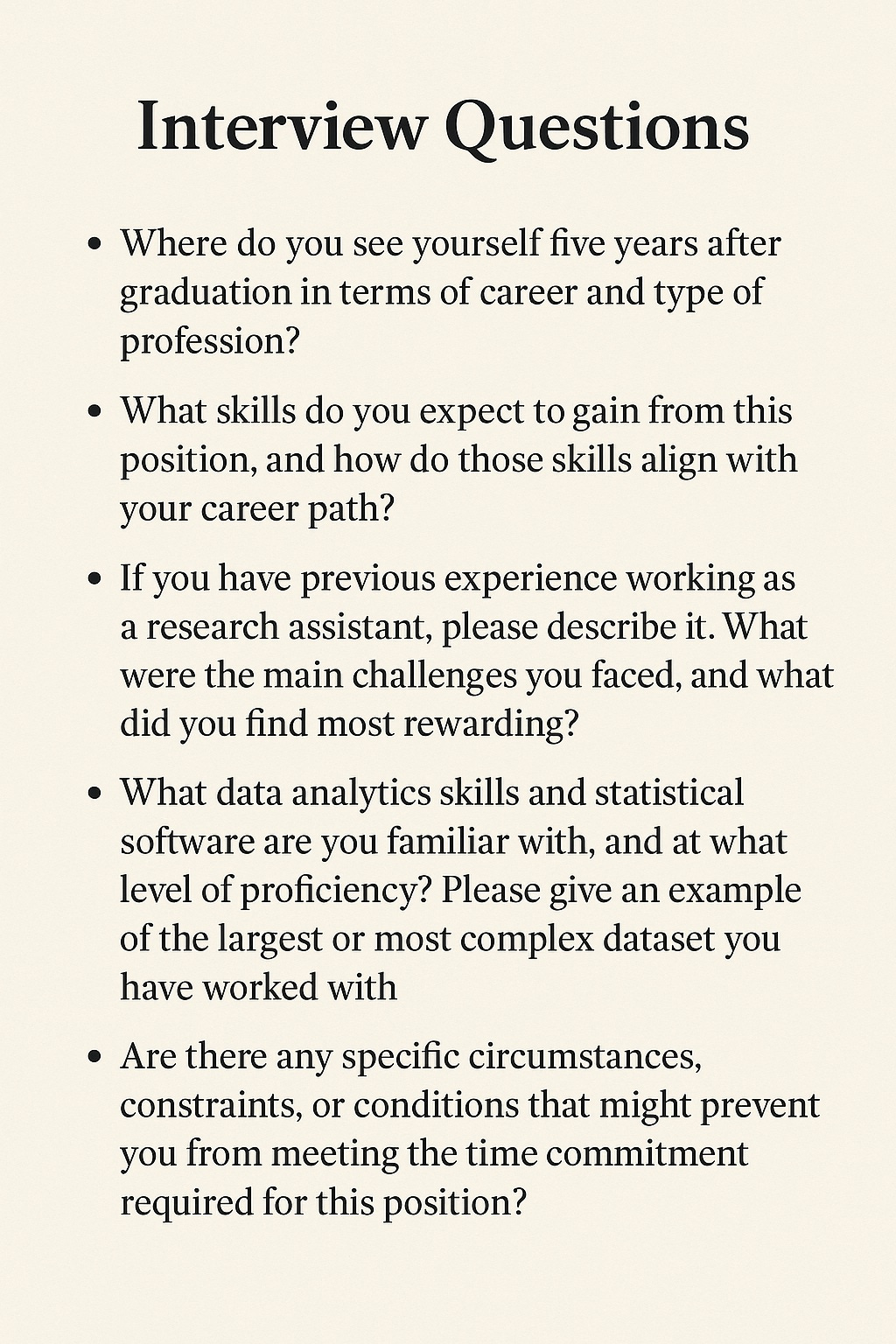
For candidates who advance to a second round, I ask them to read a short academic paper and present it in a subsequent meeting for approximately 15 to 20 minutes. I ask them to summarize the key message, discuss what they found challenging, identify what they learned, and note what remained unclear. The goal is not to test or quiz the student, but to understand how they engage with new material and where their attention naturally focuses.
Research assistantships are professional relationships built on trust, effort, and mutual commitment. Students who approach them with clarity, curiosity, and a willingness to grow consistently stand out more than those who rely solely on a perfect transcript or polished language.
Frequently asked questions
Should I email a professor before I apply to the program?
No. Apply for admission to the degree program first. Then reach out to the professor in a concise and targeted way.
Should I attach my CV to my first email?
Only if the professor asks for it. Unsolicited CVs and lengthy summaries of the professor’s research do not strengthen an application.
Do I need research experience to become a research assistant?
No. Students are not expected to arrive as experts. Professors look for students who are willing to learn, accept guidance, and revise their work repeatedly.
Do grades matter for research assistant positions?
Strong grades help, but they do not define an excellent researcher. Curiosity and the ability to take feedback seriously are what distinguish strong RAs.
Can I use AI to write my email or statement?
Generic or AI-generated statements are easy to identify and rarely persuasive. Originality, reflection, and alignment with the professor’s research agenda matter far more than polished language.
Where to go next
Finding programs that match your background: How to Use the Grad School Finder
Deciding whether to go: Is Grad School Worth It? Start With Opportunity Cost, Not the Application Essay
Writing your essay: Are You Writing the Wrong Essay for Your Grad School Application?
For faculty: How to Better Guide Student Researchers in the AI Age
I am a professor with more than 15 years of experience teaching and mentoring students, including graduate research assistants. Last updated: October 2026.
This is very helpful, Thank you Professor Mahelet.
Thank you a lot for sharing us! Very indispensable for one looking for research assistant position.