

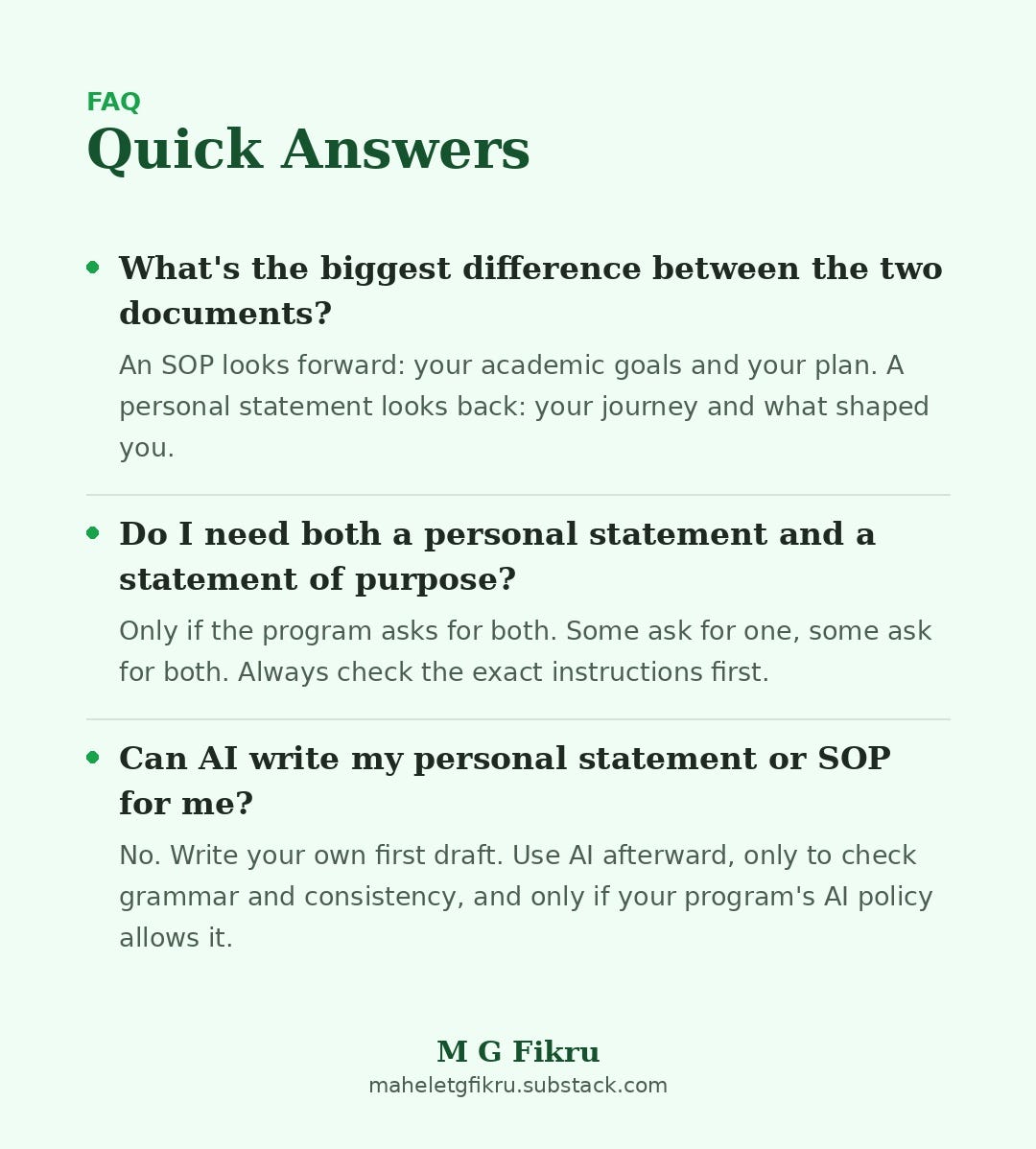
Short answer: A statement of purpose looks forward: your academic background, skills, and study plan. A personal statement looks back: your journey, values, and what shaped you. My rule of thumb is that an SOP is 80–90% professional and 10–20% personal, and the personal statement flips that ratio.
If you’re applying to grad school, confused about personal statements and statements of purpose, and English isn’t your first language, this post is for you.
I often get emails from undergrads, asking exactly this. Most want a second look at their personal statement or statement of purpose.
Students applying to multiple schools get confused fast. A personal statement. A statement of purpose. What’s the difference? And why do schools even ask for this? Isn’t a transcript enough?
This post provides a short guide on what grad schools actually want from each essay and how to write both without sounding like everyone else.
What actually separates a personal statement from a statement of purpose?
Why do schools ask for them?
What are the dos and don’ts?
What’s the difference between a personal statement and a statement of purpose?
A Statement of Purpose (SOP) covers your academic background, your technical skills, and your study plan. What’s your end goal? Why this program? How does it fit your background? It looks forward. Most research-based programs ask for one. In short, it answers two questions: what do you want to do, and how do you plan to do it?
Cornell is a good example. Their guidance on writing an SOP is specific.
Include your research experience — the project, your exact role, and what you learned. Include relevant professional or internship experience. Explain why you’re applying. Name your academic interests and the skills you bring.
They also want you to name specific faculty whose work overlaps with yours. That tells them how closely you’ve actually researched the program, not just the field.
A Personal Statement is more personal, as the name suggests. It’s your journey. Your passion. Your interests. And why did you choose this specific path? This is the part of your story no one else can duplicate — even someone with your exact GPA and your exact skills. It looks back, not forward. Your identity, your values, how you got here. This is the most common ask for scholarship and graduate applications in the UK, and it’s becoming more common across continental Europe too.
Cornell requires both documents for most graduate programs. They’re explicit that the two should complement, not repeat, each other. The personal statement covers your background and what shaped you. The SOP stays focused on your academic interests and professional goals.
UCLA works the same way. Most departments ask for both a Statement of Purpose and a personal statement. UCLA’s official prompt asks you to describe educational, personal, cultural, economic, or social experiences relevant to your academic journey. Any challenges? Any opportunities?
Separately, it asks you to describe how your background contributes to the university’s mission of community outreach, volunteer work, or research that addresses inequality. In short: the ways you’ve shown up for something bigger than your own résumé.
There’s overlap between the two, of course.
My rule of thumb: think of the SOP as roughly 80-90% professional — your background, your skills, your goals — and 10-20% personal. The personal statement flips that ratio.
Not every school asks for both. Some ask for only one. Don’t assume you need to write both — read the instructions carefully first.
Why do grad schools ask for this?
For the SOP, schools need proof that you have the appropriate training and skills. Not just to do the program, but to succeed in it.
Cornell says this directly: they use the SOP to understand your academic goals and judge whether you’re a fit for that specific program. A great GPA or test score only proves you can handle the coursework. It doesn’t prove that your goals align with what the program is actually trying to do. That alignment is what the SOP is testing.
For the personal statement, schools want to know you have the drive to make it through. Whatever shaped your path — that’s what they’re trying to measure. Grades measure aptitude. This essay measures something grades can’t show.
A quick checklist for both
✅ Do:
Read the exact term in the application instructions. A statement of purpose and a personal statement are not interchangeable. Schools notice when you’ve reused one for the other
Check for specific prompts. Address each one directly, point by point
Say something new — information not already covered elsewhere in your application
Write your own first draft. Not AI
Read the program’s AI policy before you use AI for any part of the essay. More programs have explicit rules now. If AI is allowed, use it to check grammar and consistency after your own draft is done
Once you have a first draft, try this prompt in ChatGPT or your favorite AI to refine it without losing your voice:
Without changing my voice, my content, or my substance, edit this personal statement (or statement of purpose) for my graduate school application. You may correct grammar, spelling, and inconsistencies directly. Do not rewrite my sentences, change my tone, or add any experience, detail, or claim I did not write myself. I’ll give you the application instructions. Check that I’ve addressed everything the university asked for, point by point. If something required is missing, or if there’s a major issue with structure or content, flag it for me to fix myself. Do not fix it yourself — just tell me what’s wrong and where.
Stick close to the word count. Asked for 1,200 words? Aim for 1,150–1,200. Not 800. Not 1,300
Ask someone you trust to read it. Ask for honest feedback, not a polite “looks good”
❌ Don’t:
Don’t repeat the same idea in different words just to fill space
Don’t exceed the word or page limit
Don’t make things up
Don’t submit something mostly written by AI. Schools can increasingly tell — and it defeats the purpose of the essay
Don’t write generic or vague statements; mention specific items or instances
Don’t send the same essay to every school; customize for each
Don’t use big quotes or fancy vocabulary if it is not natural to you
Final thoughts
If you’re applying to grad school and want a second pair of eyes or just honest, genuine feedback, like this post and drop a comment below. I read and respond to every comment.
For similar topics, see:
“A useful resource for learning how to organize ideas and write a strong essay
You explained it so clearly, I wish your text could be handed to all the applicants.