

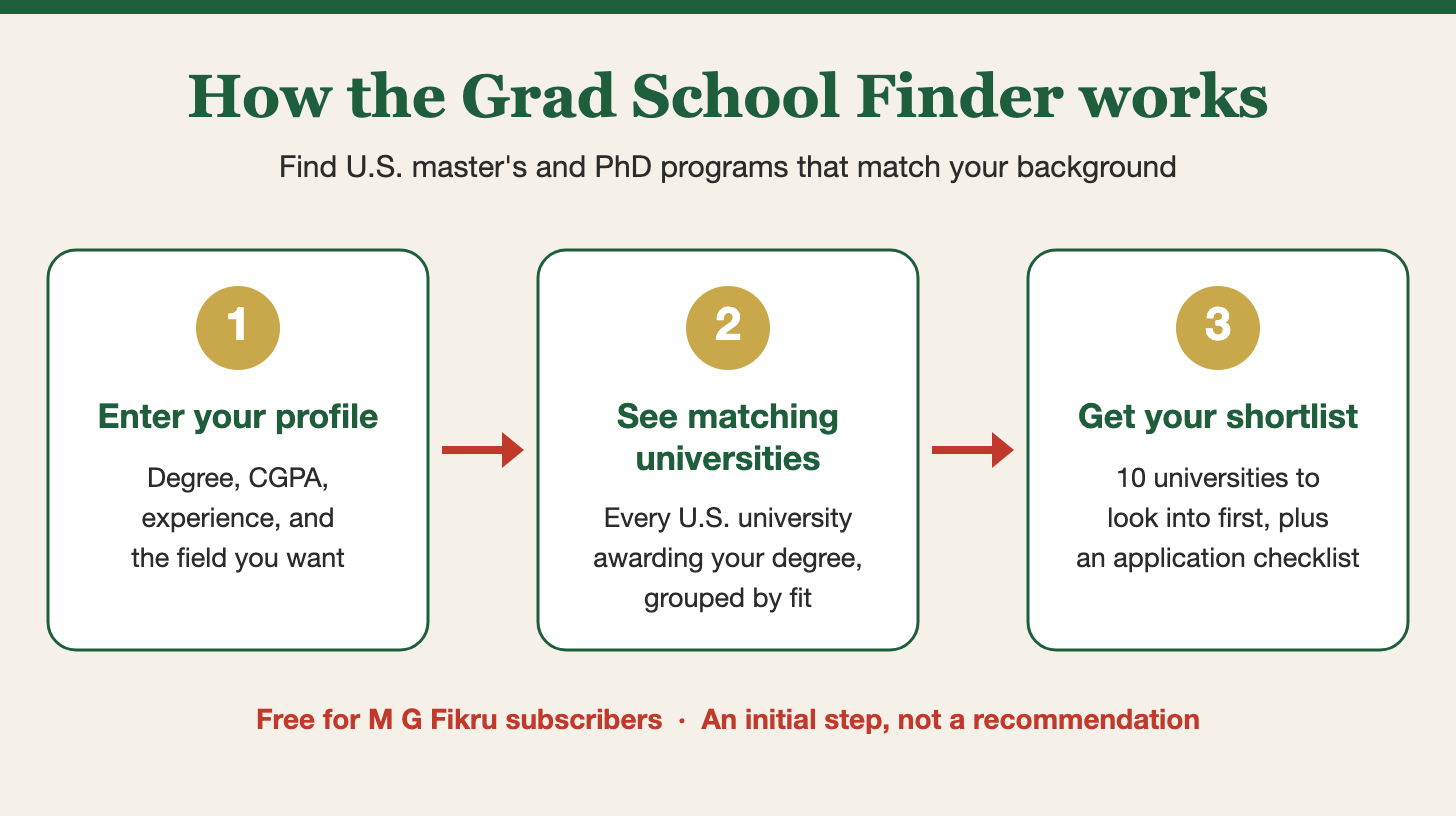
The short answer: The Grad School Finder is a free tool for subscribers that helps you find U.S. master's and PhD programs that match your background. It lists every U.S. university awarding the degree you want and sorts those schools by how your degree, CGPA, and experience compare with each one. You get a shortlist of 10 universities that match your background, plus an application checklist. It takes about five minutes once you are approved.
The Finder is free for subscribers. If you are not subscribed yet, subscribe for free and request access with the same email.
Disclaimer: The Finder is only an initial step in your search. It is not an admission decision, an approval, or a recommendation of any program.
Why I built the Grad School Finder
Every application cycle, students ask me the same first question: Where should I even apply? Most start with rankings, open dozens of tabs, and spend weeks on schools that were never a realistic fit for their background. Application fees add up quickly when that happens.
In my last post, Is Grad School Worth It?, I argued that the decision to go to grad school starts with opportunity cost, not the essay. The Finder is the practical next step. It draws on several public data sources to give you a starting list built around your degree, grades, and experience, so your time and money go toward universities that match your background.
Who is the Grad School Finder for?
Students in any country who plan to apply to a master's or PhD program in the United States, including those switching fields. It is most useful at the start of your search, before you spend money on application fees.
What students are saying
Beckham Berhanu, one of the first students to use it, put it simply:
"The grad school finder saves a lot of time."
He also gave me two suggestions I am taking seriously: link directly to the specific program or scholarship page instead of the general university website, and add a Go/No-Go recommendation based on an applicant's needs, such as funding, standardized tests, and years of experience.
Kibreab Wudu Zegeye, who read the opportunity cost post, tried it soon after:
“I checked on it and it works perfect. The matching is truly great.”
He also asked whether it could cover Europe and Australia, since U.S. requirements like the GRE and IELTS hold many applicants back.
How do I get access to the Grad School Finder?
For subscribers, enter your email at gradfinder-mgfikru.netlify.app.
Wait for approval. I check each request against the subscriber list and approve it within 24 hours.
Sign in with the code sent to your email.
Each approval gives you 7 days of access, starting from your first search, and up to 10 searches a week. When your 7 days are up, you can ask for another 7 days from the same screen.
What information do I need to enter?
Have these ready before you start:
Where you live: your country.
Your bachelor's degree: your major, the year you graduated (or expect to), your CGPA out of 4.0, and whether the degree was taught in English.
Your master's degree, if you have one.
Work experience: organization and dates. Leave the end date empty if it is your current job.
What you want: degree level (master's or PhD), the field you want to study, and where in the United States. The field is filled in from your major. Change it if you are switching fields.
Then click Show my programs.
How do I read my results?
You will see three things:
1. Every U.S. university that awards your degree. Schools are sorted into three groups based on how your CGPA and experience compare with each university. Within each group, the tool also shows which schools are more likely to offer funding, based on estimates derived from several public data sources.
2. A shortlist of 10. These are the universities that best match your background, and the ones to look into first. For each one, you will see its admission fit, funding chance, and links to the university website.
3. An application checklist. For each item, you tell the tool where you are, so you can see what is still missing.
If you are switching fields, the tool will remind you that many programs accept career changers but expect prerequisite courses, especially in math or statistics. If no university reported awarding your degree at that level, try turning on related programs or choosing a broader field.
What doesn't the Grad School Finder do?
The Finder is an initial check, not advice or a prediction of admission or funding. It works only from what you enter and from public data. Before you apply, read the program's page, confirm the deadline, and check what the application requires.
Two reminders from my own experience:
Apply first, then reach out to professors. Once your application is in, a brief, direct email to a faculty member whose work fits yours is appropriate. I explain what professors look for in What Professors Actually Look for in a Research Assistant.
For international applicants: after admission, you will need to demonstrate that you can cover any costs not covered by your funding to obtain your I-20 for the student visa. Plan for this early.
Where to go next
Your shortlist is the starting point. For the next steps, these posts go deeper:
Deciding whether to go: Is Grad School Worth It? Start With Opportunity Cost, Not the Application Essay
Writing your essay: Are You Writing the Wrong Essay for Your Grad School Application? explains the difference between a personal statement and a statement of purpose.
Working with professors: What Professors Actually Look for in a Research Assistant and How to Stand Out
Frequently asked questions
Is the Grad School Finder free?
Yes. It is free for M G Fikru newsletter subscribers, and subscribing is free. Not a subscriber yet? Subscribe first, then request access.
Does it cover master's and PhD programs?
Yes. You choose the degree level when you enter your profile.
Does it cover universities outside the United States?
No. It covers only U.S. programs, but you can use it from any country.
Where does the data come from?
The list of universities comes from College Navigator, the U.S. Department of Education's college search website. The funding chance is calculated from several other public data sources.
How many searches can I run?
Up to 10 a week, during each 7-day access period.
How long does approval take?
Usually within 24 hours. I check each request against the subscriber list.
Is the Finder a recommendation or an admission decision?
No. It is an initial step to help you build a starting list. Always confirm details on each program's own page.
Try it and tell me what you find
Open the Grad School Finder, run your first search, and tell me in the comments what surprised you in your shortlist. Suggestions from students are how this tool can get better.
If you know someone applying to grad school this cycle, send them this post. A good shortlist early in the process saves weeks of searching and a lot of application fees.
I am Mahelet G. Fikru, a professor at Missouri S&T with more than 15 years of experience teaching and mentoring students. I write The Grad School Path to share practical advice on applying to master's and PhD programs.
Last updated: October 18, 2026.