

Short answer: Graduate school is worth it when what it gives you outweighs what you give up to attend. Economists call what you give up the opportunity cost, and it differs for each person. So the question is not "Is grad school worth it?" but "Is grad school worth it for me, right now?"
The question behind the question
Many students come to me with the same question: How do I stand out in my grad school application? The first thing that comes to my mind is a different question. Are you ready for it? Do you want it? Have you thought it through? Or does it simply sound like the natural next step because you have all A's?
Many students assume that strong grades lead naturally to graduate school. They do not. Good grades show you can succeed in coursework. They do not show that you want two to six more years of study, or that you are motivated by research. Those are separate decisions, and they deserve separate thinking.
Are you sending mixed signals?
Most students I meet are trying to do both at once after graduation. They turn on the "Open to Work" sign on LinkedIn while also preparing graduate applications. I understand the instinct to keep options open, but it often sends mixed signals. Which one is it: a job until you are admitted, or graduate school until you find a good job?
Graduate programs want students who are eager to be there, especially those motivated toward research. Employers also want the full you, not a split version who spends half the workday searching for graduate program openings. Both sides can usually tell the difference.
What is opportunity cost, and why is yours unique?
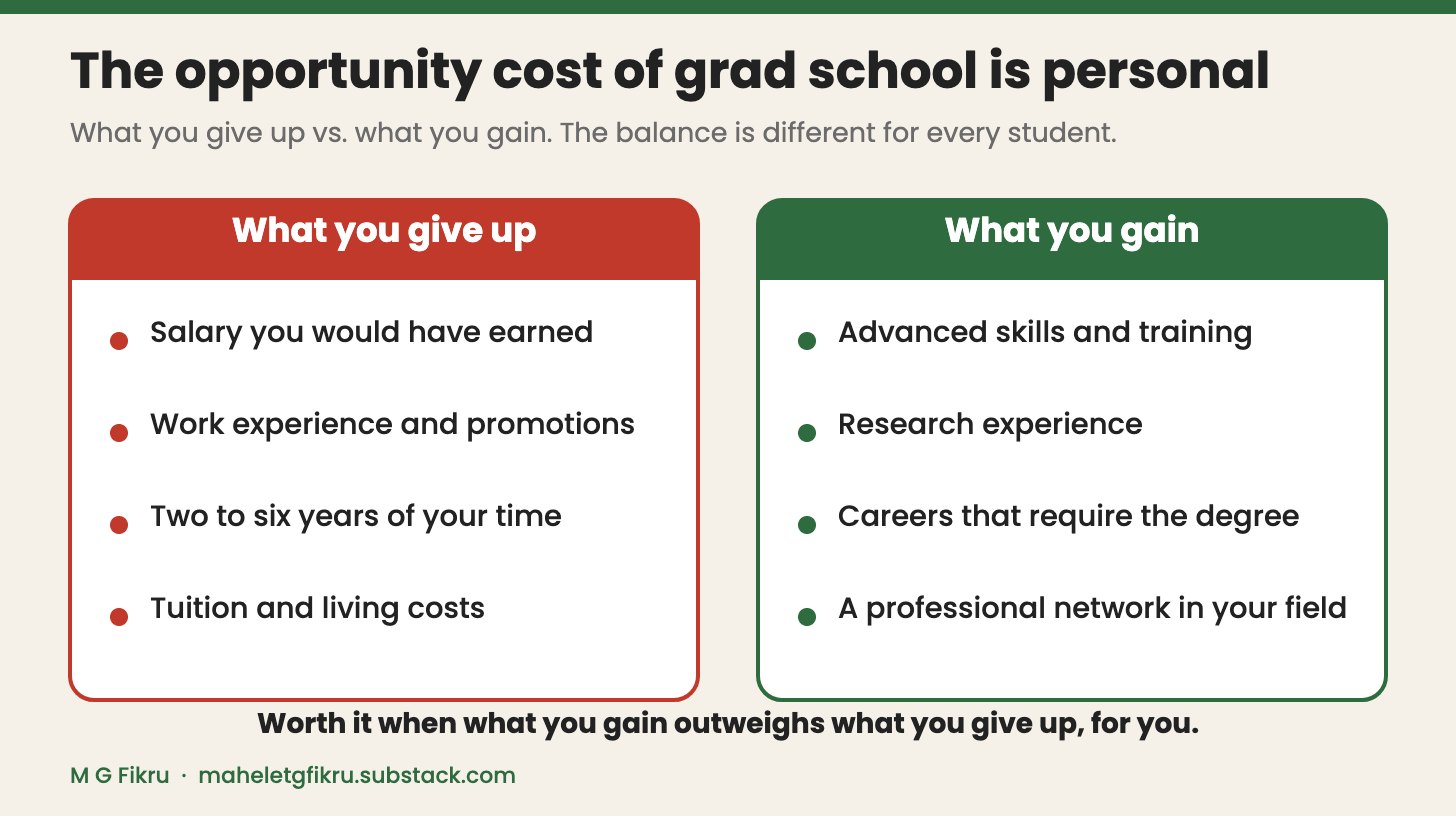
Opportunity cost is the value of the best alternative you give up when you make a choice. For graduate school, it includes the salary you would have earned, the work experience you would have gained, and the years themselves. Tuition is only part of the cost.
That cost varies from person to person. A student with a strong job offer in a field that rewards experience gives up a lot by enrolling. A student whose career goal requires a research degree, such as a university faculty position, gives up much less because the job path itself runs through the degree.
The benefits vary too. In a study of U.S. graduates, Altonji and Zhong (2021, Journal of Labor Economics) find that earnings gains from advanced degrees differ widely across fields and even depend on a person's undergraduate major. In their estimates, a few master's fields show negative rates of return. The same degree can be a strong investment for one person and a weak one for another.
Three questions to ask before you apply
What specific goal requires this degree? If you cannot name one, pause.
What would I give up by enrolling now? List the job, the salary, and the experience.
Would I still choose it if no one were watching? Choose it for your goals, not for the signal it sends.
If you answer these honestly, the application essay becomes easier to write, because you will know exactly why you are applying. For the essay itself, see my earlier post, Are you writing the wrong essay for your grad school application?, and for research roles, What Professors Actually Look for in a Research Assistant.
A free tool for your next step
If you have thought it through and decided graduate school is right for you, I built a free tool to help with what comes next. Grad School Finder lists the U.S. universities that award the master’s or PhD you want, and suggests a shortlist of 10 to look into first, with an application checklist.
It is designed for students planning to apply to master's or PhD programs in the United States, and it is free for subscribers to this newsletter. Try Grad School Finder here.
Grad School Finder is an initial check, not advice. Always confirm requirements, funding, and deadlines on each university’s website.
If you are weighing this decision right now, tell me in the comments what you are deciding between.
Know someone applying to grad school? Share this post with them. If it resonated, please like and restack it so it reaches more students weighing the same decision.
Read more on grad school and research careers:
The grad school finder saves a lot of time. As a suggestion, it would be best if it redirects me to a specific scholarship or program instead of a generic university website. Equally important is having a feature that recommends Go/No-Go based on applicants' needs (funding, standardized tests, years of experience).
Dear Professor,
Thank you so much for sharing this valuable lesson. It helped me recognize the importance of considering opportunity costs and strategic planning before pursuing graduate studies.
My main concern is English proficiency requirements. Yesterday, I submitted my application for the M.S. Assistantship in Forestry at Mississippi State University and paid the $80 application fee. However, I have not yet taken the TOEFL or IELTS.
Professor, would you recommend prioritizing the TOEFL/IELTS examination or requesting an English proficiency waiver based on my academic and professional background? Also, how can I strategically manage these requirements to avoid unnecessary costs and missed opportunities?
I would be grateful for your mentorship on this issue, and I would appreciate it if you could also discuss it with Dr. Metiku.
Thank you very much for your guidance and support.