


A guest post by Sofanit D. Mebrate, with an introduction by Mahelet G. Fikru
Welcome to The Grad School Path, a section of this newsletter with plain-language advice on applying to master’s and PhD programs, from professors and from people who have just been through it. Subscribers also get free access to the Grad School Finder.
This guest post is by Sofanit D. Mebrate, who recently went through the whole process, from shortlisting schools to getting her I-20. She is now an M.A. student in Economics at Ohio University, focusing on econometrics, quantitative analysis, and economic research. The rest of this post is in her words.
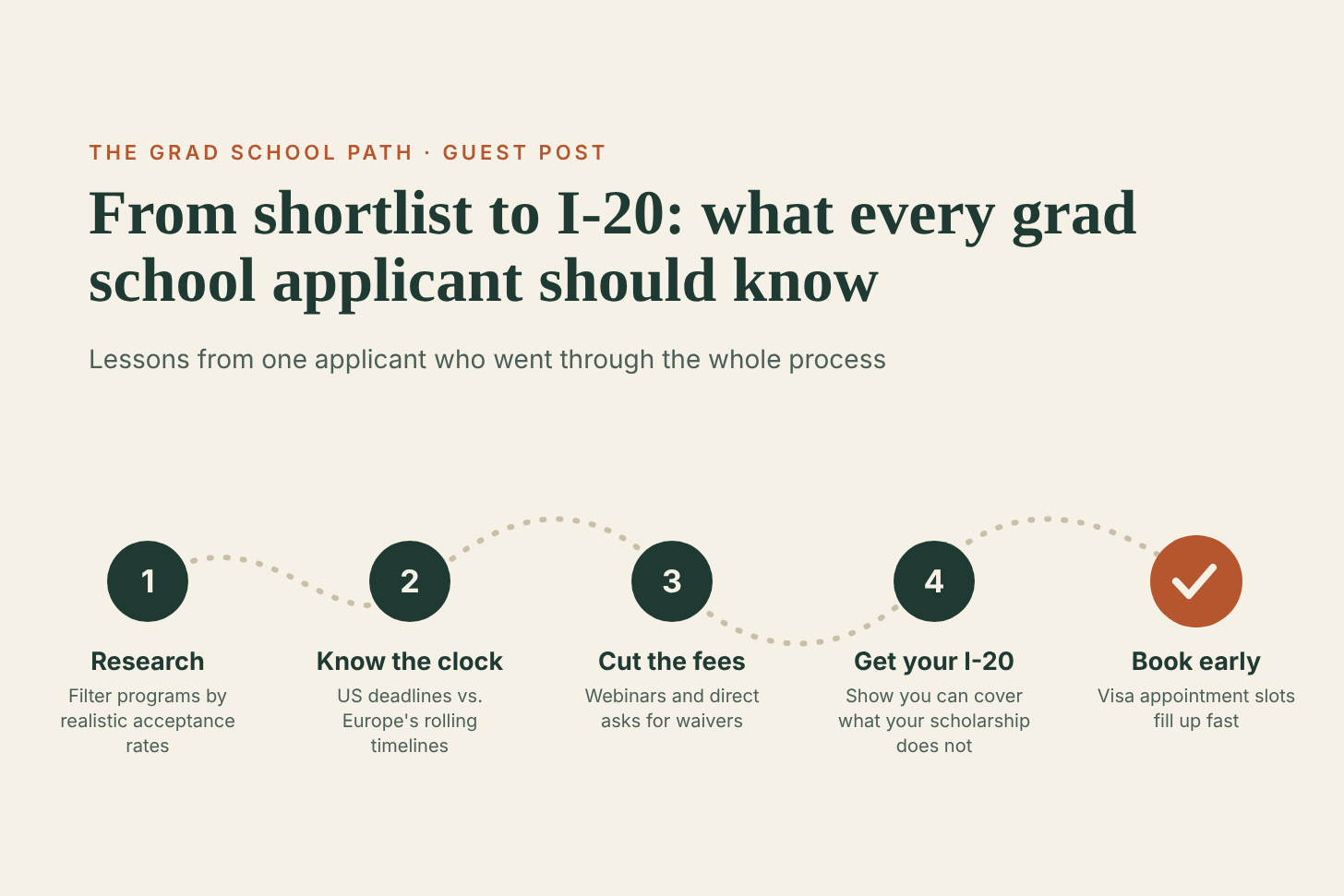
Here’s what I learned going through the process, from building a school list to getting your I-20.
1. How to build your grad school list: start with research, not applications
Applying everywhere is tempting.
My advice is to slow down first. Look closely at each program, then filter your list by acceptance rate so you end up with schools where you have a real chance.
A focused, realistic list saves money, time, and morale.
2. US vs. Europe grad school deadlines run on different clocks
If you’re looking at both, don’t treat them as one market.
United States: Deadlines are fixed and fairly standard, often around December 1. Fully funded opportunities often require GRE scores.
Europe: Timelines vary a lot more. Some universities use rolling admissions, and programs like Erasmus and other international scholarships have their own schedules and rules. Expect different language and document requirements, such as the IELTS.
Both are very competitive. The fix is the same for each: plan well ahead of time.
3. How to get grad school application fee waivers
Fees add up quickly. Two ways to cut them:
Attend university webinars. Many programs offer fee waivers to attendees.
Ask directly. Email the program and request a waiver, especially if you meet the minimum eligibility requirements.
4. After admission: how to get your I-20
For US-bound students, admission starts a second process. Here’s how it worked for me:
The university starts your I-20. You’ll need to submit financial documents, such as bank statements, that show you can cover the costs your scholarship does not.
Once your I-20 is issued, schedule your visa appointment and pay the service fee.
Have these ready: your admission offer letter, bank statements, and any other supporting documents the university or embassy asks for.
My biggest warning: start early. Appointment slots fill up fast, and waiting can cost you your start date.
5. Free resources for grad school applicants
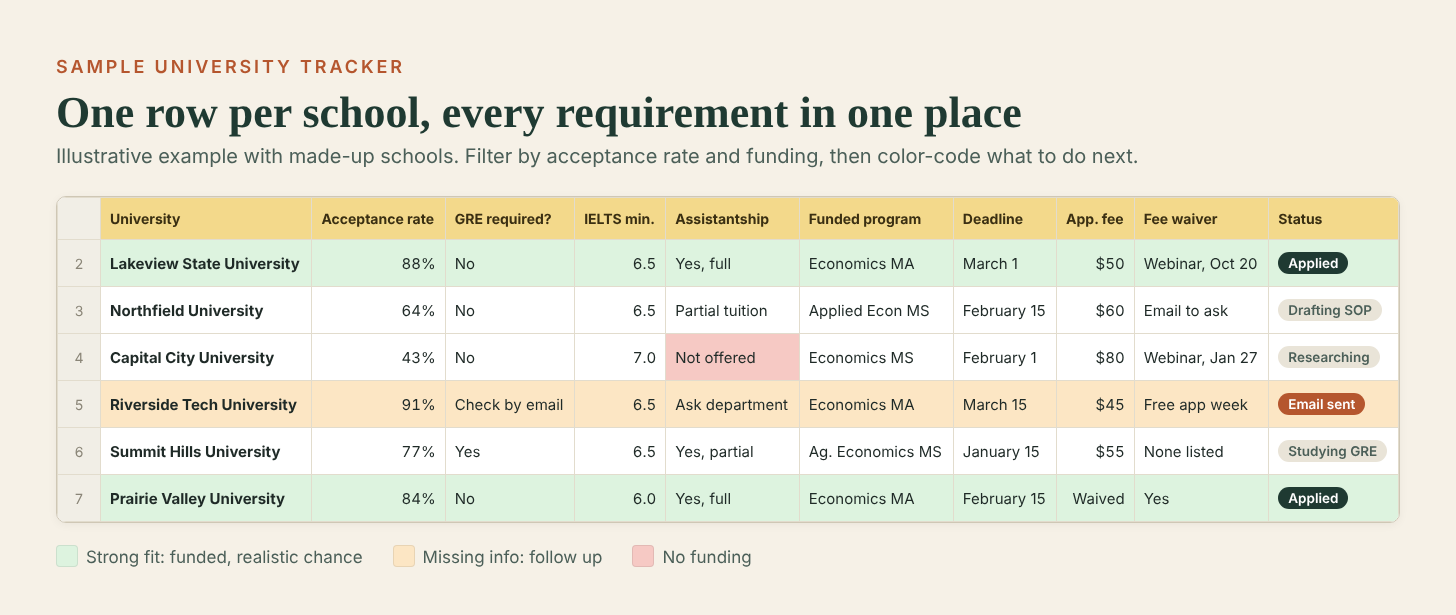
Build a tracker spreadsheet. Keep one row per school, with columns for acceptance rate, GRE requirement, IELTS score, graduate assistantship, which programs are funded, the deadline, and the application fee. Color-code each row so you can see at a glance which schools are a strong fit and which need follow-up. The sample after this list, with made-up schools, shows what mine looks like.
Start your list from the rankings. The U.S. News economics graduate rankings are a useful place to collect names, which you can then sort in your tracker by fit and realistic chances.
Prepare for the IELTS. I recommend this free one-hour IELTS crash course from IELTS Advantage on YouTube.
Go to college fairs. EducationUSA Ethiopia runs U.S. college fairs where you can meet universities in person. The September 19, 2026, fair filled up fast, so watch for the next one and register early.
Grad school application FAQs
When are grad school application deadlines in the US and Europe?
In the US, deadlines are fairly standard, often around December 1. In Europe, timelines vary more: some universities use rolling admissions, and scholarships like Erasmus have their own schedules.
Do I need the GRE for grad school?
For many fully funded US opportunities, yes. Check each program’s requirements and record them in your tracker. European programs are more likely to require an English-language test, such as the IELTS.
How do I get a grad school application fee waiver?
Attend the university’s webinars, since many programs offer waivers to attendees, or email the program directly and ask, especially if you meet the minimum eligibility requirements.
What is an I-20, and how do I get one?
The I-20 is the document a US university issues after you are admitted, so you can apply for a student visa. The university starts it once you submit financial documents, such as bank statements, showing you can cover costs your scholarship does not.
Key takeaways
Research programs and filter by realistic acceptance rates.
Know whether you’re applying on a US clock or a European one.
Use webinars and direct requests to get fee waivers.
After admission, start the I-20 and visa steps right away.
— Sofanit
More from The Grad School Path
If you want more from The Grad School Path, explore these posts:
Is Grad School Worth It? Start With Opportunity Cost, Not the Application Essay
Grad School Application 101, Part 1: How to Plan and Build Your Profile Before You Apply
Grad School Application 101, Part 2: How to Apply to Grad School Strategically
Are You Writing the Wrong Essay for Your Grad School Application?
What Professors Actually Look for in a Research Assistant and How to Stand Out
How to Use the Grad School Finder to Find U.S. Universities That Match Your Background
Applying this cycle? Leave your questions in the comments, and Sofanit and I will answer as many as we can.
Nice to meet you , Sofanit. Your advice is super wonderful.
Great read! I'm convinced that as someone targeting business school, sitting for the GRE is mandatory. Even if you get a waiver, chances are you have to be very outstanding in other aspects of the application, so I've decided to prepare for one. In short, where do I start to prepare for the GRE, especially given my base in Ethiopia? Are there test centers, preparation material, peer groups?