

Data Centers, One Point at a Time · Part 3: Jobs
By Mahelet G. Fikru, PhD, economist · Updated November 7, 2026 · Based on my ongoing research on data centers
Whenever a data center is announced, the press release leads with jobs. “Thousands of jobs.” I wanted to know what that number actually means, so as part of my ongoing research on data centers, I went through company announcements one by one and wrote down two numbers for each: how many people built it, and how many people work there once it is running.
The pattern was the same every time.
How many jobs does an AI data center create?
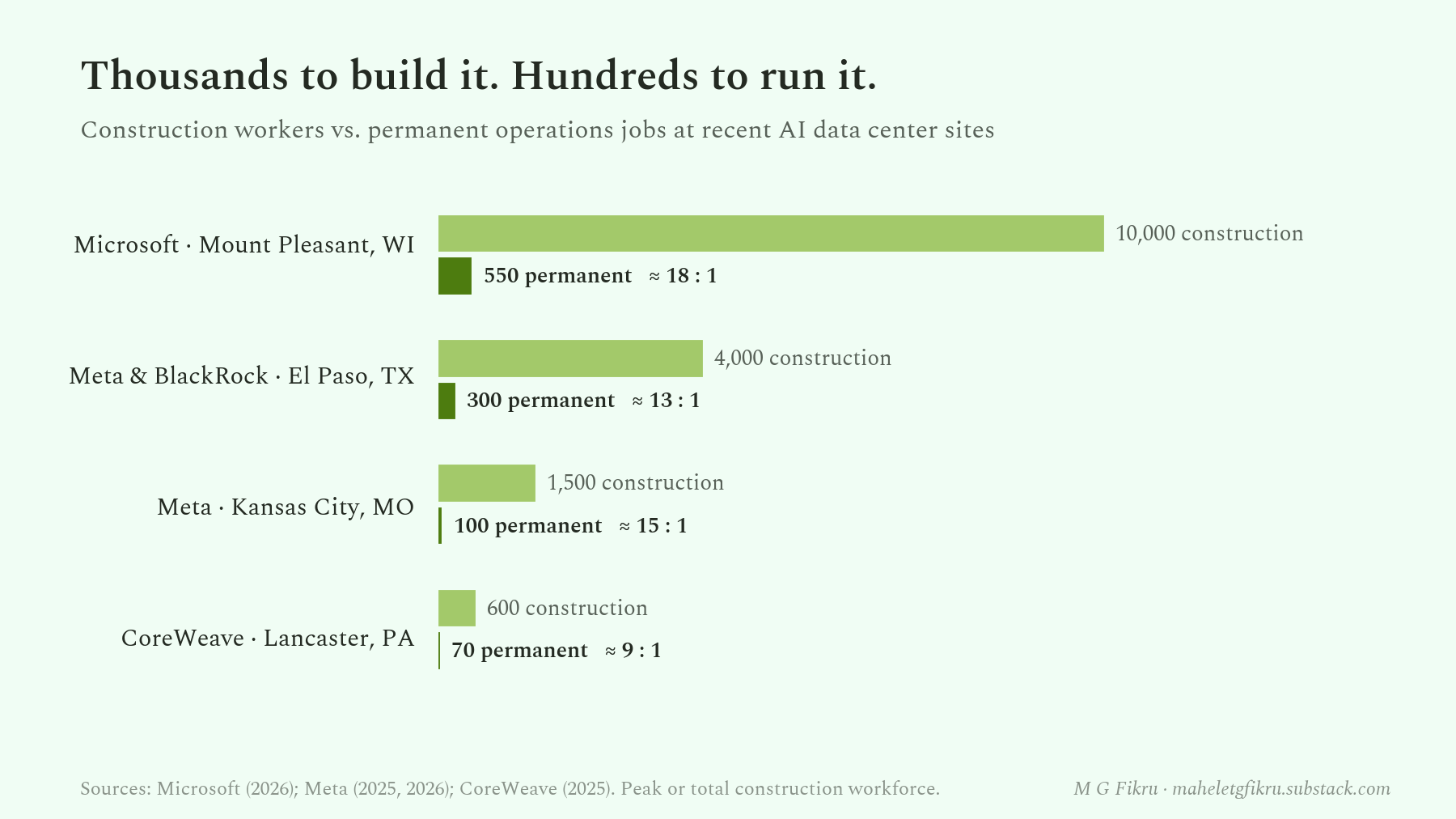
AI data centers create many construction jobs and relatively few permanent ones. At recent sites, the ratio ranges from about 9:1 to 18:1. Microsoft’s first data center in Mount Pleasant, Wisconsin, used nearly 10,000 construction workers and has about 550 full-time employees on site.
Key takeaways
Microsoft, Wisconsin: ~10,000 construction workers vs. ~550 permanent (about 18 to 1).
Meta and BlackRock, El Paso: 4,000+ vs. ~300 (about 13 to 1).
Meta, Kansas City: ~1,500 vs. 100+ (about 15 to 1).
CoreWeave, Pennsylvania: ~600 vs. ~70 at launch (about 9 to 1).
The numbers, site by site
Microsoft, Mount Pleasant, Wisconsin: about 10,000 construction workers, about 550 permanent employees. Roughly 18 to 1 (Microsoft).
Meta and BlackRock, El Paso, Texas: more than 4,000 construction jobs at peak, about 300 operational jobs. Roughly 13 to 1 (Meta).
Meta, Kansas City, Missouri: about 1,500 skilled trade workers at peak, more than 100 operational jobs. Roughly 15 to 1 (Meta).
CoreWeave, Lancaster, Pennsylvania: about 600 build-phase jobs, about 70 full-time roles at launch, growing to about 175 over time. Roughly 9 to 1 at launch (CoreWeave).
Google’s $15 billion Montgomery County project in Missouri follows the same pattern: thousands of construction jobs during the build and hundreds of long-term jobs once it is operational.
Why the gap is so wide
The way I explain it to my students is a house versus a mansion. A mansion costs far more to build than a regular house. It needs fancier materials, more complex wiring and plumbing, and specialist contractors. But it does not need five times the staff to run just because it cost five times as much to build.
AI data centers are the mansion. Most of the money goes into chips, cooling, and power systems. Once those are installed, a few hundred people can keep the place running.
What this does and doesn’t mean
I do not want to dismiss the construction jobs. They are real, they pay well, and they can last several years on a large campus. Google, for example, says it is helping train more than 2,300 construction laborers in Missouri, including 1,500 apprentices. The permanent jobs are real too, and they are often well paid.
But a community should plan around what stays after the cranes leave. If a project is sold on “thousands of jobs,” it is worth asking how many of those will still be there in five years.
Frequently asked questions
How many permanent jobs does a data center create?
Recent AI data centers report roughly 70 to 550 permanent jobs per site, far fewer than the hundreds to thousands of construction workers who build them.
What is the ratio of construction to permanent jobs at data centers?
At recent AI sites it ranges from about 9 to 1 (CoreWeave, Pennsylvania) to about 18 to 1 (Microsoft, Wisconsin).
How many jobs did Meta’s Kansas City data center create?
About 1,500 skilled trade workers at peak construction and more than 100 operational jobs once running, according to Meta.
Related reading
Virginia Gave Data Centers A Carrot. Now It’s Reaching For The Stick.
When Innovation Becomes More Than a Helper: Humanoid Robots and the Future of Work
This is part 3 in my series, Data Centers, One Point at a Time, based on my ongoing research.
Part 1: Who Works in U.S. Data Centers? What 15 Years of NAICS 518 Data Show
Part 2: Most New Data Centers Aren’t Going Where the Old Ones Are
Part 3: Ten Thousand Workers to Build It. Five Hundred to Run It. (you are here)
Part 4: The AI Money Is Booming. The Data Center Jobs Are Flat.
Mahelet G. Fikru, PhD, is an economist who studies energy, natural resources, and technology. If this was useful, share it with someone trying to make sense of the data center boom.
This was an interesting read and made me wonder about the ethics of the selling point.
Is it ethically justifiable for tech companies to use "thousands of jobs" as a primary selling point to secure local tax breaks, knowing that 90% to 95% of those jobs will disappear in a few years?