

Tesla's Optimus humanoid robot raises urgent questions about job displacement, AI ethics, and the need for robot governance before automation reshapes every job.
A few weeks ago, I wrote about Optimus, Tesla’s humanoid robot designed to function as a general domestic assistant. I wanted to follow up with some additional thoughts that have stayed with me since then. I am also thinking more carefully about the real economic consequences of displacing human domestic assistants, and about how people currently working in this space view the arrival of humanoid robots. Tesla’s Optimus is still a work in progress, but the questions I have feel urgent.
If a robot can function as a domestic assistant, what prevents it from being something else entirely? A loyal soldier programmed to fight battles? A bodyguard? Something designed not just to assist, but to protect or to harm.
What counts as an ‘unsafe’ job for a robot?
According to Tesla, the goal of developing Optimus is to:
“Create a general purpose, bi-pedal, autonomous humanoid robot capable of performing unsafe, repetitive, or boring tasks.”
That statement sounds reasonable at first glance. However, it immediately raises a deeper question: what exactly constitutes an unsafe task?
Is fighting unsafe? Is being a soldier unsafe? Is working in a chemical factory unsafe? What about working in a mining site?
And what about “repetitive” or “boring” tasks? They are subjective definitions. What is boring to one person may be meaningful work to another. What is repetitive may also be skilled, creative, or socially valuable.
Which jobs could humanoid robots replace?
Once we open that door, the list expands quickly. Data entry, packing, restocking and inventory, maintenance and cleaning, gardening, toll booth operations, and parking enforcement.
A handyman. A cashier—especially if we imagine self-checkout lanes replaced by robots, just as self-checkout once replaced human cashiers. A waiter or waitress.
Entertainment, perhaps. Playing on a sports team. A baseball player.
The list keeps growing.
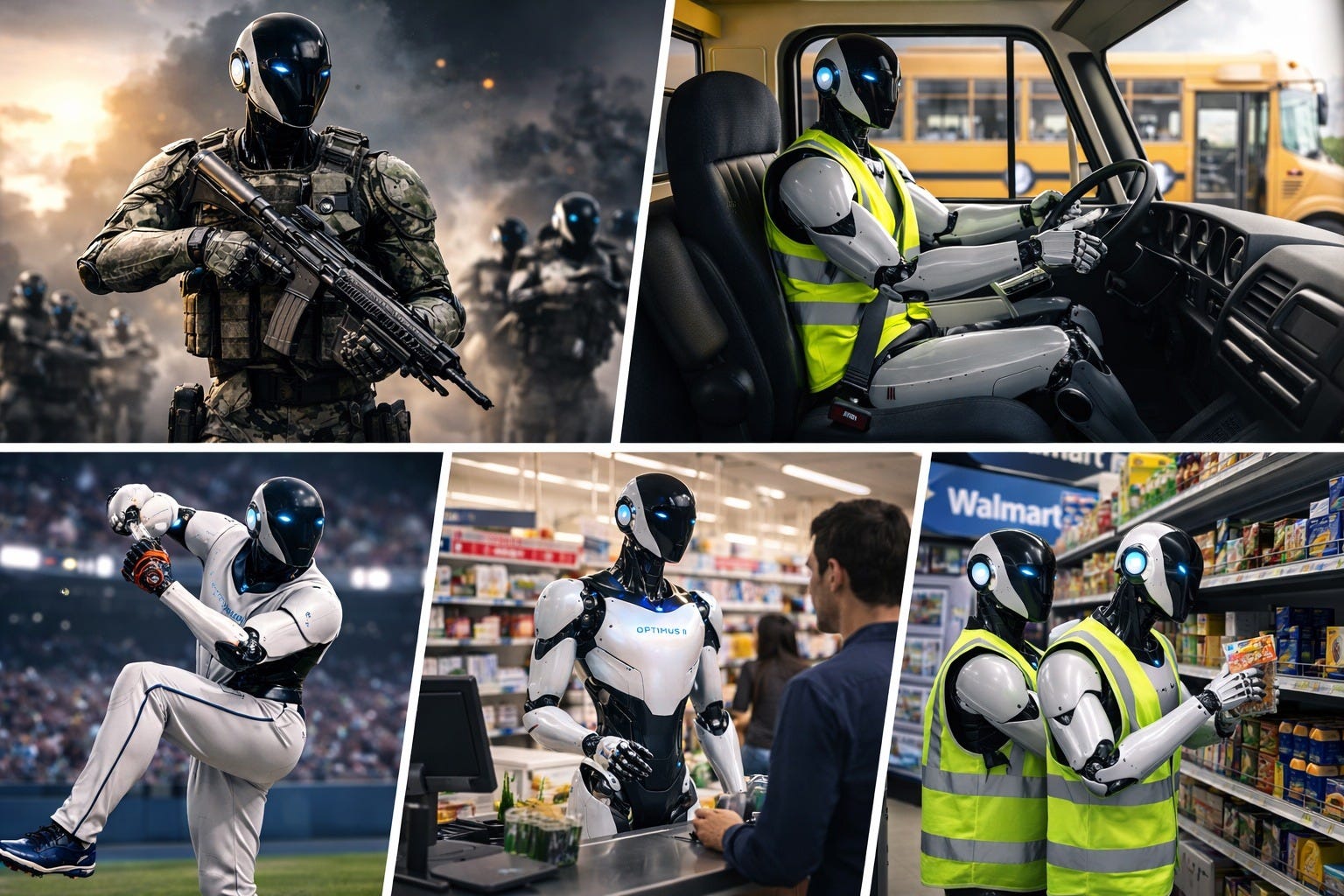
At that point, we are no longer talking only about domestic assistants. We are talking about a much broader reshaping of work. It starts to sound like science fiction, but if the technology works in one domain, why not the others?
Why we need robot governance now
This is where I want to make a clear argument for regulation. Or more precisely, for governance.
Where is it?
This conversation needs to be proactive, not reactive. I am not opposed to robots. However, as a society, we need a governance framework for AI and robots—one grounded in ethics and values, rather than just technical feasibility. Not mandates, necessarily, but clear principles that guide where and how these technologies are deployed.
Technology-driven innovation is now advancing at a pace that exceeds our collective imagination. Engineering brilliance alone cannot be the yardstick for progress. We need to ask how these machines affect real people, how they reshape livelihoods, and how they interact with the natural environment in which we live. We need to ask whether they reproduce existing inequalities or quietly deepen them.
The conversation about the future of work and humanoid robots should not start after the technology is everywhere.
It needs to start now.
For more analysis on humanoid robots:
The cost of replacing human labour is extinction level climate change. :-(
Thank you, Mahelet, for raising these very important points in this excellent post. I absolutely agree with you that the adjectives that have been used to describe these robots are very much up for interpretation. In particular, "unsafe" causes me some concern for exactly the reasons you have outlined.