

Data Centers, One Point at a Time · Part 2: Location
By Mahelet G. Fikru, PhD, economist · Updated November 5, 2026 · Based on my ongoing research on data centers
In my last post, I wrote about employment numbers in U.S. data centers. This post is about where they are going, and it is the finding that surprised me most in my research.
I had assumed new data centers would cluster where the old ones are: near big cities, fiber lines, and skilled workers. For the existing ones, that is true. For the next wave, it is not.
Where are new data centers being built?
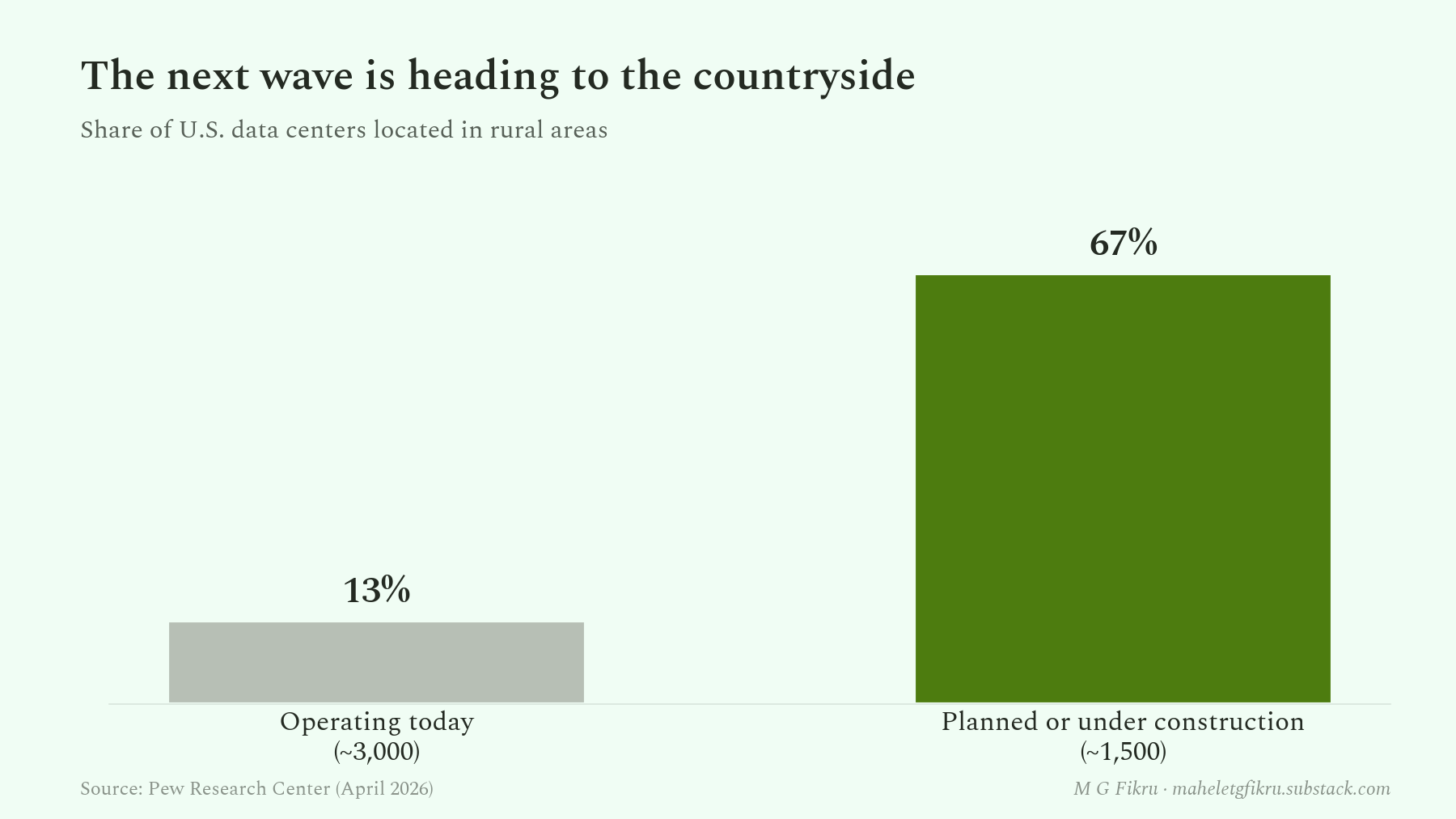
About 87% of the data centers operating in the U.S. today are in urban areas, and only 13% are in rural areas. But of the more than 1,500 data centers that are planned or under construction, 67% are in rural areas (Pew Research Center, April 2026).
Key takeaways
87% of operating U.S. data centers are urban; 67% of the more than 1,500 planned ones are rural.
39% of planned data centers are in counties that have none today.
42% of Americans live within 5 miles of an operating or planned data center.
91% of Missouri’s current and planned data centers are in the Kansas City and St. Louis areas, but new campuses are going rural.
Montgomery County, Missouri (about 11,000 people) now has $25 billion in data center commitments, roughly $2.3 million per resident by my calculation.
My take: rural counties are getting the biggest projects with the smallest planning staffs and water systems, so the hard questions about water, power, and who pays land on the smallest local governments.
Sources: Pew Research Center, April 2026; Missouri figures from Data Center Map, KOMU, and KBIA. The per-resident figure and “my take” are my own analysis.
Pew found two more things worth knowing. First, 39% of planned data centers are in counties that have none today. Second, about 38% of Americans already live within five miles of an operating data center. Add the planned ones, and that rises to 42%.
Why rural?
My read as an economist: mostly space. AI campuses are hyperscale, and hyperscale needs hundreds of acres. Google’s planned Missouri campuses run from 315 to 934 acres each. Amazon’s Project Green in Montgomery County sits on roughly 1,000 acres. Land at that scale is cheaper and easier to find outside a metro area. Access to power matters too, and I will come back to electricity later in this series.
What this looks like in Missouri
Missouri’s existing data centers are a metro story. Of the 95 current and planned data centers counted by Data Center Map, 91% are in the Kansas City or St. Louis areas. Other counts differ slightly (Baxtel lists 118 facilities across 42 providers) because they define a data center differently, but all counts agree on the concentration.
The new projects break that pattern. Montgomery County, home to about 11,000 people, now has $25 billion in data center commitments: $10 billion from Amazon and $15 billion from Google. By my calculation, that is roughly $2.3 million in committed investment per resident.
Why it matters
A rural county is a different kind of host than a big city. It usually has a smaller planning staff, a smaller water system, and less experience negotiating with global companies. A project that would be one of dozens in a metro area can be the largest thing that ever happened to a rural county.
That can be good news: new tax revenue, construction work, and investment in places that have not seen much of it. But it also means the questions about water, power, and who pays for what land on the smallest local governments. That is a reason to ask those questions early, not a reason to say no.
Frequently asked questions
Are most new data centers being built in rural areas?
Yes. Pew Research Center found that 67% of planned or under-construction U.S. data centers are in rural areas, compared with 13% of those operating today.
Why are data centers moving to rural areas?
Mainly land. AI data center campuses need hundreds of acres and very large amounts of electricity, which are easier and cheaper to secure outside metro areas.
Where are Missouri’s data centers located?
According to Data Center Map, about 91% of Missouri’s current and planned data centers are in the Kansas City and St. Louis areas, but large new projects are landing in rural Montgomery County.
What does a big data center mean for a rural county?
It can bring new tax revenue, construction work, and investment. But rural counties usually have smaller planning staffs and water systems than cities, so questions about water, power, and who pays for what should be asked early. In Montgomery County, Missouri, data center commitments come to roughly $2.3 million per resident.
Related reading
Virginia Gave Data Centers A Carrot. Now It’s Reaching For The Stick.
AI Services Require Energy and Water—Just Like Everything Else We Consume
This is part 2 in my series, Data Centers, One Point at a Time, based on my ongoing research.
Part 1: Who Works in U.S. Data Centers? What 15 Years of NAICS 518 Data Show
Part 2: Most New Data Centers Aren’t Going Where the Old Ones Are (you are here)
Part 3: Ten Thousand Workers to Build It. Five Hundred to Run It.
Part 4: The AI Money Is Booming. The Data Center Jobs Are Flat.
Mahelet G. Fikru, PhD, is an economist and professor at Missouri University of Science & Technology who studies energy, natural resources, and technology. More of her research and tools at mgfikru.com. If this was useful, share it with someone trying to make sense of the data center boom.