

Data Centers, One Point at a Time · Part 4: Capital vs. Jobs
By Mahelet G. Fikru, PhD, economist · Updated November 15, 2026 · Based on my ongoing research on data centers
This is the central finding of my ongoing research on data centers, and the one I keep coming back to.
If AI is the biggest investment story of the decade, I expected the jobs to follow the money. So I pulled fifteen years of Census Bureau employment data for the industry that comes closest to “data centers” and lined it up against the investment numbers.
They did not move together.
Is AI investment creating data center jobs?
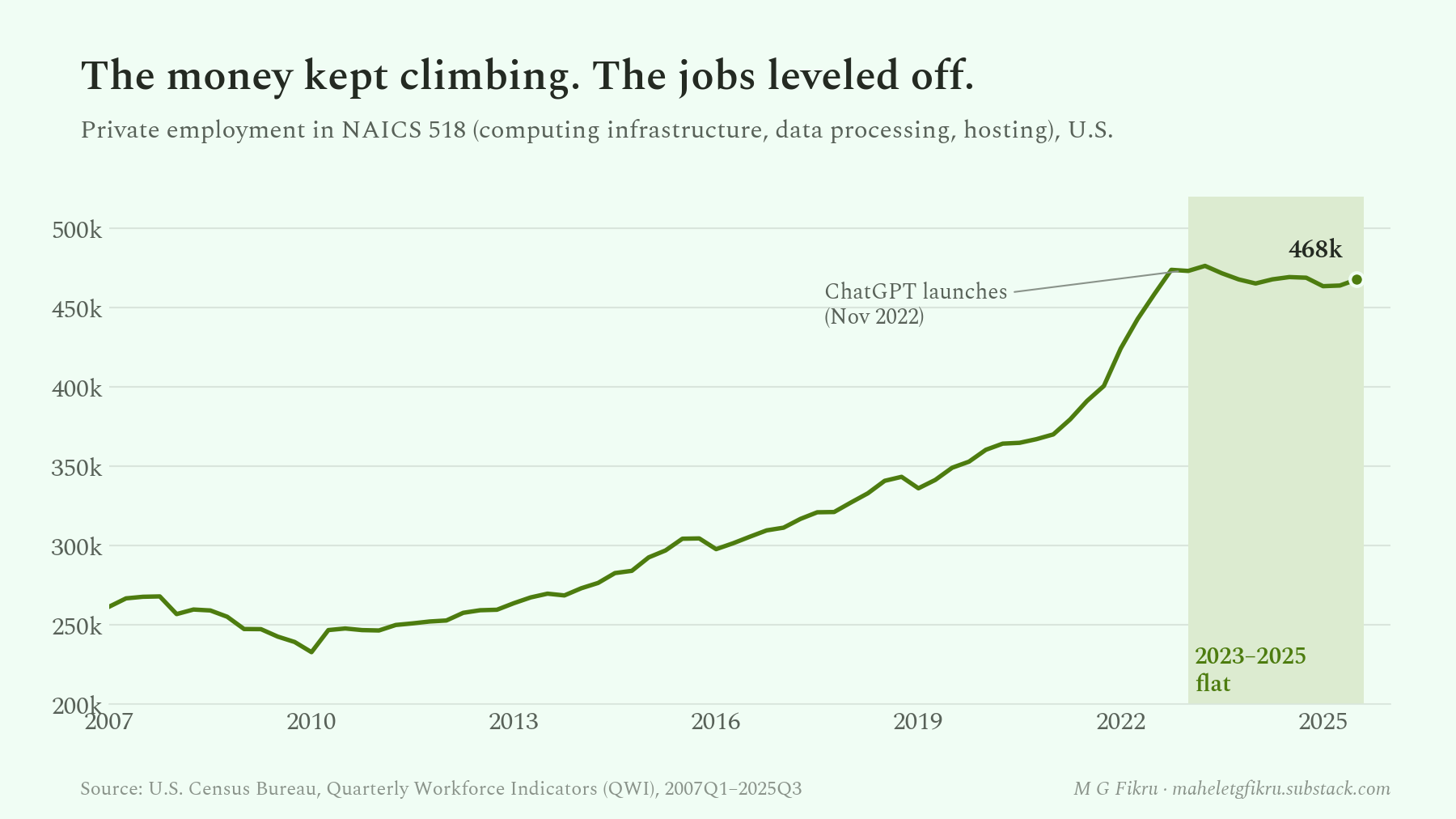
Employment in NAICS 518 (computing infrastructure, data processing, and web hosting) jumped about 18% over one year, from roughly 401,000 in late 2021 to about 474,000 in late 2022, then flattened. It was about 473,000 at the start of 2023 and about 468,000 in the third quarter of 2025. Over the same years, AI investment continued to climb rapidly. My hypothesis is that the capital story and the jobs story are coming apart.
Key takeaways
NAICS 518 employment rose about 18% from late 2021 to late 2022, then held near 470,000 through 2025.
U.S. AI investment: about $581 billion in 2026, rising from 1.8% to 2.8% of GDP by 2028.
About 30% of AI capital spending goes into data center buildings.
Hypothesis: AI data centers are capital-intensive, not labor-intensive.
The money side
Goldman Sachs estimates U.S. AI-related investment at about $581 billion in 2026, roughly 1.8% of GDP, rising to 2.8% by 2028. About 30% of AI capital spending goes into the data center buildings themselves.
The jobs side
The employment line tells three stories, and it helps to keep them apart:
2010 to 2019: steady growth as cloud computing went mainstream. Not an AI story.
2020 to 2022: a sharp jump, first from pandemic demand (remote work, video calls, streaming), then from the early AI build-out. ChatGPT launched at the very end of 2022.
2023 to 2025: the first years fully after ChatGPT, and the line goes flat.
Why would jobs stall while money pours in?
My previous post gave part of the answer: AI data centers are expensive to build but not labor-intensive to run. The extra money buys chips, cooling, and power systems, not more workers per building. And because new capacity is concentrated in a few giant hyperscale campuses, the investment does not spread to many new businesses that would each hire their own staff.
What I am not claiming
This is a hypothesis, not a settled finding. NAICS 518 is not a pure count of data center workers. It also includes payroll processors, data entry firms, and other businesses unrelated to AI, and it omits some in-house data centers. Three years is also a short window.
But the direction is worth taking seriously. So far, the AI build-out shows up much more clearly in investment than in jobs.
Frequently asked questions
Is AI investment creating jobs in data centers?
Some, mainly in construction. But Census data show employment in NAICS 518, the sector that includes data centers, was flat from 2023 to 2025 even as AI investment grew rapidly.
How many people work in data processing and hosting in the U.S.?
About 468,000 private-sector workers in the third quarter of 2025, according to the Census Bureau’s Quarterly Workforce Indicators for NAICS 518.
How large is AI investment relative to the U.S. economy?
Goldman Sachs estimates that about $581 billion will be spent in 2026, roughly 1.8% of GDP, rising to about 2.8% by 2028.
Catch up on what you missed
Part 1: Who Works in U.S. Data Centers? What 15 Years of NAICS 518 Data Show
Part 2: Most New Data Centers Aren’t Going Where the Old Ones Are
Part 3: Ten Thousand Workers to Build It. Five Hundred to Run It.
This is part 4 in my series, Data Centers, One Point at a Time, based on my ongoing research.
Next up, Part 5: The Data Center Down the Road Is Getting a Lot Bigger
Mahelet G. Fikru, PhD, is an economist who studies energy, natural resources, and technology. If this was useful, share it with someone trying to make sense of the data center boom.