

Short answer: Yes, to some extent. In our national survey of 1,200 Americans, consumers cared most about price and performance but placed measurable value on lithium mined and refined in the U.S.
Most discussions about electric vehicles focus on driving range, charging time, and price. But there is another question quietly emerging in the background of clean vehicles:
Do consumers really care where the minerals inside an EV battery come from?
Our recent study suggests the answer is yes — to some extent.
Using a national U.S. survey of 1,200 respondents, the study examined whether Americans value electric vehicles differently depending on where the lithium in the battery is mined and refined. Specifically, the study tested whether consumers prefer lithium sourced and processed in the United States rather than abroad.
The findings suggest that although consumers primarily care about the performance and price of the final product, they also place measurable value on the upstream supply chains supporting clean technologies.
What the data shows
We showed 1,200 survey respondents two different types of electric vehicles and asked them to make hypothetical choices between the offered EVs and a default gasoline vehicle.
The EVs differed in:
driving range,
charging time,
amount of tax credits available from state and federal governments,
percentage of lithium mined in the U.S.,
whether the lithium was refined in the U.S. or abroad,
and the EV price premium relative to a comparable gasoline vehicle.
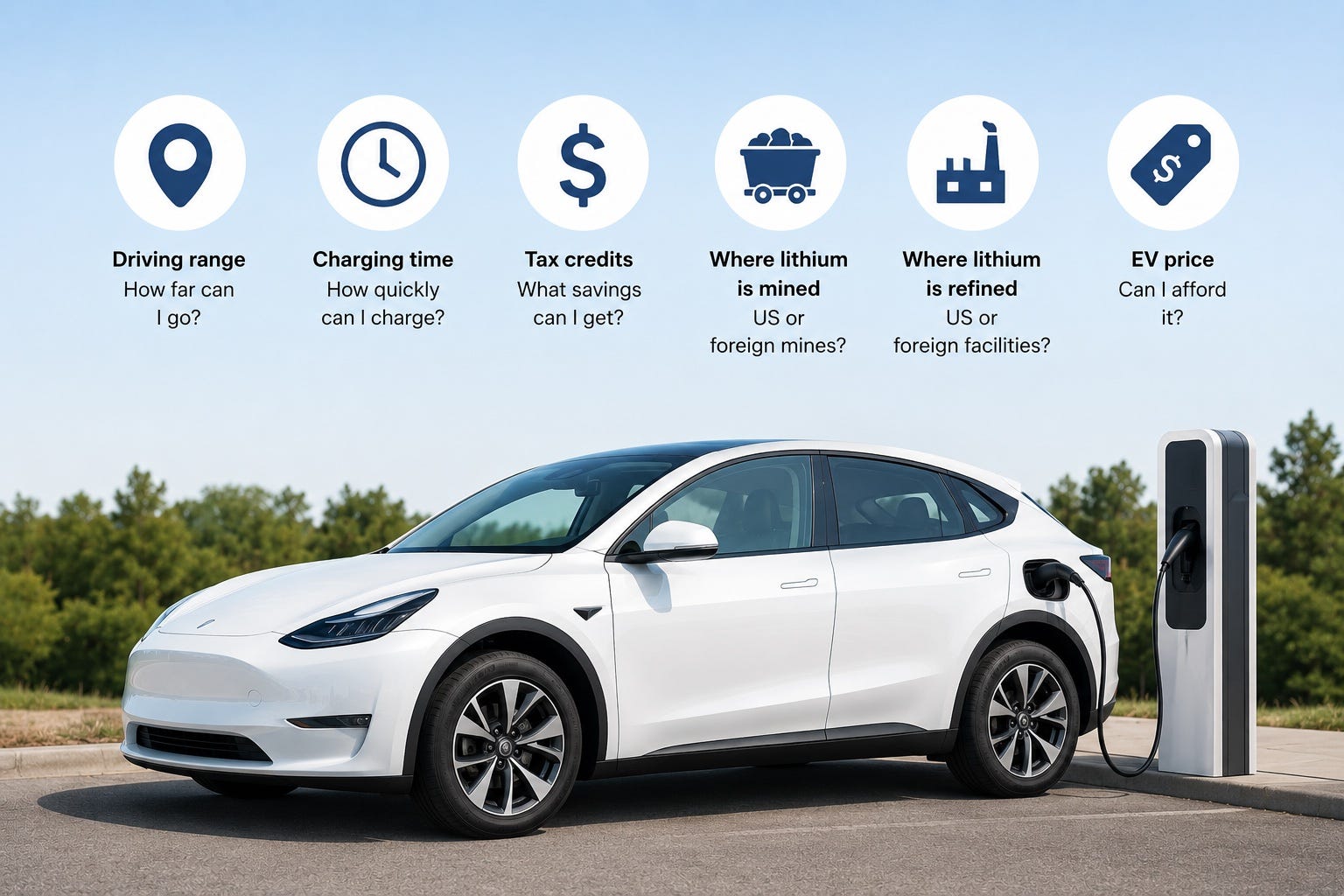
The results show that about 36% of the time, respondents chose the gasoline vehicle, either because they opposed purchasing the EVs shown or did not want to pay the higher price premium associated with them.
The results also show that consumers primarily care about the price premium. About 47% of respondents said price was the dominant factor affecting their choice, mainly to avoid paying more for the EV. Another 26% said driving range was the most important factor. Only a small percentage said they primarily focused on where the lithium was mined (6%) or refined (3%).
This suggests that price remains the main concern for potential EV buyers, followed by vehicle performance.
Consumers value domestic lithium sourcing
After respondents completed the choice tasks, we estimated how much they would be willing to pay for domestic sourcing while holding other factors constant.
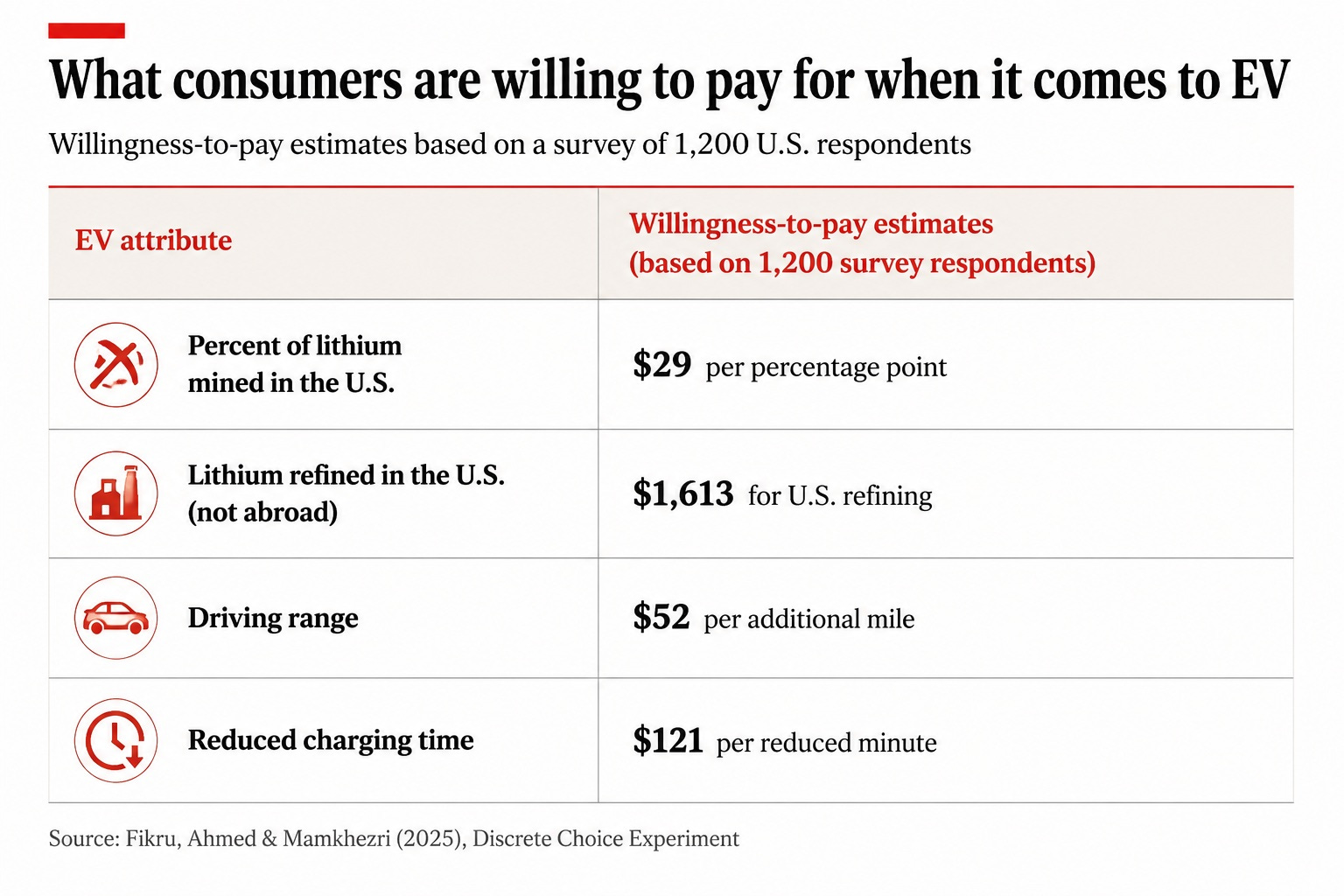
We found that respondents were willing to pay about $29 more for every one-percentage-point increase in lithium mined domestically. They were also willing to pay about $1,613 more for EVs using lithium refined in the United States rather than abroad.
Although these values are smaller than what consumers would pay for improved driving range or reduced charging time, the findings are still notable because mineral sourcing does not directly improve vehicle performance. Domestic lithium content does not make the EV drive farther or charge faster.
Yet consumers still placed some value on it.
This mirrors broader consumer research showing that people increasingly care about where products are made and where their inputs originate.
But information changed responses
The most interesting result was not simply that consumers valued domestic lithium sourcing.
It was that their valuation changed depending on the information they received.
Before completing the EV choice tasks, respondents were randomly shown different types of information, including:
emissions from lithium refining,
economic benefits from lithium mining, such as jobs and local tax revenue.
When respondents were shown positive information about the economic benefits of mining, willingness to pay for domestic lithium mining doubled, rising to about $59 per percentage-point increase in domestic lithium. Willingness to pay for U.S.-based refining also increased to $2,226.
This suggests that information about mining’s economic benefits can strengthen consumer support for domestic sourcing.
But when respondents were shown environmental concerns associated with lithium refining, their valuation for domestic sourcing weakened slightly. They were willing to pay about $25 for each percentage-point increase in lithium mined in the U.S., and about $1,609 for domestic lithium refining.
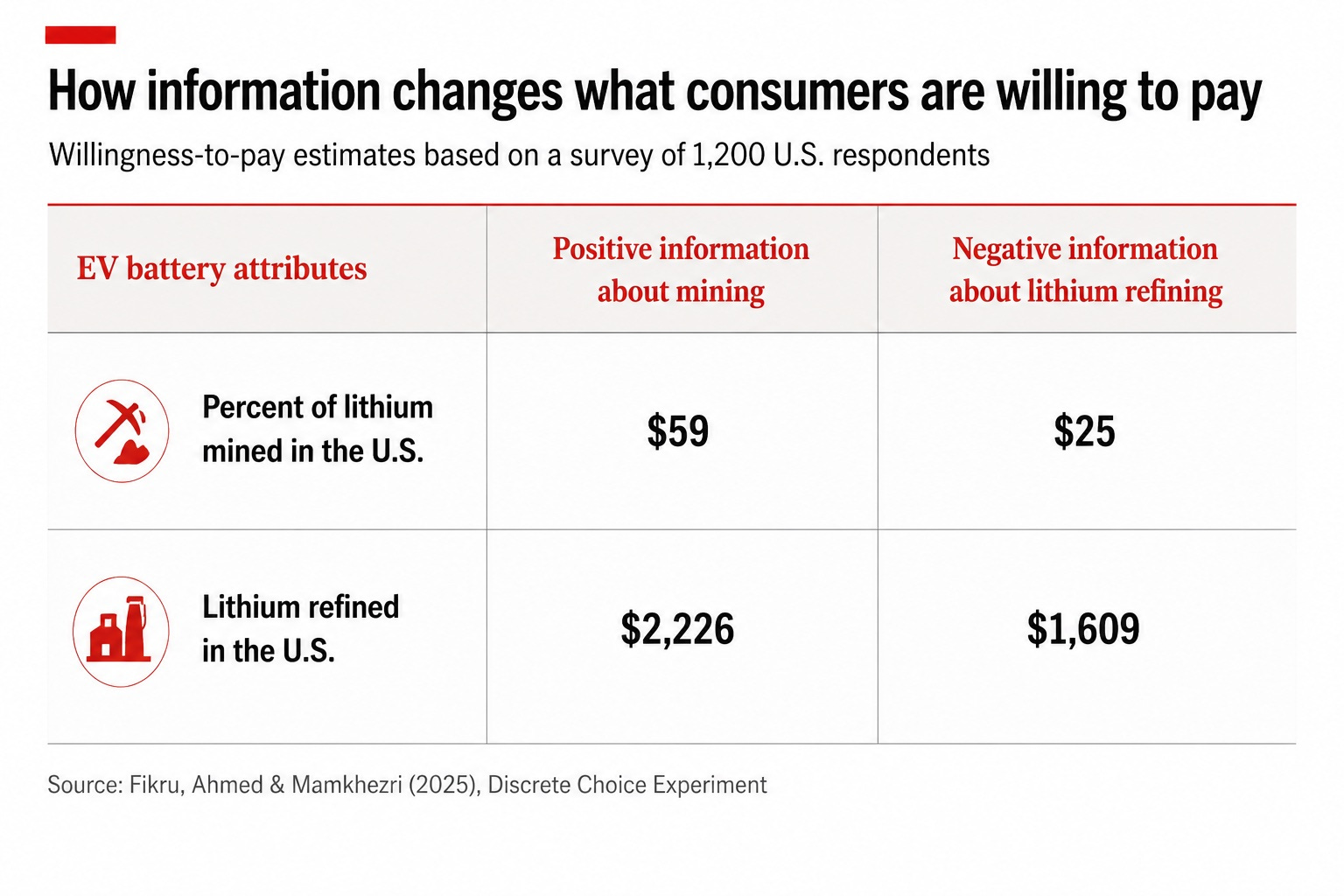
Interestingly, negative environmental framing reduced preferences for domestic sourcing, but did not fully reverse them. Consumers still showed positive willingness to pay for domestic mining and refining even under the negative-framing condition.
Overall, the research shows that domestic sourcing matters for consumers — and it matters more when people receive positive information about mining. However, traditional EV attributes still dominate decision-making.
This suggests that supply-chain transparency may complement — rather than replace — concerns about performance and affordability.
Beyond tailpipe emissions
For years, debates about EVs focused mainly on tailpipe emissions.
But as the transition to clean vehicles accelerates, attention is shifting upstream:
who processes them,
Policies such as the pre-2025 Clean Vehicle Credit (under the Inflation Reduction Act) sought to encourage domestic sourcing by linking EV tax credits to mineral-origin requirements. Our findings suggest that such financial incentives (although currently defunct) may align with at least some consumer preferences — especially when consumers understand the economic implications of domestic mining and refining.
At the same time, the results also highlight a challenge for policymakers and industry.
Consumers do not evaluate domestic mining in a vacuum. Their preferences shift depending on whether the conversation emphasizes jobs and regional development, or pollution and environmental risks.
That means the future of critical battery minerals may depend not only on geology and technology, but also on public trust, transparency, and how the trade-offs of the energy transition are communicated.
Your turn
Suppose you are about to buy an electric vehicle. Which factor would matter most to you? Why? I am curious to hear how people think about the trade-offs. Are there other factors you would consider before buying an EV?
Or would you not buy an EV at all? Use the comments section to tell me why you answered the way you did.
People may be concerned to buy products from home but why isn’t anyone talking about the hundreds of years it takes s lithium battery to decompose? I thought people bought these cars to protect the environment? There can’t be anything green about that!
Perhaps an idea for a future survey, but I wonder whether people assume "outside the US" is a proxy for China and you're capturing some form of anti-China sentiment. Even though Chile and Australia are major sources of lithium, I'm not sure most people know that.
It adds another treatment arm, but it would be neat to see options for Produced in US, Produced in Australia, Produced in China, or Produced Outside the US