

Data Centers, One Point at a Time · Part 1: Workforce
By Mahelet G. Fikru, professor and researcher with 15+ years studying energy and natural resource economics.
Last updated: November 2026. Data: U.S. Census Bureau, Quarterly Workforce Indicators (QWI), NAICS 518, through 2025.
The short answer: There is no official count of AI data center jobs in the United States. The closest public measure is NAICS 518 (Computing Infrastructure Providers, Data Processing, Web Hosting, and Related Services), which employed roughly half a million workers in 2025, about double its 2010 level, according to the Census Bureau’s Quarterly Workforce Indicators (QWI).
In this post, you’ll get:
A plain-English guide to what Sector 518 actually includes
The argument for why 518 is the closest thing we have (so far) to a national data center employment count, even though it wasn’t initially built for it
Two findings from fifteen years of this data, on gender and on education, plus a free interactive tool so you can explore the numbers yourself
Why I went looking for this data in the first place
I started this project wanting one thing: a clear read on how the AI data center boom is reshaping the labor market. I had been digging into this for a research project, and the question seemed simple enough: who is getting hired to operate the facilities powering the AI economy, and how does that workforce compare to the traditional data centers that came before?
The question was simple. The data was not.
Here’s what I ran into: I haven’t found a dataset that cleanly separates “AI data center” from “traditional data center,” or even treats “data centers” as a separate category. Not from the U.S. Census Bureau, not from the Bureau of Labor Statistics, not from anywhere I have looked. The industry code that comes closest, Sector 518, was built years before “AI data center” was a phrase in common use.
So, before I show you what I built, I want to walk through what this data actually is, what it isn’t, and why I think it is still worth your attention, if you are interested in the job impact of AI data centers.
What is a data center?
Strip away the AI hype for a second: a data center is simply a physical facility that houses computing equipment (i.e., servers, storage, networking) along with the supporting infrastructure that keeps it running (i.e., backup power, cooling, physical security, connectivity). Its job is to store, process, and distribute information.
Data centers existed well before AI did, and they come in a few different flavors:
1. Hyperscale facilities owned by the large cloud and tech companies (e.g., Amazon launched AWS in 2006, followed by Microsoft, Meta, Google, and Apple),
2. Colocation facilities operated by third parties leasing space to many clients (e.g., Equinix has done this since 1998),
3. Enterprise data centers built and run by a single company for its own use, and
4. Government data centers run by public agencies.
AI data centers vs. traditional data centers: what’s actually different?
It helps to be concrete about what separates these two things, because the distinction is real even if the US Census data doesn’t yet track it that way. AI data centers aren’t just bigger traditional data centers; they are entirely different in engineering and investment, as the comparison below illustrates.
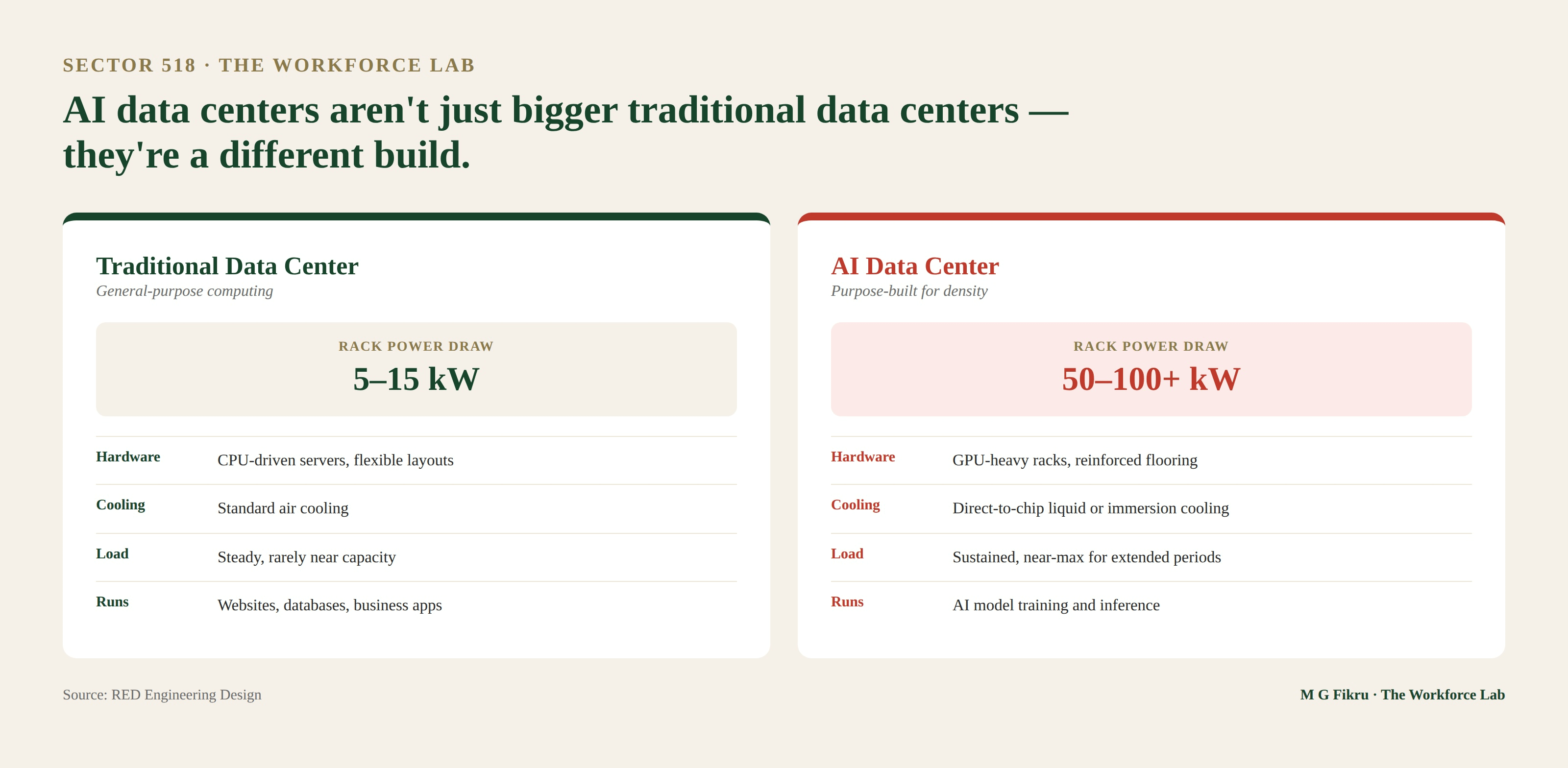
Physically, these are two different kinds of buildings; they are built and run differently. But the U.S. Census Bureau employment data does not seem to track them separately. When it tracks employment, both traditional data centers and AI data centers appear to be filed under the same category — NAICS code 518 [NAICS stands for North American Industry Classification System]. That one code also covers a bunch of other activities unrelated to AI.
So, what is NAICS Sector 518, exactly?
Under the current NAICS 2022 classification, Sector 518 is officially titled "Computing Infrastructure Providers, Data Processing, Web Hosting, and Related Services". This sector was never designed to be an AI data center tracker. As the Bureau of Labor Statistics puts it, this subsector groups establishments that provide “the infrastructure for hosting and/or data processing services”.
Establishments classified here include:
Cloud and infrastructure services
Cloud computing
Cloud storage services
Computing infrastructure provision; Infrastructure as a Service (IaaS)
Computing platform infrastructure provision
Platform as a Service (PaaS)
Application service providers
Web hosting
Game server hosting
Colocation services
Data processing and business services
Data processing services; Automated data processing services
Data entry services
Computer time-sharing and computer time rental
Optical scanning and computer input preparation services
Microfilm recording and imaging services
Disk and diskette conversion and recertification services
Computer data storage services
Data capture imaging services
Streaming and other computing services
Media streaming data storage and technical support services
Video and audio streaming technical support
Other
Virtual currency (cryptocurrency) mining
(Sources: Census Bureau, BLS)
Microfilm digitization and data entry services sit in the same Census box as the hyperscale facilities training frontier AI models. That is, 518 represents a lot of different activities compressed into a single category.
Why I still think 518 is the right place to look for data center jobs
Given all of that, you might reasonably ask why I would build anything on top of this data at all. Here’s my argument: 518 is a lot of things, but data centers — traditional and AI alike — are the physical backbone that most (not all) of these “things” actually run on. Most of the categories on the list require a facility with servers.
The growth in this sector backs that up. The number of private establishments in NAICS 518 doubled from about 13,500 in 2007 to 26,500 in 2019, then rose sharply — to roughly 46,600 by 2022 and around 56,000 by 2025 — as demand for cloud, hosting, and digital infrastructure took off.
That’s not microfilm shops multiplying.
That’s computing infrastructure, and the 2022 NAICS revision directly added the words “Computing Infrastructure Providers” to this sector’s name (more on that below).
I’m not alone in reading it this way. When U.S. Census Bureau staff analyzed employment in data centers, they used Sector 518, drawing on the same QWI data that my tool uses.
So, while I can’t slice this sector into “AI” and “traditional” — and neither can the Census Bureau, and neither, as far as I’ve found, can anyone else right now (at least using public data)— I’d argue 518 is still useful, with one condition: treat it as a preliminary, directional signal, not an absolute headcount. The raw employment number in this sector captures far more than AI data centers alone, so it’s not a count you should quote on its own. But watching how that number moves and how its composition shifts over time is a useful way to interpret this data until a more precise classification is available.
One important caveat, both directions. First: not all data center employment shows up in 518. NAICS classifies establishments by their primary business activity, and an internal data center that a company runs to serve its own operations rather than to sell hosting or cloud services externally can be treated as an “auxiliary establishment” and folded into the parent company’s own industry code, or into a catch-all “Other Establishments” category, instead of 518.
Put in economic terms: a hyperscaler’s computing infrastructure is its product because it is the ‘thing’ it sells to others for revenue. So it gets classified under 518. An enterprise data center, by contrast, is an intermediate input a company uses internally to produce something else it sells instead; that’s precisely the distinction NAICS draws when it carves out auxiliary establishments. In practice, that means a proprietary AI training facility built solely to power one company’s own products, rather than sold as a service to outside customers, may not be counted here at all; this is exactly what makes enterprise data centers, as opposed to hyperscale and colocation ones, the fuzziest case.
Second, the flip side: this sector encompasses both data-center-related infrastructure services and other data-processing activities that do not necessarily correspond to a physical data-center facility (e.g., data entry clerks and microfilm technicians are counted in the same category as data-center operations staff). 518 is both under-inclusive and over-inclusive, which is exactly why I’m presenting it as the best available proxy rather than a precise count.
Where to find data center employment data, and why it’s hard to use
The Census Bureau publishes quarterly employment data for Sector 518, broken down by sex, education level, and state, through its Quarterly Workforce Indicators (QWI) program. You can explore it interactively through the QWI Explorer or pull it in bulk using the LED Extraction Tool, which I used.
If you’ve never used either one, they are not friendly websites. You need to know which filters to combine (industry code, geography, demographic breakdown, quarter) just to pull a single clean series, and then you still have to download it in bulk and run the analysis yourself before you have anything you can actually read. I don’t say that to complain about the Census Bureau; this is a genuinely powerful public dataset, freely available, and that’s rare and valuable. I say it because I don’t want you to have to do what I did to get an answer out of it.
So I did the filtering, the bulk download, and the analysis, and I built it into The Workforce Lab, an interactive tool where you can explore Sector 518 employment trends yourself — by state, by sex, by education level — without touching a single Census Bureau filter menu.
Why the data starts in 2007, not 1990
The Census Bureau data technically goes back to the 1990s, but I started my analysis in 2007, and here’s why: that’s the year NAICS was substantially restructured. Before 2007, this sector was classified under NAICS 2002 as “Internet Service Providers, Web Search Portals, and Data Processing Services” — a much broader, more consumer-facing category. In 2007, that definition was narrowed and renamed to “Data Processing, Hosting, and Related Services,” which excluded internet service providers and web search portals and refocused the code on computing infrastructure, data processing, and web hosting businesses.
In practical terms, pre-2007 and post-2007 Sector 518 do not measure the same industry. The 2007 break marks a change in classification rather than a real shift in the underlying economy. Comparing across it directly would be comparing apples to a different, larger fruit basket. So, from 2007 onward is where the comparable data begins and where my analysis starts.
One more classification note before the findings: in the 2022 NAICS revision, Sector 518’s name itself changed again — from “Data Processing, Hosting, and Related Services” to the current “Computing Infrastructure Providers, Data Processing, Web Hosting, and Related Services.” Nothing about what actually gets counted here changed; it’s a title update, not a structural one. The Federal Register notice attributes the change to public comments about a lack of clarity in the old name, and not to AI specifically. So I don’t want to overclaim a direct link. But the timing isn’t nothing: it landed just as demand for cloud and computing infrastructure was scaling fast, and the new name captured what this sector had, in practice, already become.
Who works in data centers? Two things I learned from this data
Sector 518 employment has grown substantially, roughly doubling from about a quarter million jobs in 2010 to around half a million by 2025. But growth in the top-line number hides two shifts underneath it that I think are worth a closer look.
1. The gender gap in this industry has widened, not narrowed.
In 2010:Q1, Sector 518 employed about 9.5% more men than women. By 2025:Q1, it employed about 43.5% more men than women, because male employment grew much faster than female employment throughout this period.
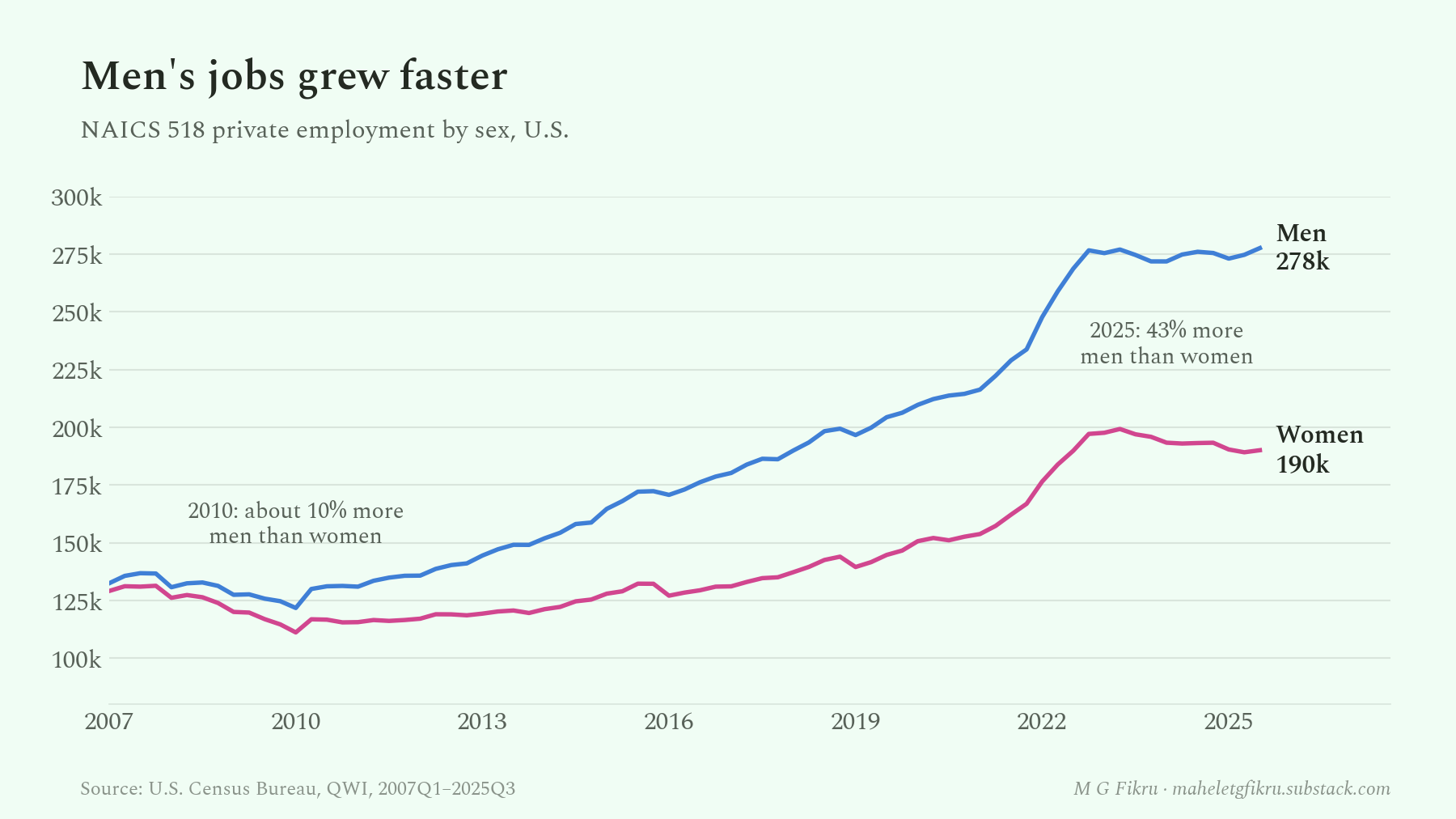
That’s an uncomfortable finding. This is an industry sitting at the center of the most consequential technology shift in a generation, and the gender gap in who gets to work in it is widening sharply.
2. Bachelor’s degree holders still dominate this workforce, but that dominance is slipping.
Workers with a bachelor’s degree or higher have consistently made up the largest single share of Sector 518 employment: 45% in 2010 and still 42% in 2025. This reflects real, ongoing demand for an educated workforce. But that share is slipping, and the some-college share also dipped, from about 27.8% to 26.3%. Meanwhile, high-school-only employment rose from 15.9% to 18.6%, and less-than-high-school employment nearly doubled, from about 4.7% to 9.4%.
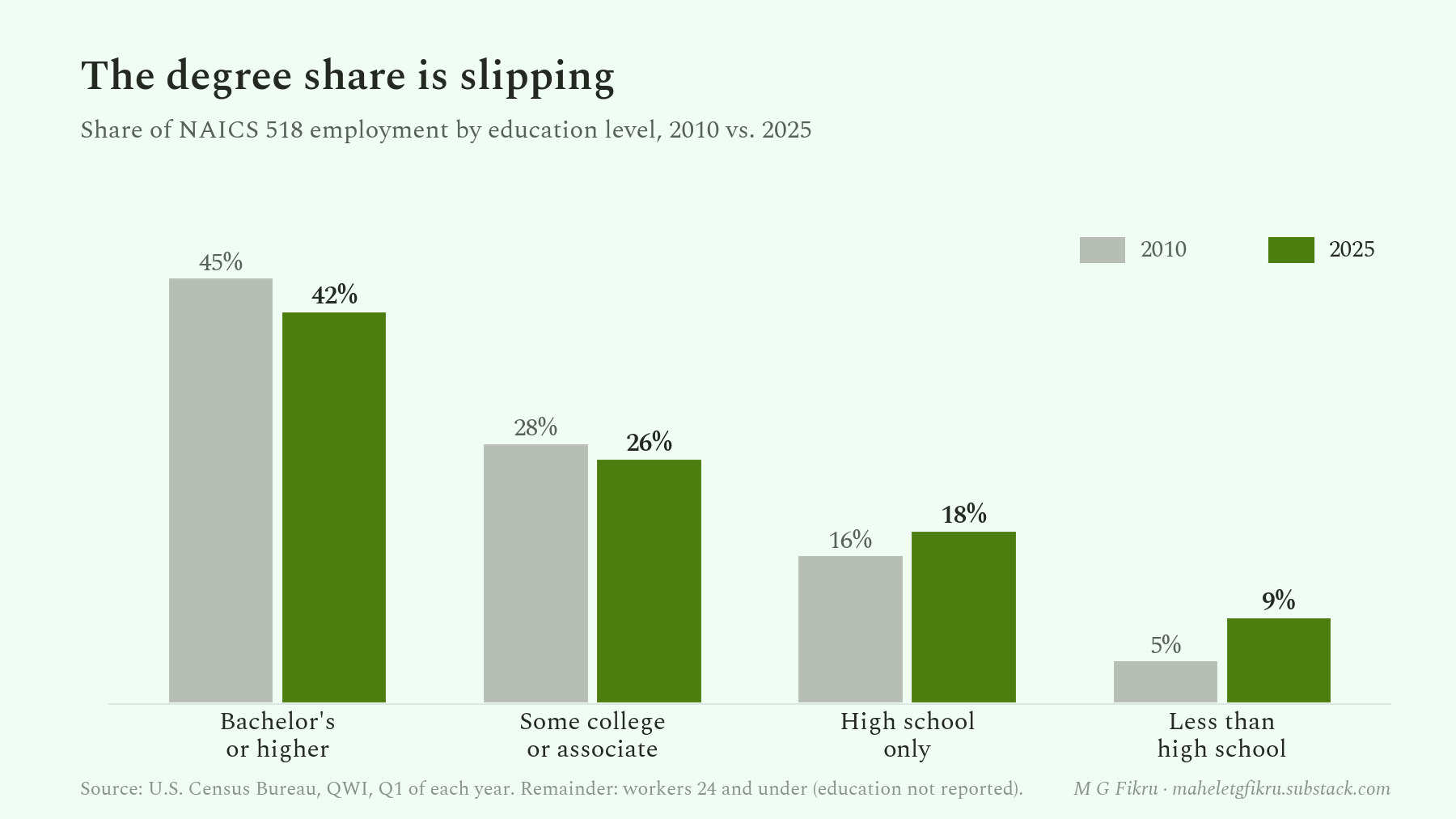
Higher education still leads the sector by a wide margin. But the visible rise at the high-school-or-less end could indicate a broadening of who gets hired into this industry as it scales, including more operations, facilities, and support roles that don’t require a four-year degree. It could also reflect something narrower, like growth concentrated in specific occupations within 518 that simply have lower credential requirements.
The data can tell us the trend is real; it can’t yet tell us why. That’s the honest limit of what a sector-level employment count can do, and it’s part of why I think this deserves more digging.
Key numbers at a glance: NAICS 518, 2010 vs. 2025
Total employment: about 233,000 in 2010:Q1 to about 468,000 in 2025:Q3, roughly double.
Men: about 122,000 to 278,000. Women: about 111,000 to 190,000.
Gender gap: 9.5% more men than women in 2010:Q1, 43.5% more in 2025:Q1.
Bachelor’s degree or higher: 45% to 42% of employment.
Some college or associate degree: declined from 27.8% to 26.3%.
High school only: increased from 15.9% to 18.6%.
Less than high school: increased from 4.7% to 9.4%.
Private establishments: about 13,500 in 2007 to about 56,000 in 2025.
Quick answers: data center jobs and NAICS 518
Is there an official count of data center jobs in the U.S.?
Not one that separates data centers, let alone AI data centers, from other activities. NAICS 518 is the closest available measure, and it is the industry U.S. Census Bureau staff used to analyze data center employment.
What NAICS code covers data centers?
NAICS 518, officially “Computing Infrastructure Providers, Data Processing, Web Hosting, and Related Services” under NAICS 2022. Its only detailed industry is 518210.
How many people work in NAICS 518?
About half a million in 2025, up from roughly a quarter million in 2010.
Does NAICS 518 include every data center worker?
No. Data centers a company runs only for its own operations can be classified under the parent company’s industry instead. And 518 also counts workers in data entry, microfilm, and other data-processing services that are not data centers.
Where can I get NAICS 518 employment data by state?
From the Census Bureau’s Quarterly Workforce Indicators, through the QWI Explorer or the LED Extraction Tool, or ready-made in The Workforce Lab.
Your turn
Open The Workforce Lab and look up your own state.
See how the gender and education composition of this workforce compares to the national trend I’ve described here. If you work in this industry yourself, tell me in the comments whether what you see in the data matches what you see on the ground. I’d like to know whether this tracks with your experience, or not.
And if you know someone who’d find this useful- a colleague in workforce policy, a friend who works in tech, anyone who’s been trying to make sense of the AI data center boom the way I have- send them this post. This is exactly the kind of imperfect-but-important data problem that gets better the more people are looking at it together.
Related reading on this newsletter
AI Services Require Energy and Water—Just Like Everything Else We Consume
Virginia Gave Data Centers A Carrot. Now It’s Reaching For The Stick.
Coming soon in my series Data Centers, One Point at a Time. Check back here for:
Part 2: Most New Data Centers Aren’t Going Where the Old Ones Are
Part 3: Ten Thousand Workers to Build It. Five Hundred to Run It.
Part 4: The AI Money Is Booming. The Data Center Jobs Are Flat.
Mahelet G. Fikru, PhD, is a Professor of Economics at Missouri University of Science & Technology who studies energy, natural resources, and technology.
This is so thorough! I'm guessing that the data you've gathered here will become more and more important in the next year.
Thank you. I will.