


A guest post by Zohre Shirazi, founder and editor of AI Wide Open, with Mahelet G. Fikru.
Imagine two students applying for the same internship.
Both submit polished résumés. Both describe themselves as analytical thinkers with strong problem-solving skills. Both used AI to refine their applications and match their experience to the job description.
One has completed a data analysis project and can explain the decisions behind it, the mistakes they made, and how they interpreted the results. The other has used AI to describe a limited classroom exercise, making it sound far more advanced.
Their applications may look equally convincing. If a recruiter or an AI screening system judges them mainly on what is written, how reliably can it tell the difference?
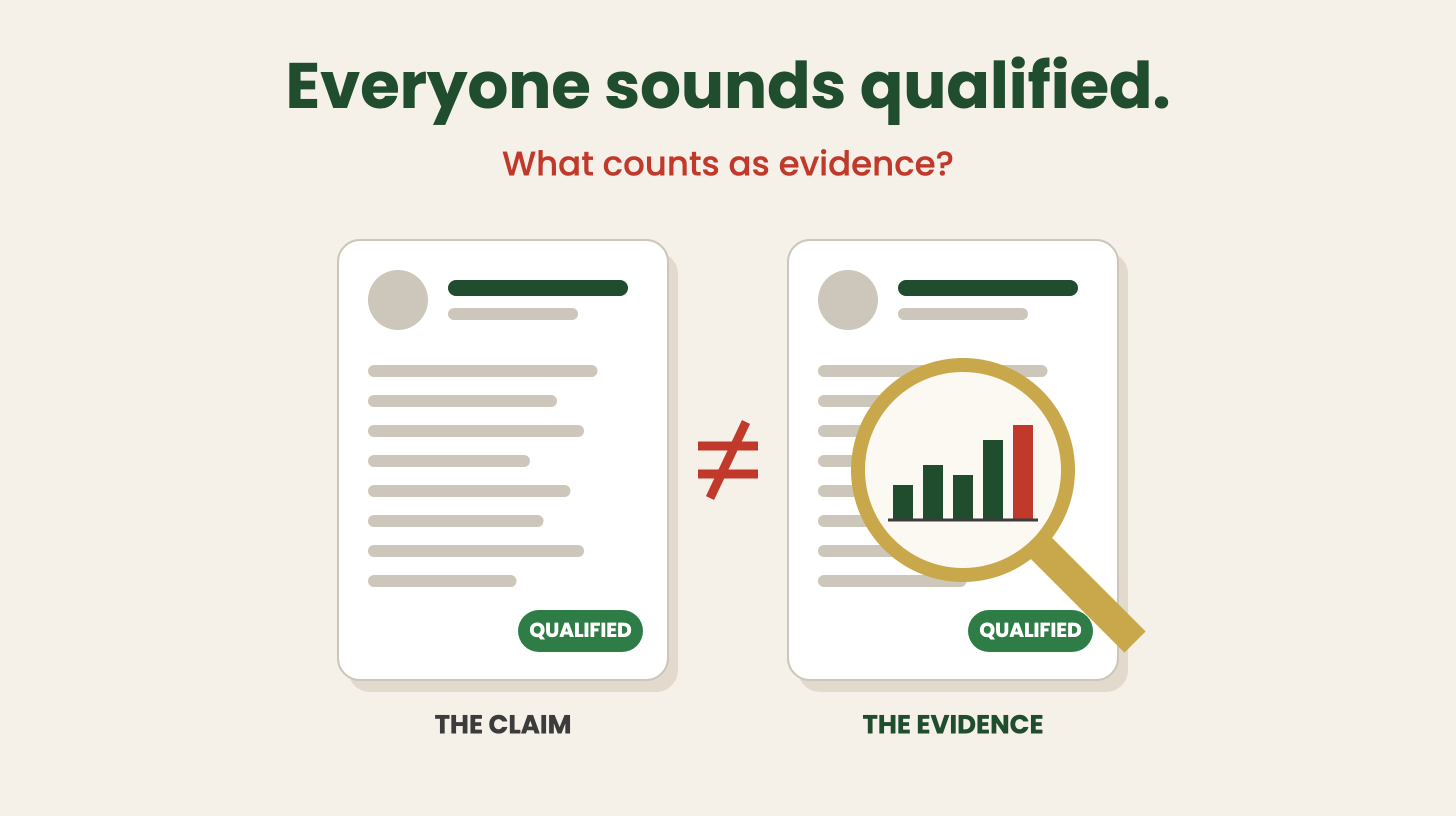
When AI can make any application sound polished, written claims no longer serve as reliable evidence of skill. The fix is to separate what applicants say they can do from what they can show and explain.
This matters for every student preparing for college admissions or the job market, because AI use is now routine. In a 2025 survey of 1,041 full-time UK undergraduates, 92 percent reported using an AI tool, and 88 percent had used generative AI for assessments. Job seekers are no different: about two-thirds of job candidates say they use AI when applying for jobs. As polished writing becomes easy to produce, a convincing application loses value as a standalone signal of competence.
The problem is not that students use AI. It is that application systems may keep rewarding polished presentations without asking for the evidence that supports the claims.
What Is the Difference Between a Claim and a Capability?
A claim is what an applicant says they can do. A capability is what they can show and explain.
For years, applicants have been told to use strong action verbs, include keywords, quantify achievements, and tailor each résumé. AI makes all of this easier. A student who struggles to communicate their experience can now get help organizing their experience and clearly describing their contributions. That is a genuine benefit.
But the same technology can make an unsupported claim sound credible. Consider this sentence:
“I used data-driven insights to improve operational efficiency.”
It sounds professional, yet it leaves the important questions open. What data did the applicant analyze? What did they find? What decision followed? Did the process improve, and how do they know? AI can polish the sentence without answering any of them.
A student should not have to be an exceptional writer to prove they are a capable analyst. Equally, an institution should not assume a polished description proves analytical ability. The challenge is to make the underlying evidence visible without turning every application into an exam.
How Does AI Change Résumé Screening for Applicants and Employers?
When applicants use AI to write, and employers use AI to screen, the application language converges and stops distinguishing candidates.
Students are not the only ones optimizing. Employers use applicant tracking systems (ATS) and AI screening tools to sort applications and flag qualifications, and some universities use AI in parts of the admissions process, though practices vary widely. In a 2025 Resume.org survey, 57 percent of companies used AI to support hiring, and 79 percent of those used it to review résumés.
Applicants emphasize the language they believe evaluators value. Institutions rely on structured signals to process applications at scale. AI makes it easier both to produce those signals and to process them.
The trouble comes when the signal replaces the quality it was meant to represent. If every résumé uses the same vocabulary about leadership, adaptability, and critical thinking, those words say little about how candidates differ. Hiring managers already see this: in Resume Genius’s 2026 survey of 1,000 U.S. hiring managers, 77 percent said many résumés appear AI-generated, even as most said résumés had become more polished and better tailored. If institutions respond with more automated screening, applicants have even more reason to optimize their language. Both sides become more efficient without becoming better at identifying ability.
This outcome is not inevitable. Screening systems differ, and the risk depends on what a system measures, how its outputs are used, and whether meaningful human review is in place. But it raises a design question: when the usual signals become easy to manufacture, what should replace them?
How Can Applications Be Evaluated in the AI Era? The Claim–Evidence–Evaluation–Review Framework
The Claim–Evidence–Evaluation–Review framework treats an application as a set of claims to be communicated and checked, rather than a document to be optimized. It has four steps.
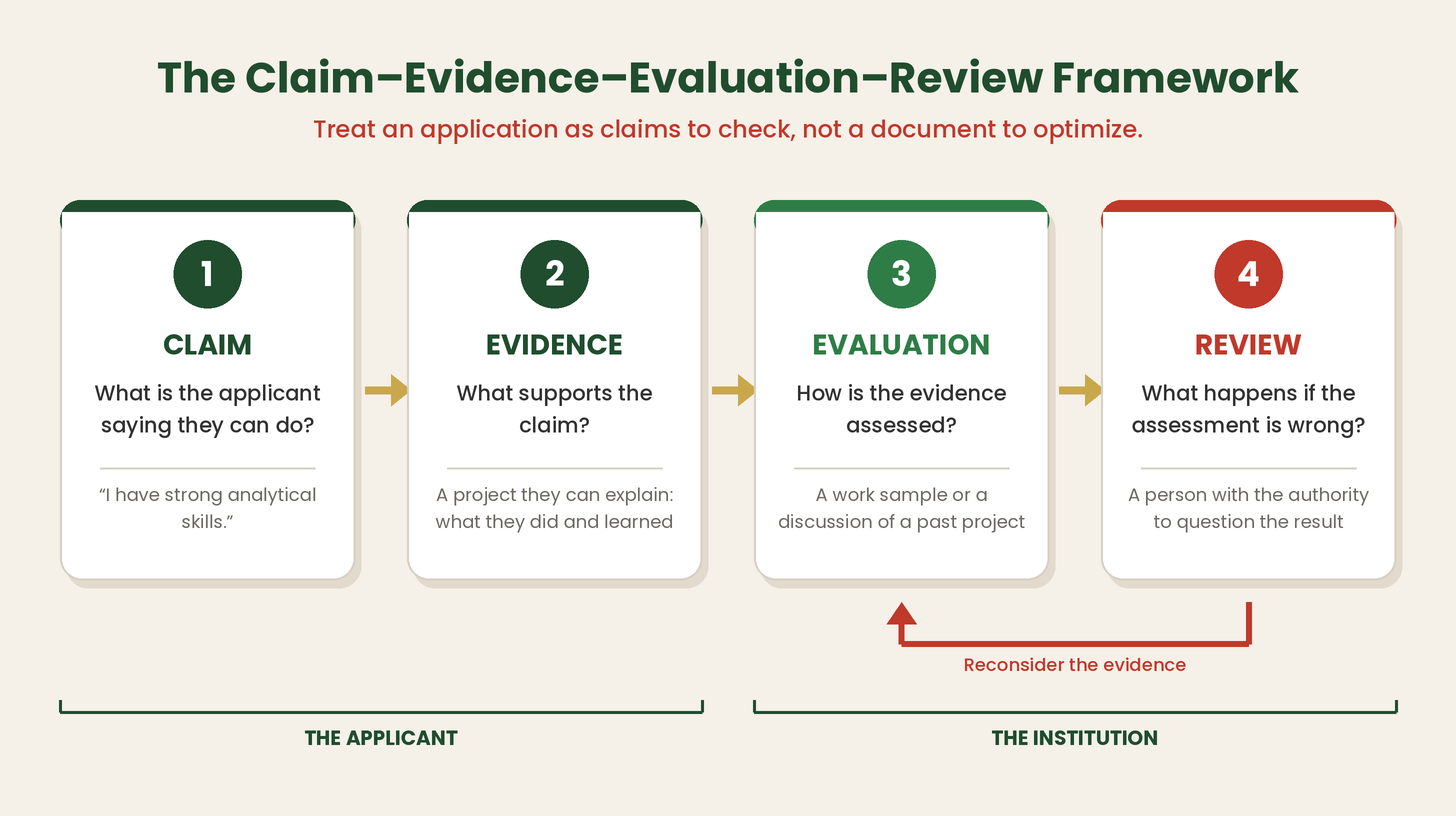
1. Claim: What is the applicant saying they can do?
A student might claim strong analytical skills, leadership experience, or the ability to do independent research. These claims should relate to the opportunity, not simply repeat qualities listed in a job description or admissions guide.
2. Evidence: What supports the claim?
Evidence can be a project, a work sample, a documented contribution, an achievement, or a detailed account of how the applicant approached a problem. A student applying for a data-related internship, for example, could describe cleaning a dataset, comparing approaches, and explaining why they chose one method over another.
What matters is not how sophisticated the project is, but whether the student can explain what they did and what they learned. AI can help communicate that experience. It should not invent the project, inflate the student’s contribution, or supply conclusions that the student cannot defend.
3. Evaluation: How does the institution assess the evidence?
The method should fit the capability being assessed. An employer hiring someone to interpret data will learn more from a work sample or a discussion of a past project than from résumé language. A university interested in intellectual curiosity should create chances to see a student’s reasoning, not rely only on style.
Research on hiring supports this. A 2022 re-analysis of hiring research found that structured interviews were the strongest predictor of job performance, and that job-specific methods such as job knowledge tests and work sample tests ranked above general cognitive ability tests.
No method is perfect. Work samples can disadvantage applicants with fewer resources, interviews can introduce bias, and extra assessments add burden. Methods should be proportionate, relevant, and accessible.
4. Review: What happens when the assessment is wrong?
An automated recommendation should not be assumed correct. This is not a hypothetical concern: in the Resume.org survey, only 26 percent of companies said a human reviews every rejection AI makes, and 57 percent of companies using AI worried it could screen out qualified applicants. Institutions should define when human review is needed, who is responsible for it, and how applicants can raise concerns. A human somewhere in the workflow is not enough; someone must have the authority, information, and responsibility to question a result.
How Should Students Use AI on Résumés and Applications?
Use AI to communicate real experience, not to upgrade it. Students cannot redesign the systems that evaluate them, but before submitting an application, they can ask themselves three questions.
Can I back up every important claim?
If I call myself a strong problem solver, can I describe a real problem I worked through and the decisions I made?
Can I explain my contribution without the application in front of me?
If someone asks about a project, can I describe my role, the difficulties I ran into, and what I learned?
Has AI improved my communication, or changed the substance of my experience?
If the tool made my work sound more impressive than it was, I should revise the description rather than keep the flattering version.
Students should also weigh the privacy implications of uploading personal documents or confidential information to AI tools.
These questions will not guarantee an interview or an admission offer. They do help students build applications that accurately represent their abilities and prepare them to discuss their work with confidence.
The Bottom Line
AI has made it easy to sound qualified, so sounding qualified no longer proves much. The Claim–Evidence–Evaluation–Review framework shifts attention from how an application reads to what supports it. For students, the goal is not an elaborate portfolio. It is making sure the claims they emphasize are relevant, specific, and defensible.
Frequently Asked Questions
Is it wrong for students to use AI on their résumés or applications?
No. AI can help students organize their experience and describe it clearly, which is a real benefit for those who struggle with professional writing. The problem starts when AI changes the substance, making a small classroom exercise sound like advanced work. The test is whether you can explain and defend every claim.
Can employers tell whether an application was written with AI?
The better question is whether the application’s claims are supported by evidence. Employers learn more from a work sample, a walkthrough of a past project, or a short discussion of decisions the applicant made than from trying to judge who wrote the sentences.
What counts as evidence of a skill on an application?
Evidence is anything that shows what you actually did: a project, a work sample, a documented contribution, or a detailed account of how you approached a problem. It does not need to be sophisticated. What matters is that you can explain your choices, your mistakes, and what you learned.
Should a human review decisions made by AI screening tools?
Yes, and the review has to be real. Institutions should define when human review occurs, who is responsible for it, and how an applicant can request that a decision be reconsidered. That person needs the authority and information to overturn a result.
About the Authors
Zohre Shirazi is the founder and editor of AI Wide Open, exploring where AI creates real value beyond the hype, from everyday workflows to the way businesses operate.
Mahelet G. Fikru is a professor of economics at Missouri S&T with over 15 years of experience teaching college students. She writes The Grad School Path, a section of her newsletter with practical advice on applying to graduate programs.
The harder it becomes to present yourself convincingly, the more important it is to find ways to demonstrate what you can actually do. I really enjoyed exploring this with Mahelet.
Thank you, Professor Mahelet and Zohre Shirazi for sharing such amazing and valuable content. I really appreciate your effort and the knowledge you are sharing with us. 🙏