

Short answer: For a household earning $80,000, the time spent on cooking, cleaning, and laundry is worth about $14,000 a year, so a $30,000 robot could pay for itself in about two and a half years. But scaling household robots raises two questions: household energy use and what happens to the robots at the end of their life.
For all the working parents out there: have you ever imagined waking up in the morning and finding your coffee already made, your breakfast ready, the kids’ lunches packed, and their clothes clean and laid out—no last-minute searching for clean socks or the missing water bottle?
Or imagine coming home after a long day, and the house is clean, the dishwasher has finished running, the laundry is folded, the dog has already had its walk, and dinner is ready.
These are the things I started imagining when a friend in the technology industry told me about Tesla’s evolving humanoid robot - Optimus. “It can even tutor the kids,” she said. And suddenly I felt a rush of anticipation: I want that—can it come any sooner?
Innovation That Changes Our Lives
Technological innovation has always reshaped our daily routines—laundry machines replaced hours of scrubbing, microwaves sped up meal preparation, and smartphones turned every pocket into a communication hub.
If Tesla’s robot (or its future competitors) truly becomes functional in households, it represents the next stage of this evolution: a technology-driven innovation that moves beyond a single appliance and into a general-purpose domestic assistant.
However, this kind of innovation cannot be limited to engineering brilliance alone.
It has to be:
• Technology-driven, yes
• Customer-centered, absolutely
• And environmentally friendly, now more than ever
Because when these robots become commercialized and widely used, two major questions emerge:
1. What happens to household energy use?
A future where millions of households own personal robots will result in increased residential electricity demand. We already worry about EV charging at scale—what happens when the home also includes a human-sized robot that needs nightly charging?
2. What happens to the robots at the end of their life cycle?
A machine this complex cannot end up in a landfill. The industry needs a plan that incorporates recyclable materials, resource-light design, and a circular economy system for refurbishment and recovery. Scaling humanoid robots without a sustainability strategy would simply repeat yesterday’s mistakes with tomorrow’s machines.
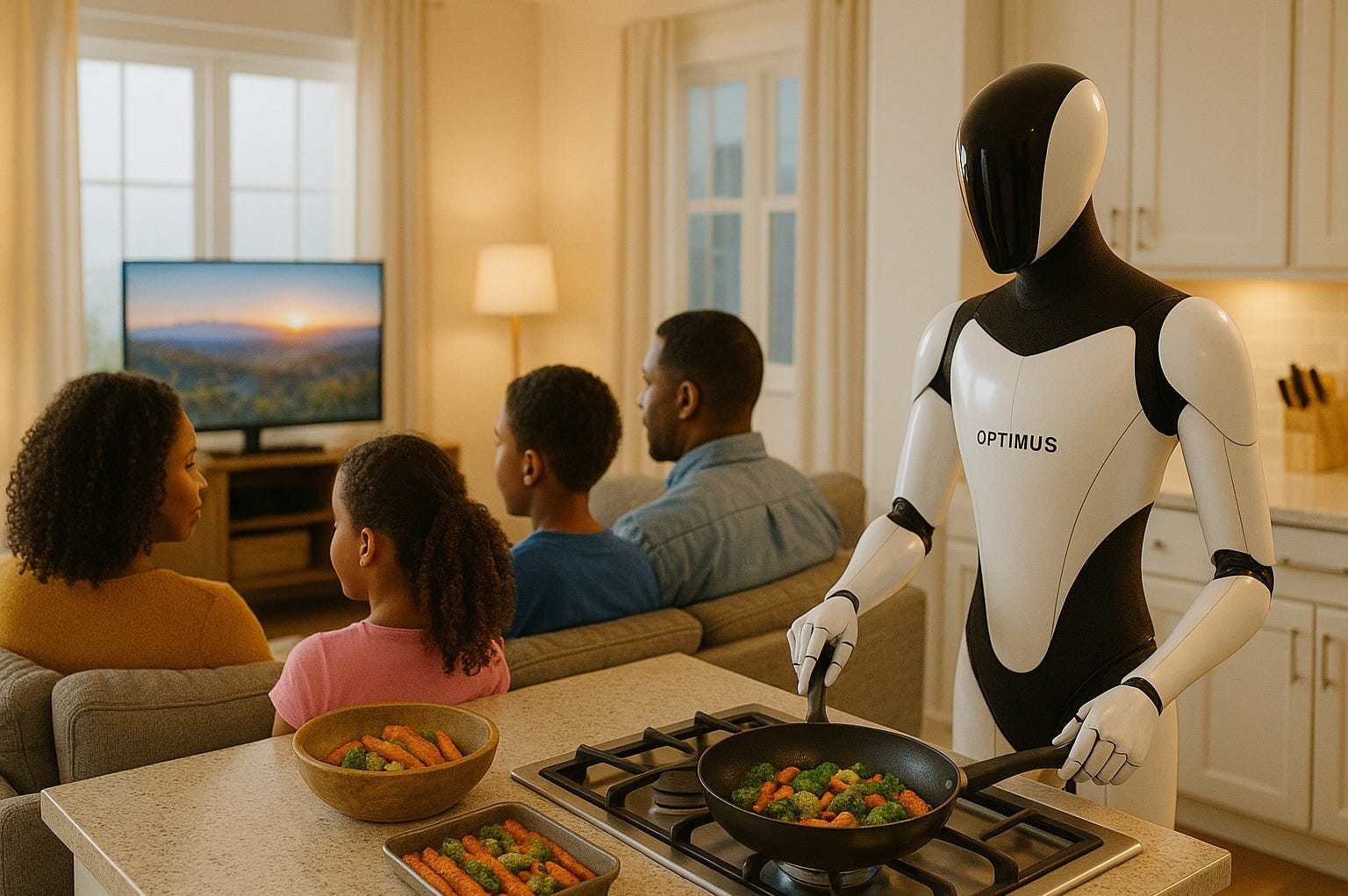
Let’s Talk Economics: Time, Value, and the Cost of a Robot
If Tesla eventually prices this robot like a car—say $30,000—would households adopt it? Cars began as luxury goods and have evolved into essential infrastructure for daily life. Could domestic robots follow the same path?
Think of it this way:
How much time could a working parent actually save?
Let’s take an example of a family of four, two parents and two kids:
A mom who spends 10 hours cooking and meal preparation, 12 hours cleaning, and 8 hours on laundry per month. That’s 360 hours per year, equivalent to 45 working days or 9 full work weeks every year, or slightly over 2 months’ worth of work.
Time that could be used for rest, exercise, traveling, side projects, additional work, or simply breathing room in a two-career household.
The Price Speculation…
For a household that earns an annual income of $80,000, the time spent doing just the three chores (cooking, cleaning, and laundry) manually amounts to about $14,000 in lost earning power per year. If Optimus had a lifetime of at least two and a half years, which it should, then this household would be willing to spend $30,000 to save time in cooking, cleaning, and laundry. Because the robot saves more time that could be used to earn income. But more than this, even if the time is not used to work, households would still value the time saved.
The moment I speculated to my sister that the robot might cost $30,000—or roughly the price of a compact car—she didn’t even blink.
She said, “If you paid me that much, I would do everything the robot is supposed to do, and Optimum’s maintenance cost can be my annual bonus.”
Her response made me laugh, but it also revealed something deeper: she was instantly putting a market value on the kind of work we usually take for granted.
Household labor, the time we spend caring for our families, has always had value. It is simply that markets haven’t priced it properly, and the economy doesn’t even measure it, even though families rely on it every day.
Whether a home robot becomes as common as a car will depend not only on its technological capabilities, including safety and efficiency, but also on whether the value of reclaimed time justifies the cost.
Final Thoughts
For these robots to succeed —not just technologically, but socially—they will need to deliver meaningful value by:
Solving real household needs
Fitting within families’ budgets
Minimizing energy use, and
Being fully recyclable
Innovation isn’t just the spark of invention. It’s about creating change that fits naturally into people’s lives and budgets, adds real value, and respects the environment. And when that happens, the future shows up faster—and closer to home—than we ever imagined.
For more analysis on humanoid robots:
I enjoyed reading this piece, Mahalet! It gives you a couple of things to think about - especially the environmental impact concerns you raised. Another point to think about is the potential for such robots to be hacked and used for nefarious purposes by someone with criminal intent, as we’ve seen with baby monitors. How do you monitor your child’s interactions with the robot 24/7? How do you ensure that the robot is not being used by such individuals to produce C-SAM materials?
This is how I think household robots will become commonplace. The first generation of these robots will be expensive and buggy. They will mostly be purchased by those rich enough to have them for novelty and influences for creating context. Within a few years, cost will lower, second hand or refurbished models will become more common and more people will start having them in their homes. Once it gets to the point where you go over to a friend house, see it clean, hear how they doesn't have to get up at 5 am to let the dog out and how much time they are saving, more people will start to buy them. Only once the costs lower and the technology becomes reliable, will they start to become common. Until that point they will remain a novelty.