

A walk through Addis Ababa reveals that ordinary things—a bike lane, a charcoal stove, and a mobile banking app—are connected by the same fundamental economic questions: what societies produce, how they produce it, and who benefits from it.
You don’t need a textbook to think like an economist. You need to notice what’s already around you.
I spent part of this summer in Addis Ababa, and I found economics everywhere—in an empty bike lane, in a city where charcoal and modern energy systems coexist, and in a financial system that has moved from bank branches to mobile phones in just a few years.
These everyday observations reveal some of the most fundamental questions in economics: What do we produce? How do we produce it? And who benefits from it?
You don’t always need data or tables to see economic transformation. Sometimes you just need to pay attention to what people build, what they use, and what they choose.
1. A brand-new bike lane, just no bikes on it yet
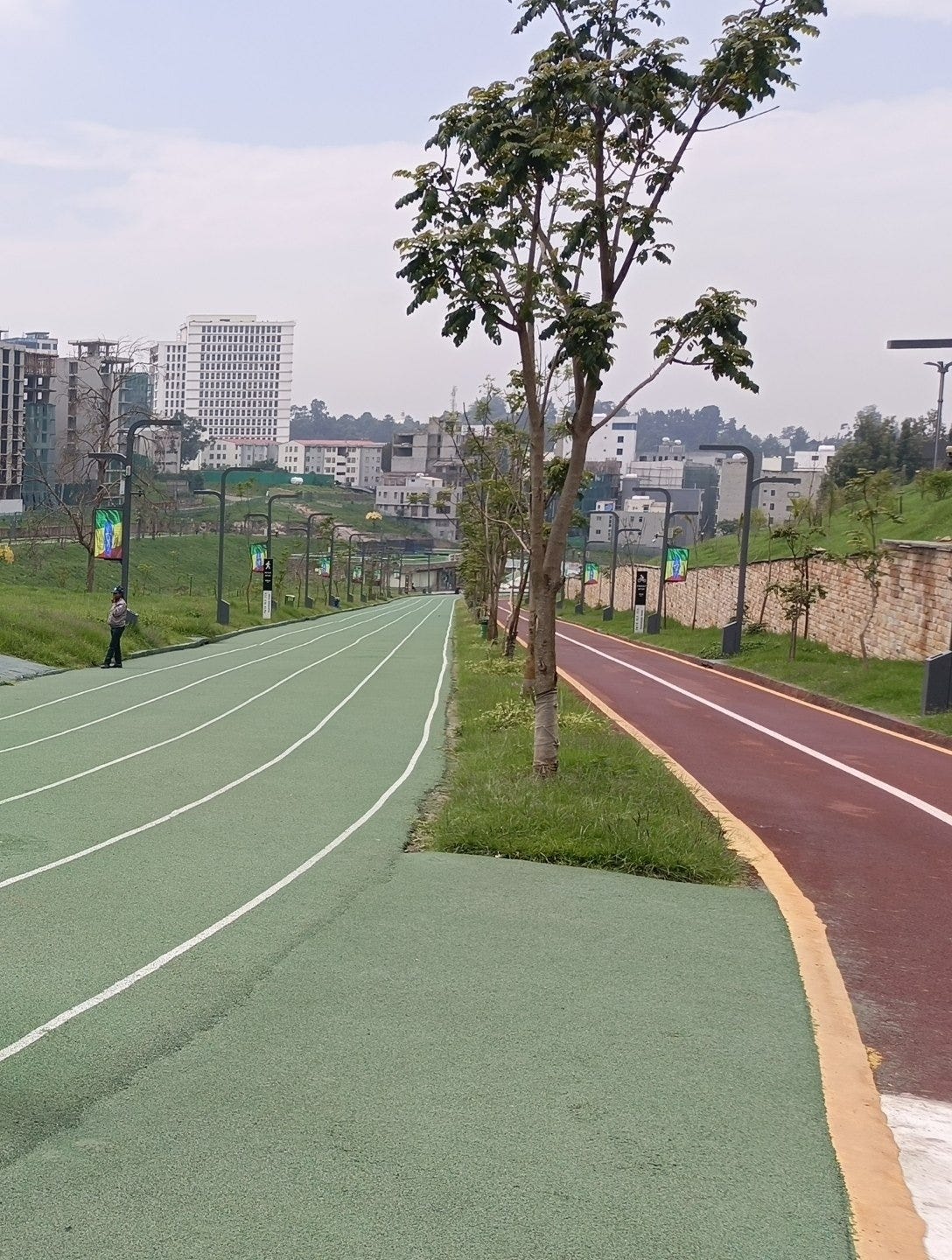
Addis Ababa has new parks now—real ones, landscaped, with dedicated bike lanes running through them.
Walking along the Arada Park, I didn’t see a single bicycle.
That’s an economics lesson hiding in plain sight.
Economists often frame resource allocation around three questions:
What should we produce?
The city decided to produce more public infrastructure. Arada Park was inaugurated by Prime Minister Abiy Ahmed on April 30, 2026 — 40 hectares, with a 5-kilometer dedicated bike lane, a 5-kilometer running track, and a 6-kilometer pedestrian walkway, built alongside the renovation of more than 700 existing homes on the site. I was walking on infrastructure that was at most 10 to 11 weeks old. That's a supply-side investment intended to improve urban mobility and quality of life.How should we produce it?
The infrastructure was built quickly through public investment. Besides the infrastructure, a functioning cycling system also requires complementary investments—affordable bicycles, safer road designs beyond the park, secure parking, maintenance, traffic enforcement, and public awareness.For whom is it produced?
Bike lanes create value only if people actually use them. Today, many residents may not own bicycles, may perceive cycling as unsafe, or simply may not view biking as a practical way to commute. The intended beneficiaries have not yet become active users.
The key insight is that building infrastructure creates supply, but it does not instantly create demand.
In this case, the supply arrived. But demand hasn’t caught up yet.
Demand for cycling depends on complementary capital, incentives, habits, expectations, and social norms—all of which evolve much more slowly than concrete and asphalt.
Governments can build a bike lane in months. They cannot build bike ownership, a safe cycling culture, or commuter confidence on the same timeline.
The empty bike lane shouldn’t necessarily be viewed as a failure. It is the beginning of a natural adjustment process. The more interesting question is not what the bike lane looks like today, but whether usage will steadily increase over the next two or three years.
Public infrastructure succeeds when people change their behavior because of it, not just when it’s built.
2. Two different systems, running at the same time
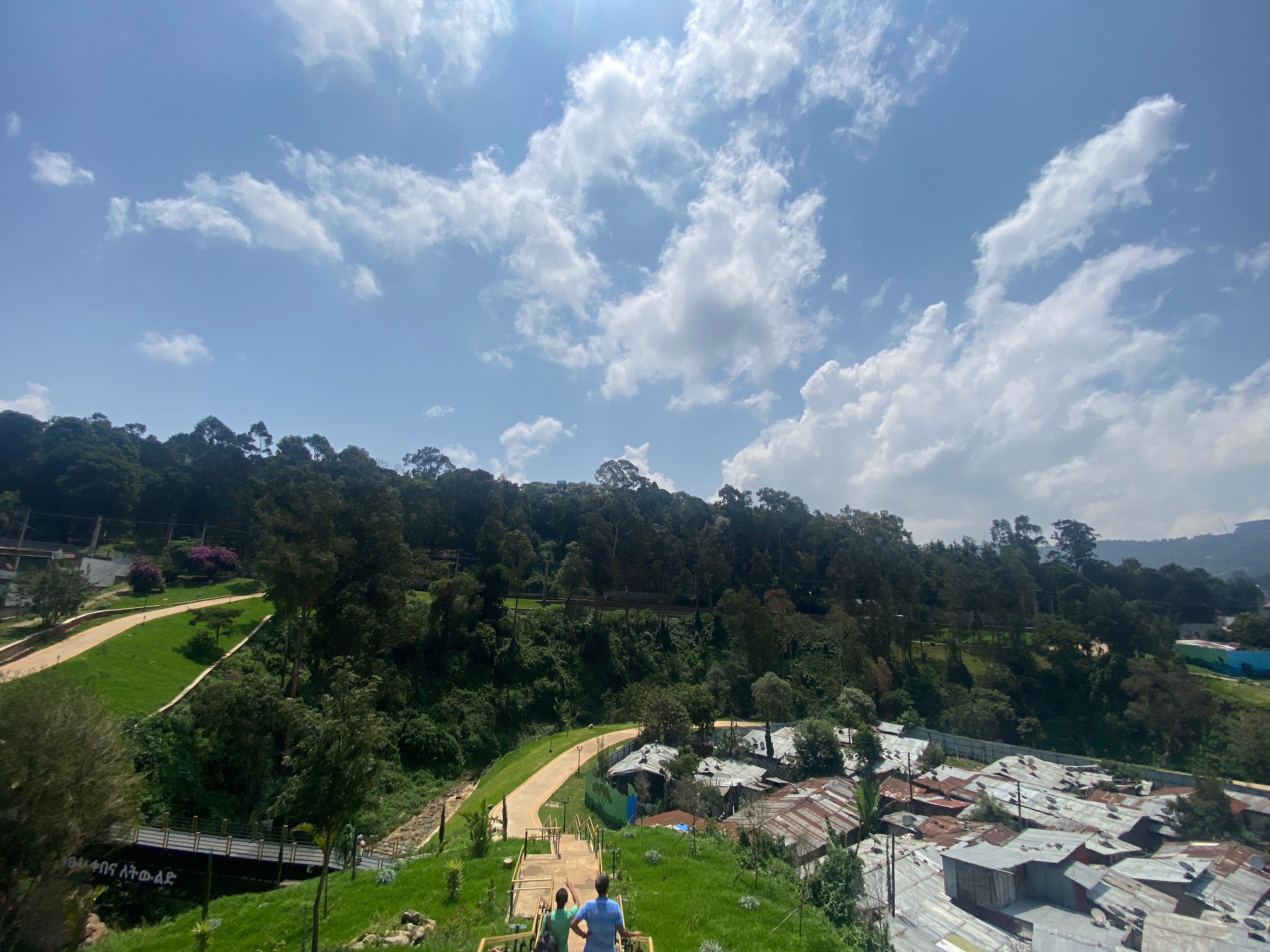
A new park on one side. Corrugated rooftops on the other.
Both are real. Both are visible from the same spot — this stretch of Kebena Riverside Park was inaugurated on June 28, 2026, part of an 87.6-hectare, 10.5-kilometer riverside project that's one of eight such projects covering roughly 48 kilometers across the city.
The same contrast appears in Addis’s food culture.
Restaurants and cafés are everywhere now, serving beautifully plated, photo-ready food you’d expect in any global city. It’s not just that there are more restaurants—the menu itself has changed. Hummus, fusion small plates, latte art, cold brew, imported ingredients like olive oil and tahini—not long ago, many of these were difficult to find in Addis. Today, they are increasingly common.
This is more than a food trend. It is an economic signal.
The three fundamental questions of economics help explain what is happening.
What should we produce?
As incomes rise and an urban middle class expands, consumer demand changes. People begin to seek not only basic necessities, but also variety, convenience, and new experiences. Businesses respond by producing and importing new goods and services. Injera and wat have not disappeared; they have been joined by new choices because more consumers now have the purchasing power to demand them.
How should we produce it?
New demand creates new markets and new production systems. Restaurants invest in modern kitchens, specialized skills, new supply chains, and imported inputs. The economy adapts because entrepreneurs see opportunities as consumer preferences change.

For whom is it produced?
This is where the contrast becomes most visible. The new cafés, restaurants, and lifestyle services are evidence of rising incomes—but they also reveal who has benefited most from economic transformation. Economic growth does not reach all households at the same speed. Some consumers are choosing between specialty coffee and global cuisine, while others are still making choices based on affordability and access.
The same uneven transition appears in Ethiopia’s energy system.
At my mother’s house, coffee still begins the traditional way—charcoal glowing in a small metal stove, smoke rising before the jebena ever goes on.
This is the economic lesson: Ethiopia is not moving from charcoal to electricity in a straight line. It is running multiple energy systems simultaneously.
Economists often describe this as energy stacking rather than energy switching. As incomes rise, households frequently add modern energy sources without immediately abandoning traditional ones. Different energy sources continue to coexist because choices are shaped by income, reliability, infrastructure, and cultural practices.

A household with steady access to electricity may adopt electric appliances and cleaner cooking technologies. Another household may continue using charcoal because it remains affordable, available, and familiar. Or just in case there is a power outage.
This is why measuring Ethiopia’s energy transition only through solar panels, electric vehicles, or grid expansion misses an important part of the story. The transition is not happening in one economy—it is happening across multiple realities within the same city.
Development is rarely a clean replacement of old systems with new ones. It is a process of gradual transformation in which new opportunities emerge alongside older ways of living.
3. A financial system that didn’t exist five years ago
People in Addis are online in a way that’s easy to miss until you’re looking for it.
Walk down a quieter street, and you’ll often spot someone filming—almost certainly for TikTok—using the empty space and good light the same way creators do everywhere else. Attention has become an economic resource, one that can be created, traded, and monetized.
The same digital transformation is happening in finance.
Telebirr — Ethiopia's mobile money platform — launched in May 2021. It reached 50 million users within four years, and Ethio Telecom had projected 62.5 million users by June 2026.
Five years ago, sending money, paying at a shop, or settling a utility bill by phone—without ever visiting a bank branch—was simply not an option for most Ethiopians. Today, for millions of people, it’s routine.
Again, the three fundamental questions of economics help explain why this matters.
What should we produce?
The economy is no longer producing only physical goods and services. It is increasingly producing digital financial services: mobile payments, electronic transfers, digital wallets, and online commerce. Financial services themselves have become an important output of the economy.
How should we produce it?
Instead of relying on costly physical bank branches, transactions are increasingly delivered through digital platforms. Mobile money dramatically reduces the time, travel, paperwork, and administrative costs associated with making payments. Economists describe these savings as reductions in transaction costs—one of the most important drivers of economic development.
Digital finance doesn’t simply replace cash; it makes economic exchange faster, cheaper, and more accessible.
For whom is it produced?
Perhaps the greatest benefit is inclusion. Mobile money extends financial services to households and small businesses that previously had limited access to formal banking. A smartphone can now perform functions that once required a physical bank branch, expanding participation in the formal economy.
Development is not simply about building more infrastructure or adopting more technology. It is about steadily lowering the cost of participating in markets and expanding people’s choices, and mobile money does exactly that.
Why is this worth your five minutes?
Economics is often presented as graphs, equations, and theory. But the most important economic ideas are already visible in everyday life.
Three ordinary things in this short walk through Addis — a bike lane, a charcoal stove, a mobile banking app — answer the same three questions that shape every economy: what we produce, how we produce it, and who benefits. Seeing the pattern here helps you see it anywhere.
What’s the version of this on your own street? Tell me in the comments — I’d like to know what you’re noticing.
As an ordinary citizen I see so many contrasts in Addis. At the same time, I also understand that development is a complex topic. I haven't visited all the parks but I loved the bike lanes around Ambassador park. My son loved the occasional 'city ride' but it is far from where we live.
I also wonder how accessible such infrastructures are to the majority of the public. I appreciate the small green spaces in some neighbourhoods and wish to see many more of such spaces.
On the other side, there is also the human cost of such changes. For e.g. I hear stories that people are given few days notice to leave their homes and relocate, which is really sad. One thing I observed in general is that the contrast in many aspects is widening.