


Virginia’s new data center tax — 1.1 cents per kilowatt-hour, effective July 1, 2026 — is the first state-level energy consumption tax on data centers in the United States. This post breaks down what the tax is designed to do, how it compares to the $1.6–$2 billion in existing tax incentives, and whether the economics support the policy.
Key Facts
1.1¢/kWh — New energy consumption tax on Virginia data centers, effective July 1, 2026
$600 million/year — Expected state revenue from the tax
$1.6–$2 billion/year — Equipment tax exemptions still in place through 2035
26% — Share of Virginia’s electricity consumed by data centers in 2023
371 operating data centers in Virginia; 471 more planned
First state-level energy consumption tax on data centers in the US
On June 22, 2026, Virginia made history.
Starting July 1, the state will impose a 1.1 cent per kilowatt-hour tax on electricity consumed by data centers — the first state-level energy consumption tax of its kind in the United States. Virginia expects to collect $600 million per year.
The timing is deliberate. Virginia is home to 371 operating data centers and 471 more in the pipeline. In 2023, those facilities consumed 26% of the state’s total electricity supply — roughly 35.9 million MWh out of 138 million MWh sold statewide. The grid is under pressure, electric prices are rising, and the state is responding.
But here is what makes this policy interesting: Virginia is not pulling back the incentives that built the data center industry here in the first place. The sales and use tax exemptions on equipment and infrastructure — worth $1.6 to $2 billion per year and locked in through 2035 — remain fully intact. Those exemptions waive the 5.3% to 7% sales tax on equipment purchased inside Virginia, and the equivalent use tax on purchases made online or out of state.
Virginia is adding a stick. It is keeping the carrot. Understanding what that combination actually does requires looking at the numbers carefully.
Virginia’s Data Centers and Electricity Prices
Virginia’s energy portfolio runs on 38% natural gas, 29% nuclear, 17% renewables, and about 8% coal. It is a net electricity importer, part of the PJM interconnection that covers much of the mid-Atlantic and parts of the Midwest.
The state operates under a vertically integrated utility model: the utility owns the power plants, the transmission lines, and the distribution infrastructure. Consumers have no choice of provider. Rates require regulatory approval — but not all costs do. Wholesale fuel costs can be passed through to customers without rate approval, and that distinction matters enormously when demand spikes.
The data shows what has happened. In March 2025, the commercial electricity rate in Virginia was 8.84 cents/kWh. By March 2026, it had climbed to 10.16 cents/kWh, representing a 15% increase. Residential customers saw their rate rise from 14.89 to 17.05 cents/kWh over the same period.
Across every sector, prices rose sharply. The Virginia average moved from 10.75 cents/kWh in March 2025 to 12.23 cents/kWh in March 2026.
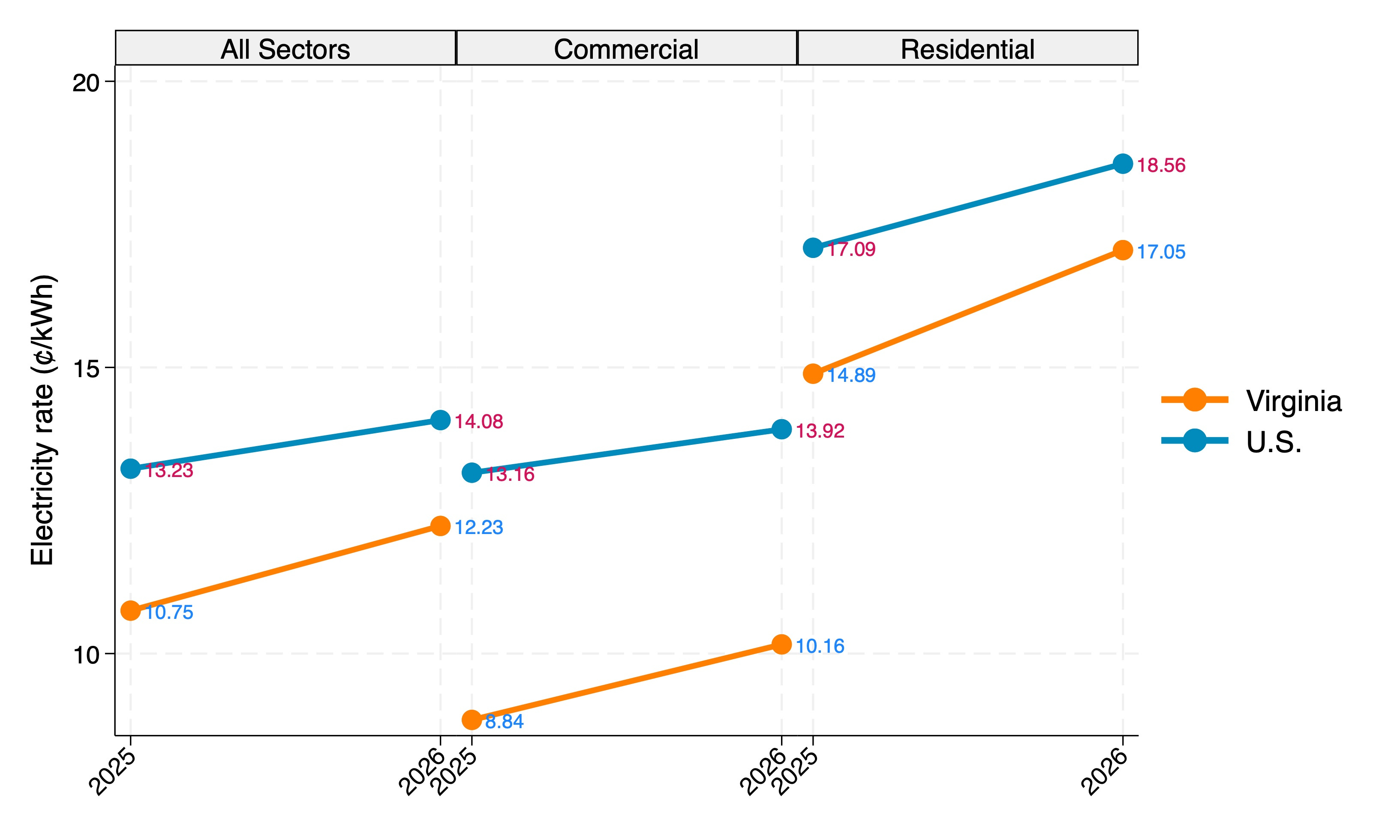
The mechanism is straightforward. When data center demand surges, expensive generators that had been sitting idle have to start producing. Those incremental fuel costs pass directly to consumers. Virginia’s overall average and sector-specific electric rates are still below the US average, but the gap is closing fast.
How Virginia’s Data Center Energy Tax Works
Before analyzing the policy, the design of the tax needs to be clear: this is a consumption tax, not a carbon tax.
That distinction carries real consequences. A data center running entirely on renewable energy pays the same 1.1 cent/kWh tax as one running on coal. The tax creates no incentive to shift toward cleaner energy sources. Its purpose is different: to reduce the quantity of energy data centers consume, and generate state revenue in the process.
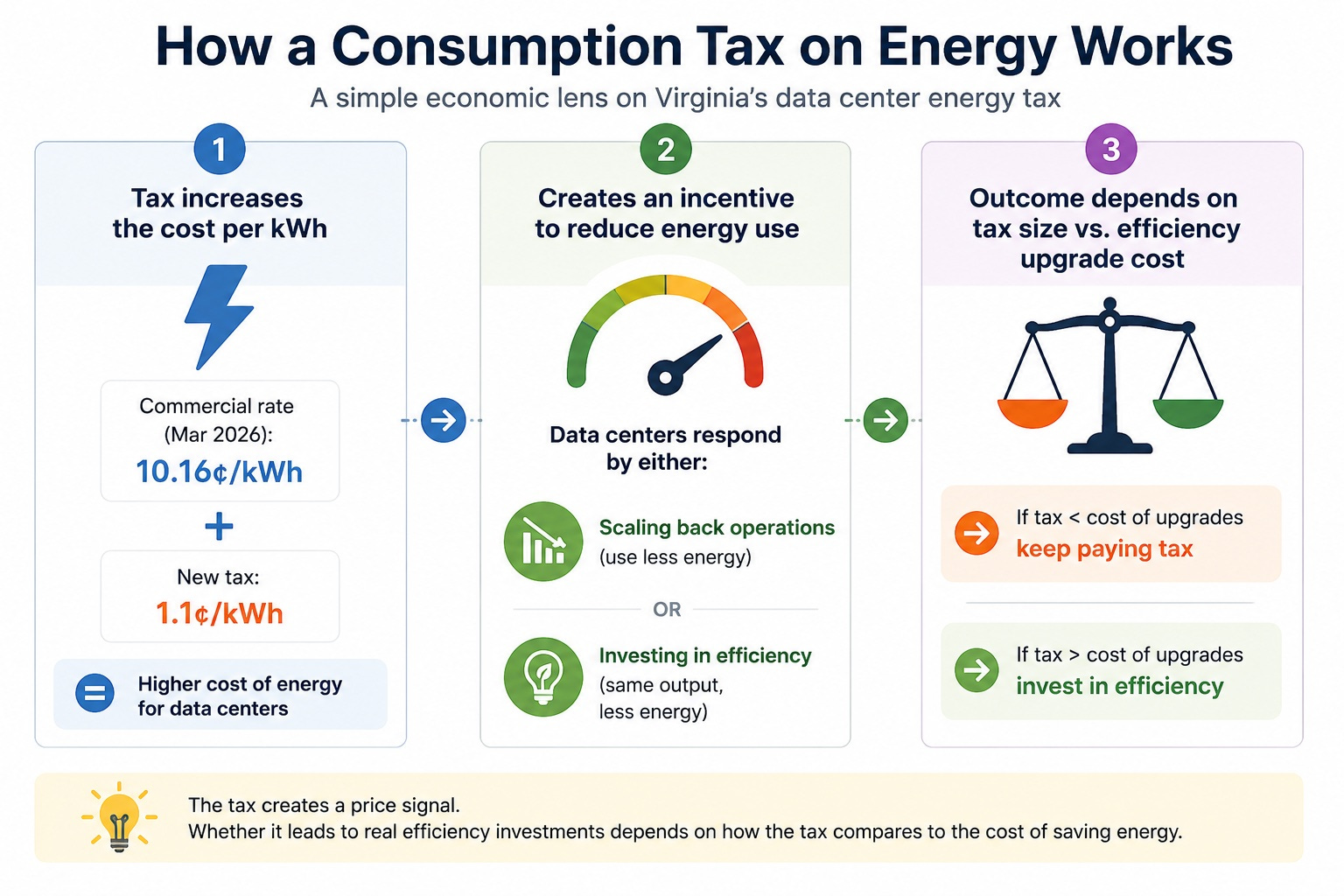
In standard economic models, taxing energy consumption pushes firms to reduce their energy use. The critical question is how they respond. They can cut operations — running the centers less — or they can invest in energy efficiency, achieving the same output with lower energy intensity. The second response is the better outcome: the centers keep running, the grid gets some relief, and efficiency improves. The first response is costly.
So the question here is whether this tax is large enough to make efficiency investment the rational choice.
Is Virginia’s 1.1 Cents Per kWh Energy Tax High Enough to Change Behavior?
Economic theory is specific on this point. If the tax is too low relative to the cost of efficiency upgrades, firms will absorb it as a routine operating expense and change nothing. If the tax is high enough that the savings from reduced energy use exceed the cost of the upgrades, firms will invest. The tax has to cross that threshold to change behavior.
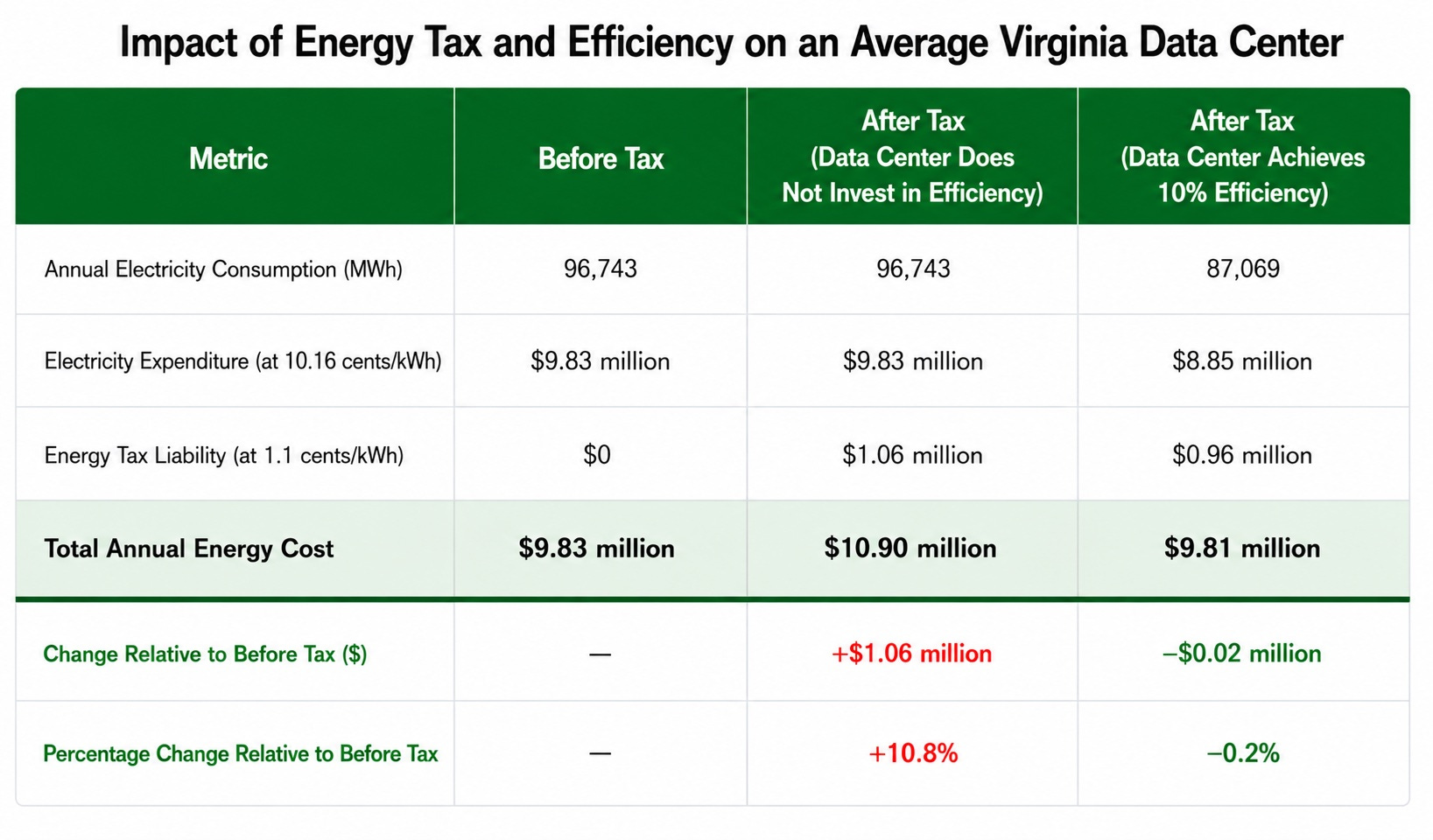
Consider the math. Data centers in Virginia likely face the commercial rate of approximately 10.16 cents/kWh. A 1.1 cent tax could add up to 10.8% to their energy bill if they do nothing. That is a meaningful number — not a rounding error.
The following figure illustrates why the tax may encourage some efficiency investments. If the data center were able to reduce electricity consumption, say by 10%, both its electricity bill and tax liability would fall, essentially returning costs closer to (or even below) their pre-tax level.
Whether a 10.8% increase in energy costs is large enough to trigger efficiency investment depends on the actual cost of upgrades relative to the resulting tax savings. That is an empirical question, and we do not yet know to what extent the tax rate would shift the industry’s response towards efficiency or other meaningful reductions in energy usage.
Another way to look at the tax burden (the stick) is to set it against the full incentive picture (the carrot). The state projects collecting $600 million per year from the energy tax. The equipment and infrastructure tax exemptions are worth $1.6 to $2 billion per year. The energy tax offsets between 30% and 38% of the value of those exemptions. Put differently, the stick is worth roughly one-third of the carrot.
After accounting for energy tax payments, is the net value of equipment tax exemptions sufficient to keep Virginia competitive enough that data centers are unlikely to leave? The answer is likely yes, but the ultimate effect remains to be seen as both existing and prospective data centers weigh the state's carrot-and-stick approach in their location and investment decisions.
Two additional features of this tax deserve attention.
First, it is a discriminatory tax in the technical economic sense — it applies exclusively to data centers, not to other commercial consumers paying the same 10.16 cent base rate. This is an intentional policy design. The state is targeting the specific sector that has placed disproportionate pressure on the grid. That is a defensible choice that effectively creates a two-tier structure within the commercial rate class.
This energy tax also appears to be the first tax of its kind in the United States — a state-level energy consumption tax applied specifically to data centers.
Second, because this is a consumption tax and not a carbon tax, decarbonization is not the primary goal. A data center that cuts its energy use through efficiency improvements — regardless of whether that energy came from natural gas or solar — lowers its tax liability. The incentive is to use less energy, not necessarily to use cleaner energy. Those are related goals, but not the same goal.
The Open Question: Will Virginia’s Data Center Tax Drive Efficiency or Just Become a Cost of Business?
Virginia’s $600 million revenue projection may be the most revealing number in this policy. A state that expects to collect $600 million per year while continuing to provide sales tax exemptions worth up to $2 billion annually may not expect a swift, widespread behavioral change. If every major data center invested heavily in efficiency and dramatically reduced consumption, the tax revenue would fall well short of that figure.
The projection suggests Virginia is anticipating something between the two extremes: some efficiency investment, and some absorption of the tax as a cost of doing business.
Whether 1.1 cents per kWh proves to be the right signal — enough to move the industry toward genuine efficiency, without being so high that it disrupts the investment environment Virginia has spent years building — is the question this policy will answer over the next several years.
The data will follow. Virginia has set the price. Now we watch what the market does with it.
About this post
I am an economics professor at Missouri University of Science and Technology, and I study the economic impact and public perception of data centers. If you are interested in the employment impact of data centers, explore Sector 518 jobs in Virginia and other states in The Workforce Lab, a free interactive tool built from U.S. Census Bureau data.