

I learned that asking for opinions does not prevent students from using AI, which is why I now allow AI and redesign assignments to force evaluation and personal reasoning.
I used to assign a straightforward homework question in my environmental economics course:
In your opinion, what are the top three environmental problems in the United States? Explain.
I framed it explicitly as an opinion-based question. And yet, in the age of generative AI (GenAI), that wasn’t enough.
Despite being asked for their own views, many students still turned to AI-generated answers, which I have reflected in my November 21, 2025 post. The responses were polished and largely homogenous. But they revealed very little about how students were reasoning or about how they connected the issue to their own experiences.
In other words, asking for “opinion” did not guarantee that thinking would occur.
So, I redesigned the assignment.
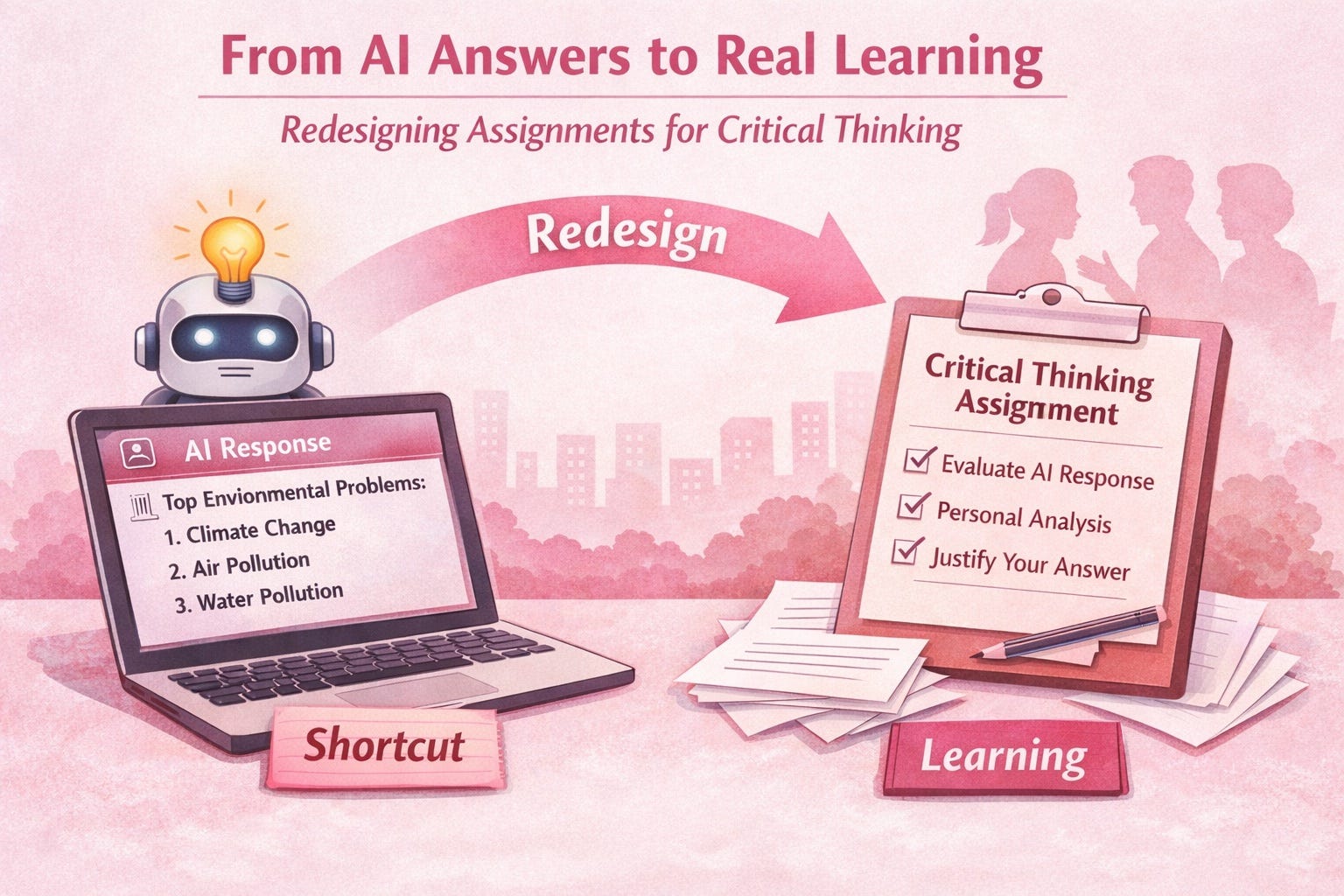
Instead of starting with student opinions, I asked them to first engage with GenAI explicitly:
1. If you ask AI, “What are the top three environmental problems in the U.S.?”, what three items does it list? Evaluate the response by highlighting strengths and weaknesses.
2. In your opinion, what are the top three environmental problems in the U.S.? Discuss and justify.
The grading rubric intentionally separated the tasks:
Summarize what a GenAI tool identifies as the top problems
Evaluate the AI response
Identify three other problems of personal concern
Justify those choices based on your own experience
Why this redesign works better
I wanted students to be able to use GenAI—but not stop there. If I had simply asked them to identify the top three environmental problems, learning would likely have ended with the AI output.
Requiring evaluation forces students to pause and think about what GenAI produces rather than accepting it at face value. Asking them to identify other problems pushes them beyond familiar, broadly defined categories (e.g., climate change) and helps them focus on problems they personally care about.
What I learned
Students had no difficulty generating AI responses. GenAI reliably produced broad, accurate, and widely accepted categories.
The learning happened when students were required to evaluate those responses and then articulate their own concerns. The class moved from convergence to diversity. Instead of repeating the same polished answers, students engaged with more specific, localized, and less visible environmental issues. Their reasoning was grounded in observation: what they see, what has changed, and what affects their own communities.
GenAI can produce a competent answer to almost any question, including opinion-based ones. But learning happens when students are required to make judgments, explain tradeoffs, and defend priorities. This redesign did not ban GenAI. It made GenAI visible, assessable, and insufficient on its own.
My redesign accomplished what the old prompt could not: it shifted GenAI from an output to be submitted to an input to be assessed. It created a clear difference between a polished answer and a reasoned answer.
Two questions for you
I share this as one example of how assignment design can be rethought in the age of GenAI. I am curious how others are approaching this shift:
1. How are you redesigning assignments?
2. Where are you allowing AI use, and how are you structuring tasks so that learning still requires evaluation, judgment, and personal reasoning?
Let me know your thoughts in the comments.
I would take it one step further and ask students to hypothesize a real-life environmental application that includes projected outcomes and community involvement. AI still struggles to retrieve such specific, grounded details. Even when students prompt AI for these kinds of tasks, they’ll quickly realize it often comes up short. That gap creates a powerful opportunity… bringing critical thinking, creativity, and applied reasoning to the forefront.