


This is a collaborative piece. Mahelet G. Fikru is an economist and educator who encountered a problem in her classroom that no existing system had prepared her for. Devika Toprani is a researcher and framework creator who has been building the structural answer to exactly that problem. This piece is what happened when their work met.
The Problem
By Mahelet G Fikru
I teach principles of microeconomics using a Cengage textbook. Cengage has built-in interactive homework exercises — multiple choice questions, problem sets, activities — all delivered through their digital platform. Students complete them at home, get immediate feedback, and receive a grade. I thought it was a clean, efficient system. My students thought so too.
What I did not anticipate was how quickly they would find a workaround.
Some students took a screenshot of the problem and uploaded it directly to ChatGPT. Others copy-pasted the question text. Either way, the AI returned an answer — and for multiple choice questions, it was almost always the right one. Students submitted that answer, the platform registered it as correct, and they earned full marks. Most of them got A’s on the homework.
A few weeks later, I gave a closed-book in-class test using the same types of questions. The scores were strikingly low.
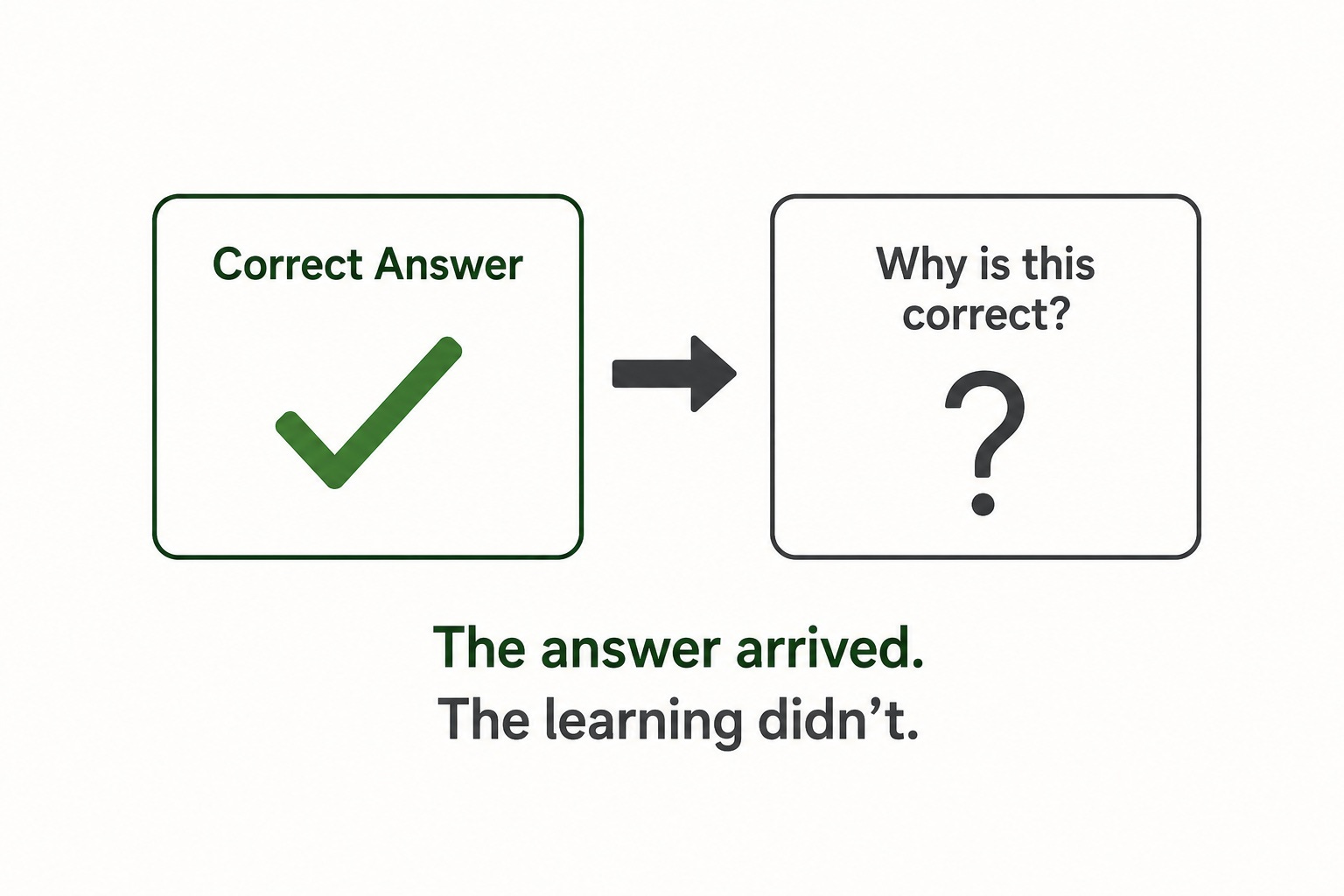
What stayed with me from that experience was not the test scores. It was what happened before the test. Some students came to me after completing the homework, holding their A, and asked me why that particular answer was correct. They had the right answer and no idea why it was right. A few told me they had tried to work backwards from the AI output — they took the answer and tried to figure out what it meant — but the logic still wasn’t landing.
They were not cheating, at least not in the way I had understood that word. They were not hiding what they had done. They told me openly, matter-of-factly, as though it were an obvious strategy. And honestly, I could not fully disagree with them. The homework was designed to produce a correct answer. They produced a correct answer. The system rewarded them for it.
The problem was that the assessment was not designed to make them learn. It was designed to produce an output, and AI had made producing that output effortless. The A was real. The learning was not.
That was not a pleasant moment for me as an educator. But it was an important one. It forced me to ask a question I had not seriously asked before: What was the homework actually for?
The Solution
By Devika Toprani, Soulful Learning with AI
What Mahelet describes is one of the clearest illustrations I have seen of what I call the missing cognitive layer. Not missing from the student. Missing from the learning design.
Her students were not confused about economics because they were incapable. They were confused because the sequence gave them the answer before their brains had formed any question. And that is a structural problem. Not a moral one.
There is a name for what happens cognitively when an answer arrives before any internal framework exists to receive it. Automation bias. The documented human tendency to defer to an AI output because it arrived first... and because it arrived confidently (Skitka et al., 1999; Endsley, 2016). The student does not evaluate the answer.
They accept it. Then they submit it. Then they earn full marks. And the gap in their understanding stays invisible.
Invisible gaps do not get fixed. That is the part that does not show up in the gradebook.
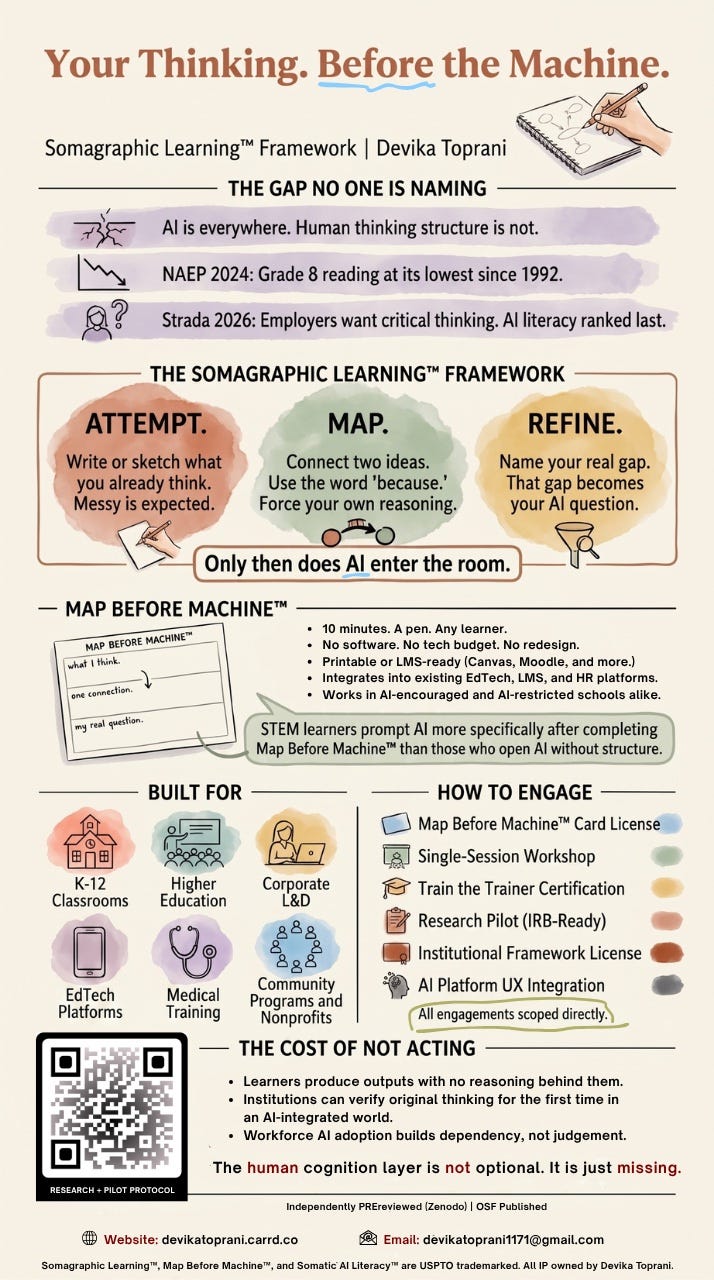
The Somagraphic Learning™ framework is built around a three-stage sequence: Attempt → Map → Refine (Toprani, 2026). You can see it in the infographic above and explored in detail on my website. It was designed precisely for this moment. Not as a policy response to AI use. As a cognitive intervention that changes what the learner brings into the encounter with AI.
🖊️ Attempt: Write or sketch what you already think about the question. Messy is expected. Wrong is fine. Incompleteness is the point. Research on productive failure shows that effortful initial retrieval, even when incorrect, strengthens subsequent encoding (Kapur, 2016). The attempt is not a warm-up. It is the first layer of learning.
🗺️ Map: Connect two ideas. Force a relationship. Use the sentence: [this] affects [that] because [your reason]. Even one directional relationship, written in the learner’s own words, changes everything that follows. It creates what I call a cognitive artifact. A timestamped, externalized record of the learner’s own reasoning. Before any AI output exists. That artifact becomes the learner’s reference point.
✨ Refine: Now AI enters. But it enters a different room. The learner is no longer open-handed, ready to receive whatever the machine offers. They are holding their own structure. They are comparing. Questioning. The gap they identified in the Map stage becomes the question they take to AI. That is the difference between generating answers and refining understanding.
Mahelet’s students would have arrived at ChatGPT with something that could not be faked: a directional claim of their own. Something like “demand falls when price increases because consumers have a fixed budget and substitute options.” That one sentence. That one, because it would have changed everything about how they read AI’s response. They would have had something to compare it against.
The Map stage produces what no detection tool, no proctoring system, and no AI literacy curriculum currently on the market produces. Verifiable pre-AI evidence of original human reasoning. Not surveilled. Not inferred. Visible. Dateable. Theirs.
This is also why I built Map Before Machine™ as a deployable tool, not a concept to aspire to. It is printable in under a minute. LMS-ready on Canvas, Moodle, and any comparable platform. It requires no app, no subscription, no curriculum redesign. Ten minutes. A pen. Paper. That is the entire barrier to entry. Because if the solution is not that accessible, it will never reach the students who need it most.
What Mahelet named was the real question educators are circling right now without quite landing on it. What was the homework actually for? Was it for producing a correct answer? Or for building a mind that could recognize one?
The Somagraphic Learning™ framework says: the sequence is the pedagogy. When AI enters, is the design decision that everything else depends on.
The A+ grade was real. The learning was not. And there is a structure that changes that…
Have you seen something similar in your classroom or organization? We would love to hear from you in the comments!
Related: The Age of Content Scarcity Is Over. Judgment Is What’s Scarce Now.
About the authors
Mahelet G. Fikru is an economist and educator who has taught a variety of economics courses for nearly fifteen years. She writes about education, technology, and economics on her Substack, M G Fikru.
Devika Toprani is an independent researcher, educator, and EdTech Futurist with 5+ years of multidisciplinary experience across three countries. She is the founder of the Somagraphic Learning™, a USPTO trademarked, IP-protected, human-first visual cognitive framework that reduces automation bias in AI-integrated learning. She writes at Soulful Learning with AI on Substack.
References
Endsley, M. R. (2016). From here to autonomy: Lessons learned from human-automation research. Human Factors, 59(1), 5–27. https://doi.org/10.1177/0018720816681350
Kapur, M. (2016). Examining productive failure, productive success, unproductive failure, and unproductive success in learning. Educational Psychologist, 51(2), 289–299. https://doi.org/10.1080/00461520.2016.1155457
Skitka, L. J., Mosier, K. L., & Burdick, M. (1999). Does automation bias decision-making? International Journal of Human-Computer Studies, 51(5), 991–1006. https://doi.org/10.1006/ijhc.1999.0252
Toprani, D. (2026, May 8). Somagraphic Learning™ Framework: A human-first, AI-supported visual cognitive approach (Version 3). OSF Preprints. https://osf.io/preprints/edarxiv/fnk7z_v4
👌
Yep always make sure you know what the question is first!
I love the map before machine, because I think AI has the tendency to make us lazy thinkers.