


The U.S. has correctly diagnosed its rare earth problems: a lack of midstream processing and concentrated sourcing. The nation has moved with real speed and real money to address them. The proposed solution is to create a national champion through equity, debt, guaranteed demand, and price protection, all at once. While this approach may temporarily solve the capacity gap, it recreates the concentration risk by shifting dependency from a single foreign country to a single domestic company.
Quick Takeaways
The U.S. holds substantial known rare earth reserves and has mine-level production, but is missing midstream capacity to process them into compounds and metals.
The U.S. is a net importer of rare earth compounds and metals, with roughly 71% of imports coming from China.
The U.S. faces two distinct problems in the rare-earth space, and each requires a different policy fix.
In 2025, the U.S. government’s response to these problems was to turn one company, MP Materials, into a “national champion”.
Better alternatives exist: targeted research funding for innovative processing technologies spread across multiple firms, investment in workforce development and recycling, and binding partnerships with allied countries.
What are Rare Earths?
Rare earth elements (REEs) are a group of 17 metallic elements extracted from the earth’s crust that serve as essential inputs across high-technology, energy, industrial, and defense applications.
Their industrial applications are wide-ranging: they are incorporated into consumer electronics such as smartphones, laptops, headphones, and hard disk drives; they are essential components in electric vehicle motors and magnetic resonance imaging (MRI) systems; and they are required inputs for jet engine components and missile guidance systems.
What distinguishes rare earths from most other industrial inputs is the limited availability of substitutes. In most of their current applications, REEs cannot be readily replaced by alternative materials because, in many production processes, viable substitutes do not yet exist at comparable cost or efficacy.
This near-irreplaceability is a central feature of the economic significance of REEs, and it underlies much of the policy attention directed toward securing their supply.
The Rare Earth Value Chain: Five Stages
The conversion of REEs from raw ore into a usable industrial input (for example, the magnet in your smartphone) proceeds through approximately five stages of production, each typically undertaken at a distinct location.
Mining: The process begins with the extraction of rare earth-bearing ore, a practice that occurs at sites such as the Mountain Pass mine in California and is sometimes referred to as an upstream activity.
Concentration: The extracted ore is then crushed and processed into a concentrate, a step in the upstream operation.
Separation: The concentrate is subsequently chemically separated into individual rare earth oxides (such as neodymium-praseodymium (NdPr) oxide). This is a midstream process that, for ore from Mountain Pass, also occurs on-site.
Metal conversion: The separated oxide is then converted into metal form at a dedicated facility, such as MP Materials’ Independence facility in Fort Worth, Texas.
Alloying and magnet-making: Finally, the metal is alloyed and processed into a finished magnet — the downstream stage of the value chain — as is expected to occur at the planned MP Materials’ 10X facility
How Import-Dependent is the U.S.?
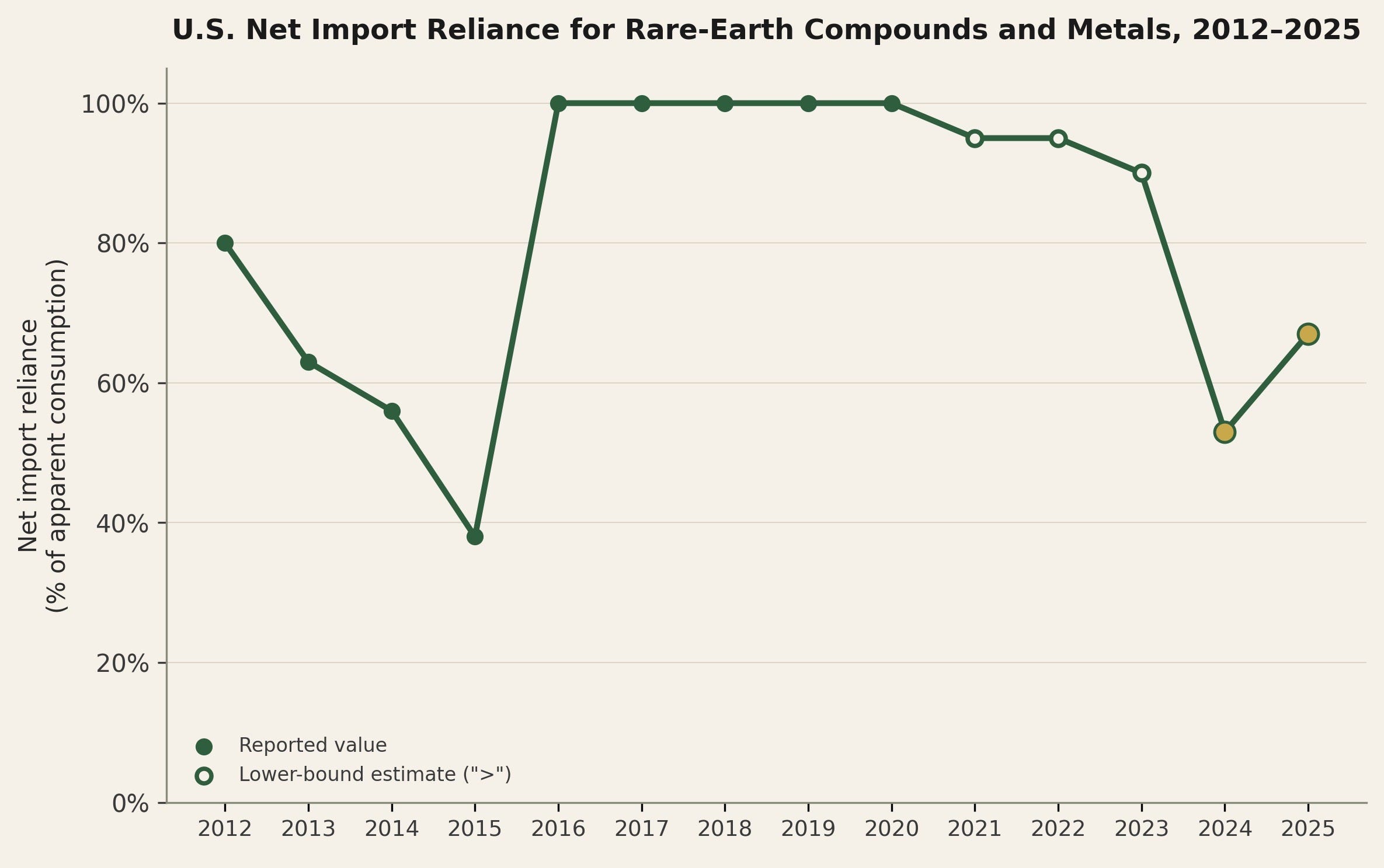
The United States has long been a net importer of rare earth compounds and metals. For example, between 2016 and 2020, the U.S. imported, on net, 100% of the rare earth compounds and metals consumed. During 2021–2022, net import reliance was at least 95%, while in 2023 it was at least 90%.
Furthermore, U.S. REE imports are heavily concentrated. Between 2021 and 2024, 71% of U.S. rare-earth compound and metal imports came from China, with Malaysia supplying another 13%, and Japan and Estonia supplying 5% each.
Why is the U.S. import-dependent?
It isn’t because the U.S. lacks known rare earth deposits.
The U.S. holds substantial known rare earth reserves and has mine-level production of concentrates, but is not processing them into compounds and metals.
According to the USGS, the United States ranks sixth globally in rare earth reserves, with an estimated 1.9 million metric tons, accounting for 3% of global reserves. Most of this reserve is located at the Mountain Pass Mine in California, where the company reported about 1.69 million metric tons of total reserves as of December 31, 2023.
Beyond Mountain Pass, the U.S. has several other known but largely undeveloped deposits, which the USGS has identified as advanced exploration sites. Examples include Bear Lodge, Wyoming; Bokan Mountain, Alaska; Elk Creek, Nebraska; and Round Top, Texas.
REE mine production in 2023 was 41,600 metric tons of mineral concentrate, representing 11% of the world's mine production, making the US rank third after China (255,000 metric tons) and Burma (43,000 metric tons).
In the same year, 2023, U.S. consumption of REE compounds and metals was estimated at 10,100 metric tons, while compound and metal production totaled only 250 metric tons.
So, in 2023, the U.S had high import reliance on compounds and metals (>90%), due to low production of these midstream products (only 250 metric tons), while having huge reserves of 1.9 million metric tons and modest mine production. Most of this mine production in concentrate form is exported abroad for further processing and then reimported in compound and metal forms.
This is because, since the 1990s, the U.S. has been steadily losing the midstream industry: the factories, processes, metallurgists and engineers, and processing facilities themselves. Instead, we were relying on imports of REE compounds and metals, most notably from China, which has built its technical capabilities to process rare earths over the same period.
The reason domestic separation and processing cannot compete is straightforwardly economic: at prevailing global prices, U.S. companies cannot recover their costs. Those prices are set by low-cost producers — chiefly China, whose rare earth sector is state-supported and has had decades of investment behind it.
Framing the Economic Problem Correctly
Before getting to what was actually done about this, it is worth being precise about what the problem even is. Because the U.S. importing a lot of rare earths by itself isn’t a problem.
The U.S. is a high-import country generally, and has been for a long time. Importing something you don’t have a comparative advantage in producing is well-established economics: other countries can make it more cheaply, and it’s a better use of everyone’s resources to trade rather than produce it domestically at a loss. There’s nothing alarming about that principle on its own.
The actual problem here is two separate things layered on top of each other:
A missing midstream industry. Domestic separation and processing capacity have nearly disappeared.
Concentrated sourcing. 71% of what the U.S. imports comes from a single country, namely China.
These are different problems, and they call for different fixes. Conflating them — treating “build more capacity” as automatically the same thing as “reduce concentration risk” — is where a lot of the current U.S. policy goes wrong.
Fixing the Capacity Gap
The barrier to entry here is cost.
The sustainable fix is to make domestic processing cost-competitive by improving the technical efficiency of separation and refining, and by investing in technologies that improve the ore-to-metal ratio. Rebuilding this capability takes time: it requires expertise, a trained workforce, and specialized equipment that is no longer in sufficient supply, which in turn requires real R&D investment in that equipment.
That points to a specific toolkit:
Targeted research and process-innovation funding aimed at separation and metallurgical efficiency, not blanket subsidies or general tax breaks, which tend to be inefficient.
Public-private partnerships or national lab investment in the development of improved solvent extraction and separation technology.
Investment in metallurgical engineering training, since much of that domestic expertise has eroded over the past several decades.
The goal should be to help an industry get on its feet and enable the private sector to develop better processes and innovative technologies, not for the government to take a piece of it or to keep supporting it for multiple years without tying that support to performance. Support should taper off once the industry reaches an organic comparative advantage, and it can reasonably favor eco-friendly innovation with extra incentives along the way.
Insulating producers from market prices doesn’t hold up as a long-term solution for two reasons. First, global prices move a lot and are uncertain — you want the supply side to be resilient to that, not shielded from it. Second, insulation removes the incentive to invest in cost-reducing processes. If the government cushions the midstream against low prices, producers have no reason to keep investing in the technology that would bring their costs down on their own.
Fixing the Concentration Risk
Even if the U.S. had all the midstream capacity it needed, that capacity shouldn’t rest on a single entity — whether that’s one country or one company.
This is a different problem from the first one. Fully price-competitive domestic processing would still leave the U.S. structurally reliant on a single dominant supplier unless sourcing is deliberately diversified. You don’t solve concentration risk by making one domestic producer bigger and richer; you solve it by multiplying the number of independent supply nodes, so that a disruption at any single one doesn’t take the whole system down.
The fix here looks different from the capacity fix:
Spread the same targeted federal support (the tech and process-innovation funding) across multiple companies and multiple stages of the supply chain, including promising startups and recycling efforts, instead of concentrating it in one entity, a national champion.
Binding agreements with a different set of allied countries that hold independent reserves and processing potential.
Strategic stockpiling as a bridge while diversified capacity comes online — not as a permanent substitute for it.
A country sourcing a critical input from several independent suppliers can absorb the loss of one or two of them. A country sourcing it from a single dominant supplier can’t: if that supply is disrupted, every downstream industry that needs the material gets hit at once, with no alternative source to absorb the shortfall. That’s both an economic and a social problem, and it’s exactly the kind of thing markets alone aren’t well-suited to fix. It does merit policy intervention, but the form that intervention takes matters just as much as the decision to intervene.
The U.S. Policy Response: A National Champion in MP Materials
Given the U.S.’s two REE problems, the missing midstream and concentrated sourcing, the approach that has been taken is to pick a national champion and back it with a wide range of support.
MP Materials is a publicly traded company that owns and operates the Mountain Pass mine and processing facility — the only rare earth mining and processing site in the United States. It is vertically integrated: mining, concentration, and separation happen at Mountain Pass, and metal, alloy, and magnet production happen at its Independence facility in Texas. Additional large-scale magnet manufacturing is planned at the 10X facility in Texas.
Mountain Pass has a history worth knowing. It dominated world rare earth production from the 1960s through the 1980s, before Chinese state-subsidized output undercut its costs, and the site went dormant in the early 2000s. It was acquired by MP Materials from bankruptcy in 2017, when it resumed mining and concentrate production (upstream).
In 2023, MP Materials commenced midstream operations, including NdPr oxide among other processed REEs. In January 2025, the Independence facility started commercial production of NdPr metal and trial production of magnets. By December 2025, the Independence facility started producing commercial magnets, making MP Materials a fully integrated company.
The national-champion package, announced in July 2025, deployed four tools at once:
A $400 million preferred-equity stake — a 15% share — making the Department of Defense MP’s largest shareholder.
A $150 million Department of Defense loan for heavy-rare-earth separation capacity at Mountain Pass.
A 10-year guaranteed offtake for the 10X magnet facility, under which the government committed to ensuring 100% of the magnets it produces get sold, split between defense and commercial buyers.
A 10-year NdPr price floor of $110/kg, signed in July 2025, insulates MP from Chinese price competition. Since payments began in the fourth quarter of 2025, MP has collected $110.9 million in cumulative price-support payments from the U.S. government. That price floor covers NdPr content in concentrate, oxide, and metal form, but excludes support for the finished magnet.
The national-champion deal’s effect, as captured by the data
The immediate impact of the national-champion policy is straightforward: domestic REE processing capacity doubled, and ore exports fell by more than half as MP absorbed more concentrate at home instead of shipping it abroad. The capacity gap appears to be starting to resolve.
But the U.S. still imported a meaningful share of its compounds and metals that year because demand outpaced what the single facility driving these gains could supply. And as demand grows, which it will, as the nation invests in AI, the digital economy, and energy technologies, one facility alone won’t be enough to supply the rare earths the economy needs.
In fact, the national champion policy, by its own design, has not and cannot solve the concentration risk problem.
The U.S. may still end up sourcing its midstream output from a single site operated by a single company. Swap “China” for “MP Materials” in the sentence “the U.S. depends on one supplier for 71% of its rare earths”. That’s not a side effect or unintended effect of the policy; it is the direct, mechanical result of choosing a national-champion strategy over a diversification strategy. You simply cannot fix a concentration problem by concentrating harder.
Relying on a single entity, domestic or foreign, to solve a national problem is, at best, a fragile strategy. Decisions at a single company should not be able to sway national statistics. The fix is to encourage competition and remove barriers to entry so that new separators and alloyers can come online, broaden the base, and create the competition that a single national-champion deal can’t.
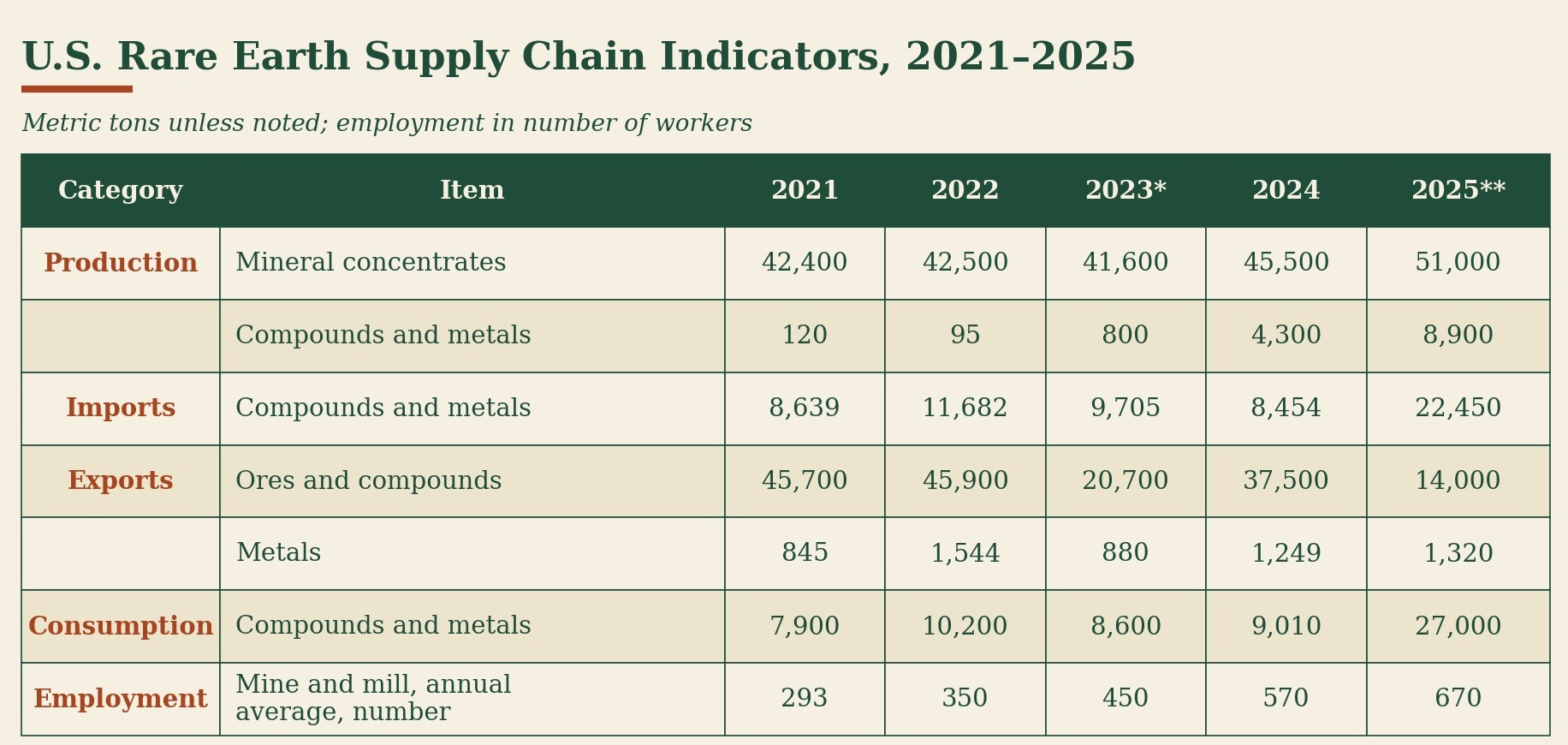
Let’s look at how the numbers moved once the national-champion package took effect in mid-2025 and MP’s midstream capacity came online.
By 2025, U.S. REE mine production had reached 51,000 metric tons of concentrate, an increase from levels recorded during 2021-2024. Compare this against the domestic production of 8,900 metric tons of REE compounds and metal in 2025, representing a doubling of production capacity from the previous two years.
The export side tells the same story from the other direction. In 2024, the U.S. exported 37,500 metric tons of rare-earth ores and compounds — raw material shipped abroad because domestic processing couldn’t absorb it. By 2025, those exports had fallen to 14,000 metric tons, as MP’s own processing capacity started absorbing more of that concentrate at home.
Yet in 2025, the U.S. still imported roughly 21,000 metric tons of compounds and about 1,450 metric tons of metals to meet growing demand.
In 2025, net import reliance for REE compounds and metals stood at 67% — still high, but a major improvement from the 100% import reliance recorded from 2016 to 2020.
The 2024 improvement predates the national champion deal
Here’s the detail that matters most for evaluating the national champion policy: the 2024 drop in import reliance (53% net import reliance) happened before the July 2025 “MP as national champion” deal was even signed.
It was MP’s own Stage II/III capital ramp-up and capacity that it had already been building.
MP Materials’ own reported numbers show the ramp-up in Q4:2024: the company’s rare earth concentrate production rose from 10,766 metric tons in Q3: 2023 to 13,742 metric tons in Q3:2024, a 28% increase, while its NdPr product output jumped from 50 metric tons in Q3: 2023 to 478 metric tons in Q3:2024.
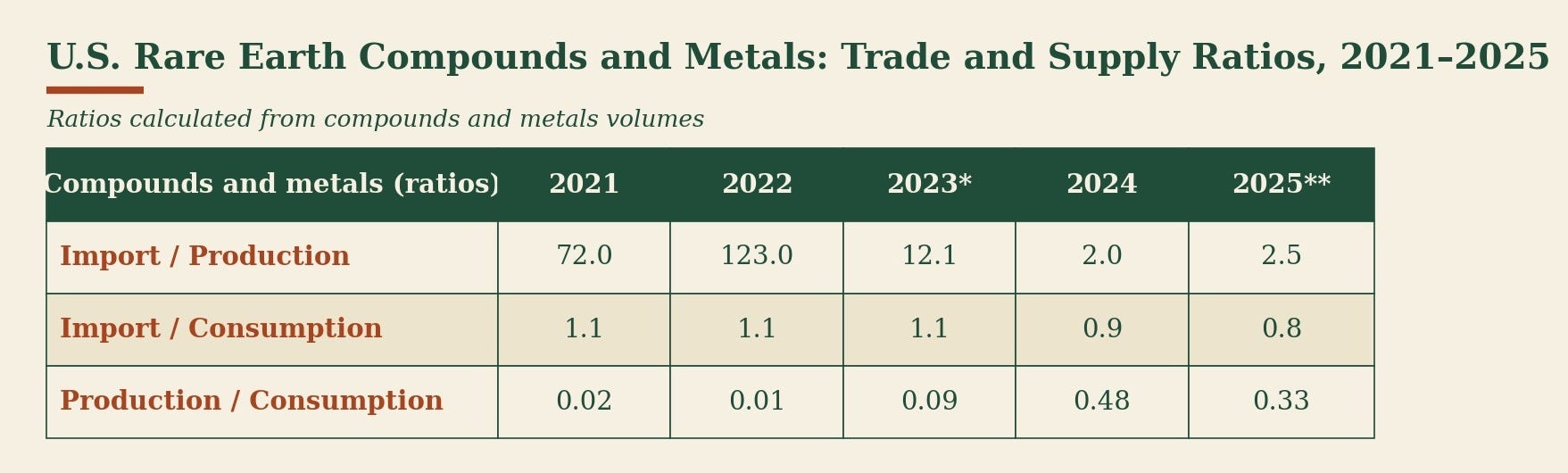
Looking at the national ratios between 2023 and 2025 makes this even clearer.
The import-to-production ratio of REE compounds and metals was the lowest in 2024, even lower than the 2025 value.
The import-to-consumption ratio declined from 1.1 over three consecutive years (2021-2023) to 0.9 in 2024, then to 0.8 in 2025.
The production-to-consumption ratio was the highest in 2024, exceeding the 2025 value.
Furthermore, from 2023 to 2024, national production of REE compounds and metals jumped from 800 to 4,300 metric tons, a 438% increase, reflecting the midstream capacity MP brought online in 2023. The net import reliance was 53% in 2024, the lowest amount since 2015.
Looking at how the data was already moving in the right direction in 2024, without the national-champion policy, raises questions:
Was the deal actually necessary, and would MP have continued to perform well without it? Or did MP do well in 2024 in anticipation of the deal?
And does improving one company’s bottom line count as national policy, or is that a separate outcome from solving the country’s rare earth problem?
What’s Wrong with the National-Champion Approach
At its core, a national-champion approach creates a government-backed monopoly, with weaker incentives for cost-cutting and innovation.
It just relocates concentration. The supply risk moves from China to a single company. A mine failure, an accident, or any disruption at one of MP’s facilities reproduces the exact same vulnerability, just from a different source.
It solves the capacity gap by re-creating a concentration risk. Mid-stream capacity increases due to the national champion, but it’s concentrated entirely in a single entity, MP Materials.
It raises the barrier to entry for everyone else. The price floor works for exactly one company. Every other potential U.S. entrant, such as a competing miner, a separation startup, or a magnet manufacturer trying to raise private capital, still faces the real market price, roughly half of MP’s guaranteed price floor.
Price floors blunt the incentive to innovate. Extending the same protection to every incumbent and new entrant would require enormous public funds, and taking equity stakes across the board — as DoD did with MP — would amount to a form of nationalization. A guaranteed price also removes the pressure to improve efficiency: firms keep producing with high-cost techniques because the floor already covers their costs, wasting both company resources and public funds. The NdPr price floor for MP protects only one recipient and raises the effective cost of entry for everyone else.
It creates a moral-hazard trap. Once the government is an equity stakeholder in the firm it’s subsidizing, it has an incentive to keep subsidizing that firm regardless of whether it is the efficient long-run winner, because withdrawing the subsidy would mean writing down the government’s own stake. That is a trap a healthy competitive-entry policy wouldn’t create.
It crowds out private capital. An investor weighing whether to fund rare earth midstream capacity now has to reckon with competing domestically against a government-backed entity, even if global prices improve. Policy should crowd in private finance, not push it out.
What Better Strategies Look Like
None of this means the government should sit out of rare earths policy.
The market failure here is real and merits some intervention (not just a national-champion approach). There are at least three types of market failures at play here, and their combination justifies some form of government intervention.
Supply security, or the security benefit of not depending on a single entity, is an impure public good that benefits a majority of industries in the economy, but no single firm captures that value, so the market underprovides it.
U.S. producers face global prices that are uncertain, less transparent, and often decoupled from their rivals’ true cost, so the price signal itself is distorted, facilitating an information asymmetry problem.
Barriers to entry imply that building domestic separation and processing capacity requires years of upfront investment before it pays off. No single firm can rationally bear that risk when competing against an incumbent that is state-subsidized and has already recovered its costs.
The question here is the choice of instrument, and there’s a whole set of alternatives that would address the same two problems without concentrating the fix in one company. A few alternatives, other than the ones we already discussed above, include:
Loans, rather than equity, for expanding existing producers and helping new entrants get built. Loans are repaid, while equity stakes create an incentive for the government to maintain its support.
Support for recycling and the circular economy, not just mining, presents an underused capacity for REE sourcing.
Every one of these tools does real work toward closing the capacity gap and spreading out the concentration risk. These alternatives build resilience by relying on multiple competing sources of supply, whereas the MP deal creates a monopoly.
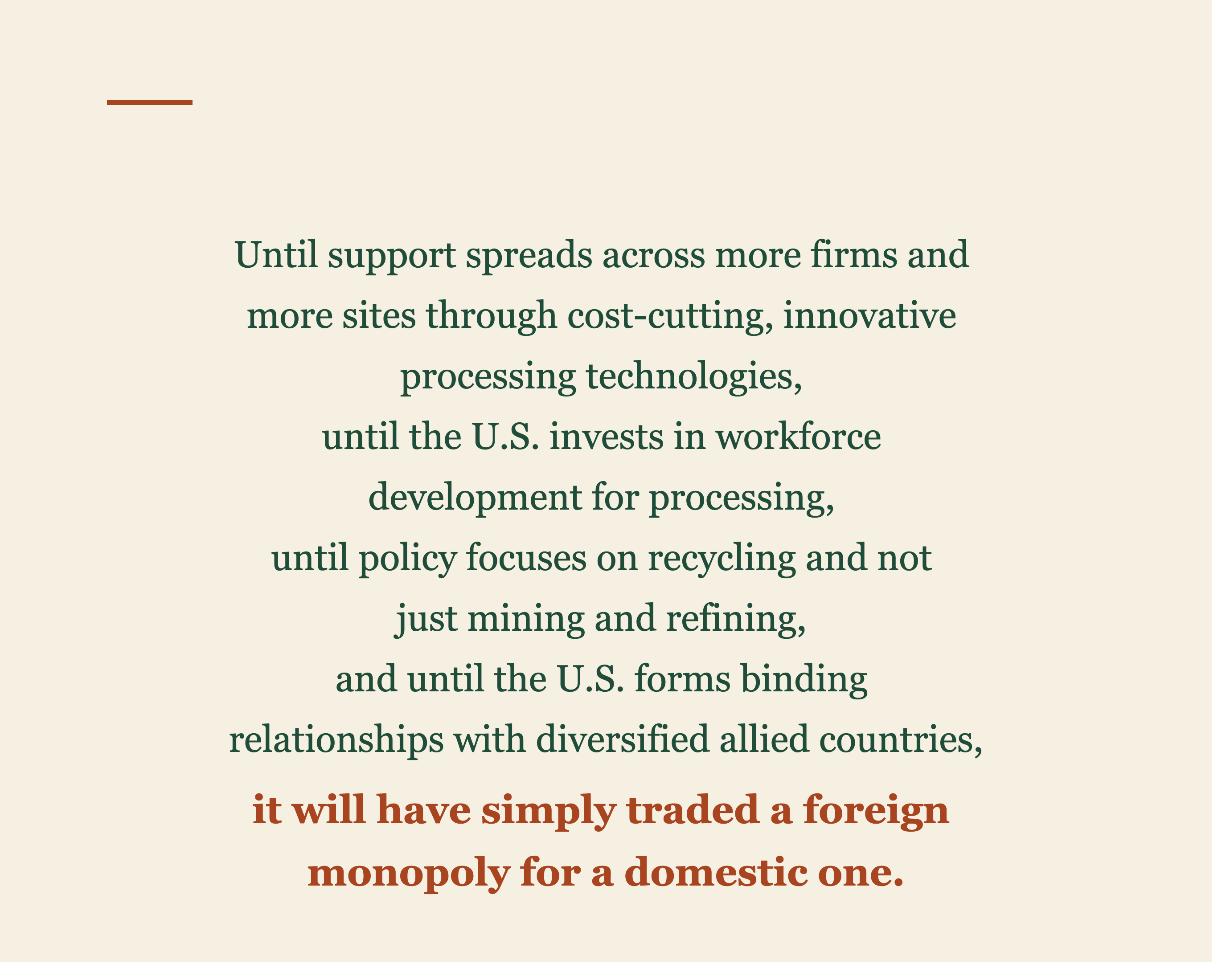
The capacity problem and the concentration problem are both real and distinct problems, and both deserve a national policy response. But treating them as the same problem and solving both with the same company is how you end up trading one dependency for another.
About the Authors
Mahelet G. Fikru is an economist and educator whose work focuses on critical minerals and the societal challenges of the clean energy transition. Her Substack examines how innovation and technology shape markets and society.
Bonnie L. Thornton is a writer covering critical minerals, with a particular focus on rare earth elements. Her work on Substack explores the industry from multiple perspectives, including geopolitics, environmental impacts, policy, and the role of rare earths in the energy transition.
Interesting readddd. You got me when you said you lost 5 subs over this essay. Must be the Anti-AI bots 😂💯
This really helped me understand the issues at stake. Is China’s current system essentially the national champion approach? I know a lot of it is state-owned enterprises…