

In this post, I offer a simple way to think more clearly about the technology-enabled products we bring into our homes.
Humanoid robots.
Electric vehicles.
AI services.
Residential solar panels.
Smart electronics.
Gaming equipment.
Most conversations about these tech-enabled products focus on their performance. Consumers want them faster, smarter, safer, and cleaner.
Economists think of something slightly different.
We recognize that innovation draws on scarce resources, entails tradeoffs, and often produces distributional consequences. Our conversations revolve around three questions.
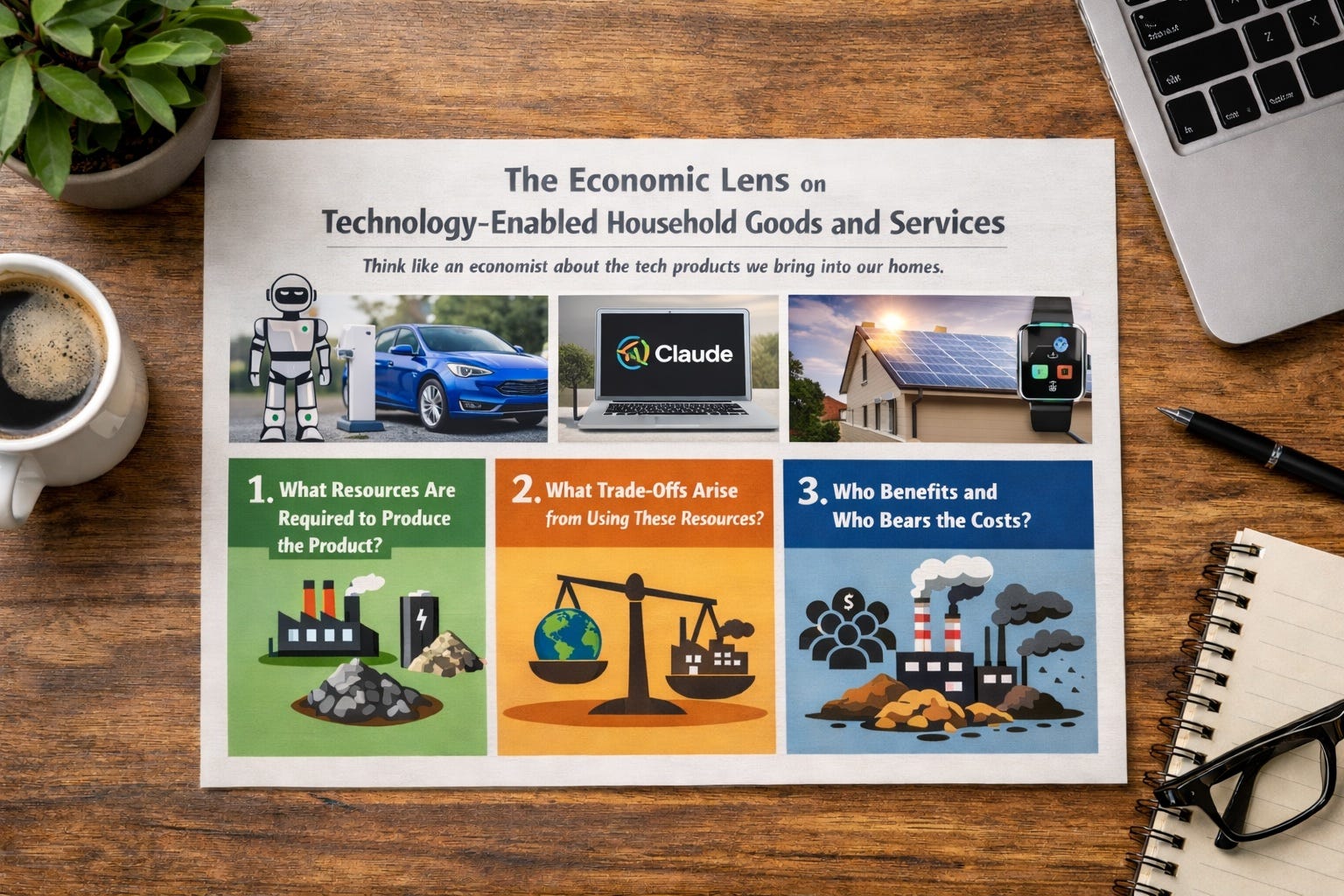
1. The Resource Inputs Behind Every Smart Device
Every technology-enabled product is produced using inputs. This is production theory.
Natural resources include minerals and water. Energy is an indispensable input in any production process. Human resources, along with physical and digital infrastructure, are also essential.
Using this economic lens, you can ask your AI to identify the most important resources required to produce your favorite technology-enabled home product.
Act as a senior environmental economist expert. I will provide a technology-enabled product or service. Identify the most critical inputs required for its production, focusing on natural capital and physical infrastructure. Select only the two most economically significant inputs in each category. Be precise and concrete. Prioritize inputs that are indispensable at scale and avoid exhaustive lists or generic descriptions.
2. The Hidden Trade-offs of Resource Use
Using resources always involves trade-offs. The trade-offs involve both what society gives up in alternative production and entities that bear external costs in the form of environmental and infrastructure-related burdens.
First, the resources could have been used elsewhere to produce another good or service. For example, allocating more lithium to smartwatches may mean having less for electric vehicles.
Second, resource use may impose costs on entities other than the resource user. Mineral extraction may impose environmental damage on nearby communities. Water use may reduce availability for others. Electricity demand may strain the grid for other energy consumers.
The central economic questions are: Which costs are paid by the producer? Which costs are imposed on others?
3. Who Benefits and Who Pays: The Distribution Problem
Once the good is produced and consumed, the distribution of benefits and costs matters. Who benefits monetarily? Who benefits non-monetarily? Who bears external costs?
Producers and their shareholders expect to earn profits; otherwise, they wouldn’t be incentivized to produce. Workers also benefit from working in high-tech industries.
Consumers benefit from the products they use, along with the convenience, connectivity, and other attributes they offer. There may also be broader benefits that aggregate beyond individual entities.
At the same time, external costs may be inevitable. Communities near extraction sites may bear environmental degradation. Regions hosting energy-intensive manufacturing may face higher resource use or local pollution. These burdens are often geographically and socially distant from final consumers.
The key question is whether technology is generating sufficient net social gains (which is the benefit that remains after reducing both private and external costs) and to what extent the full social costs are shared across the entities that benefit from the product’s value chains, rather than being borne disproportionately by parties external to the market transaction.
Why This Matters to You
Technology-enabled goods and services reshape economies.
But they do not emerge without inputs.
They do not operate without trade-offs.
They often do not distribute benefits and costs evenly.
This three-step reasoning is not branding. It is simply how economists think.
If you want to practice, pick one product you use every day (e.g., your smartwatch, EV, cloud storage, or gaming console) and run it through these three questions.
Better yet, copy the prompt from this post, paste it into your AI tool, and see what it reveals. Compare the answer to your own reasoning. Then share your thoughts in the comments section.