

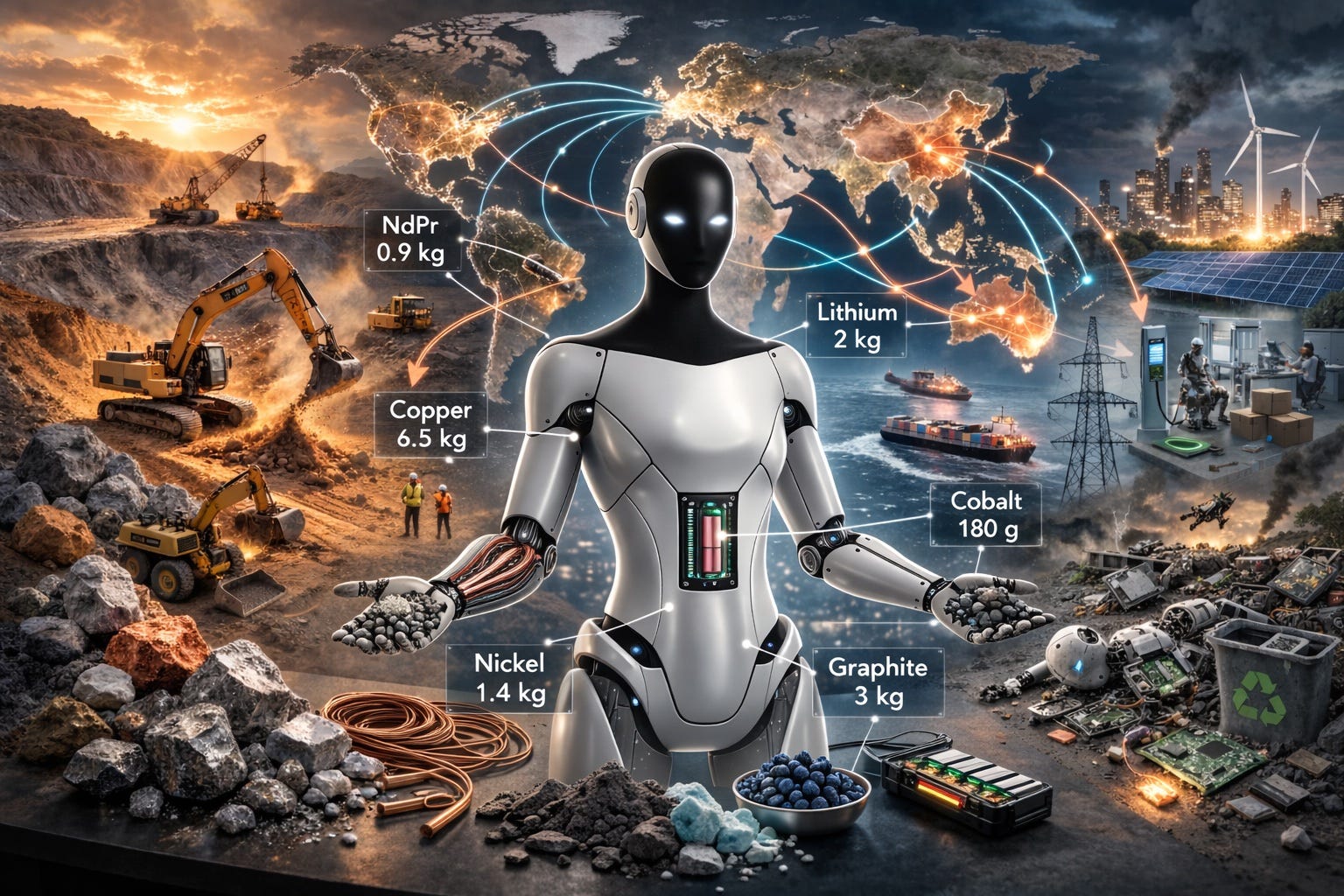
Short answer: According to Morgan Stanley estimates, a single humanoid robot may contain about 0.9 kg of rare earth elements (neodymium-praseodymium), 2 kg of lithium, 3 kg of graphite, 1.4 kg of nickel, and 180 g of cobalt. With up to 1 billion robots projected by 2050, that adds up to major new demand for mining.
As an environmental economist, I break down the copper, lithium, and rare earths inside every humanoid and what it means as production scales towards 1 billion robots.
I wrote about humanoid robots and their impacts on the environment and society in my December 10 and 22, 2025, posts, and I am still fascinated by them. The possibility of saving time by using them as domestic assistants is compelling. At the same time, I remain concerned about their potentially high energy usage during nighttime charging, what happens to them at the end of life, and the absence of built-in recyclability programs in their design.
As an environmental economist, I am often interested in examining how innovation and technological progress affect sustainability outcomes.
The hidden mineral footprint of humanoid robots
Another dimension I would like to point out today is the volume of metals and materials needed for each robot, which are produced from ores that must be mined.
Robots are mineral-intensive capital goods. Recent projections suggest that the scale could be enormous.
A report by Market Index, citing Morgan Stanley research, estimates that there could be 1 billion humanoid robots globally by 2050, roughly 1 robot for every 10 people on the planet. Other industry commentary similarly highlights the possibility of exponential expansion in robots and the resulting surge in metals demand.
So, what does one robot actually require?
According to the Morgan Stanley estimates summarized in the Market Index piece, a single humanoid robot may contain approximately:
0.9 kilogram of neodymium-praseodymium, which are rare earth elements needed for high-performance magnets that enable robotic movement,
2 kilograms of lithium, 180 grams of cobalt, 3 kilograms of graphite, and 1.4 kilograms of nickel, which are needed for the lithium-ion batteries powering the robots, and
6.5 kilograms of copper for electrical and structural parts.
This is close to 14 kilograms of critical minerals, and these are essential hard-to-substitute materials, not decorative inputs. Now scale those per-robot numbers to one billion units. Even without comparing these figures to current global production levels, the magnitude is striking.
For example, according to the U.S. Geological Survey, global refined copper production in 2024 was approximately 27 billion kgs. Based on Morgan Stanley’s estimate of copper intensity per robot, producing 1 billion robots would require about 24 percent of one year’s current global refined copper output.
These statistics make it clear to me that the backbone of a future economy built on robots is necessarily mineral-intensive.
Design with sustainability in mind
Every transformative technology carries both benefits and costs, and humanoid robots are no exception.
On one hand, robots may make our lives easier, saving time, augmenting labor, and enabling new forms of productivity. On the other hand, every robot embodies extracted minerals, energy use, and potential environmental disturbance, with long-term waste management challenges.
The question, therefore, is not whether humanoid robots will arrive. The question is: with what trade-offs? And how can we ensure the benefits meaningfully outweigh the costs? Robots will become foundational capital goods in the modern economy, and so sustainability considerations and environmental performance must be treated as a core design parameter from the outset, alongside functionality, safety, and profitability.
Three questions for you
When humanoid robots become as common as cars:
Would you care where their minerals come from?
How much more in your electricity bill would you be willing to pay to charge them each night?
Would you care whether or not the materials in the robots are recyclable?
I would love to hear your perspective. Please share your thoughts in the comments.
If this resonated, please tap restack so other readers can find it.
For more analysis on humanoid robots:
i really appreciate this angle. How much do the projections depend on battery chemistry or design choices? Seems like that could change the mineral needs pretty quickly