

Short answer: When AI makes information free, its value moves to the skill that sits next to it: judgment. Judgment means deciding what matters, noticing what is missing, seeing what is wrong, and explaining why. AI can produce content at almost no cost, but it cannot take responsibility for those four decisions. In a world of abundant content, judgment is what students need to build, what teachers need to assess, and what readers will pay attention to.
A note that traveled further than I expected
On June 24, I posted a short note on Substack:
Most of my notes are read by a couple of hundred people, mostly readers who already know my work. This one was different. It was shown 1,698 times, well above my average. Of the roughly 1,400 people who saw it, nearly nine in ten were not subscribers or followers. It drew 63 likes, 10 restacks, 11 replies, and nine new subscribers.
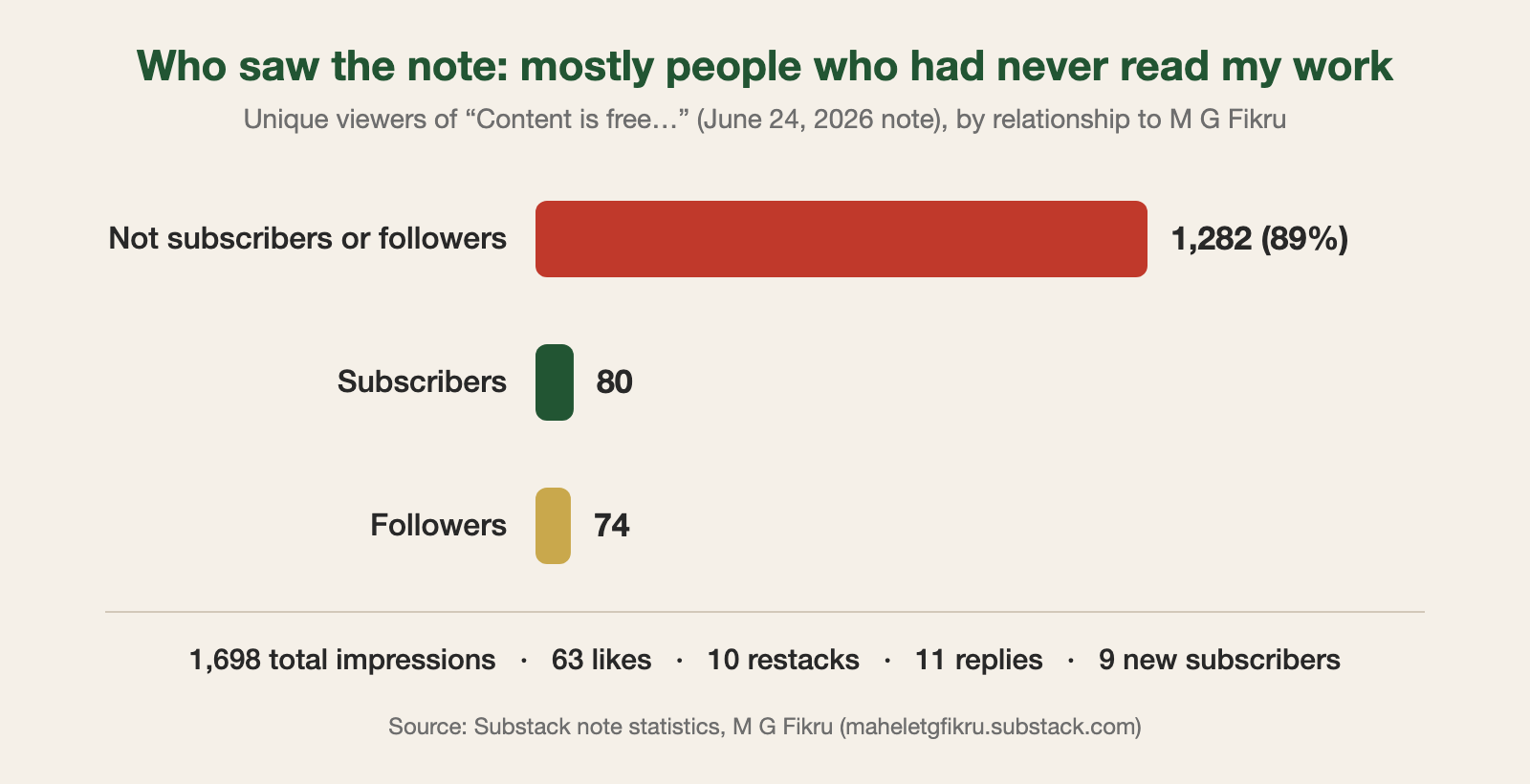
Who saw the note: nearly nine in ten viewers had never subscribed to or followed my work. Source: Substack note statistics.
What I keep coming back to, though, is not the numbers. It is the replies. People did not simply agree. They added to the idea, pushed on it, disagreed with it, and in a few cases put it better than I had. This post is my attempt to take those replies seriously.
What readers told me
Jiajie Zhang, a cognitive scientist and author of The Cognitive Revolution, wrote: “The age of content scarcity is over. The real value of education is shifting from knowledge transmission to judgment cultivation.” I borrowed his first sentence for the title of this post, because I have not found a better way to say it.
Darja Koneva agreed that “judgment is becoming even more valuable.” Her point was that AI can support analysis and generate ideas, but it cannot fully replace “the experience, mentorship, and contextual understanding that great educators bring.”
Andrew Errant remembered his best professors as the ones who “challenged me as my ideas were evolving, pushing me to be more deliberate with every sentence.” Not the ones who delivered the clearest lectures, but the ones who pushed back while the thinking was still being formed.
Alyssa Fu Ward, PhD, noted that people can do a great deal on their own with AI, “but there’s something to be said for expertise to just put you on a different starting plane.” Everyday Human Rights, written by two educators, made a similar point: an expert still brings “discretion.”
Juliet, who writes The Future We Design, took the idea one step further: “The question isn’t just whether students can evaluate information. It’s whether they understand how institutions determine what counts as knowledge in the first place.”
Don Southerton said simply that AI “has accelerated my learning.” I believe that. For a motivated learner with good judgment, AI is an extraordinary tool.
And a few readers did not fully agree.
tablefor1drinksfor2 wrote that “judgements are byproducts of subjective interpretation and can often be bias.” What serves students better, they argued, is curiosity and questioning, and helping students “reach their own conclusions,” using AI “as a research partner not the qualified answer.”
Dont stop the beat. argued that “abundance of knowledge and its effective understanding and utilisation is education,” and that universities that encourage self-directed thought, or apprenticeships, teach more than teachers do.
I have learned a lot by thinking more carefully about these two points; disagreements are the most useful replies of all.
An economist’s way to see it: information and judgment are complements
In economics, two goods are complements when they are used together: cars and gasoline, printers and ink, coffee and cups. When the price of one falls, people use more of it, and demand for its complement rises.
Now think about information and judgment as complements.
For most of history, information was expensive. You needed a library, a textbook, a teacher, a subscription, or a lot of time. A university’s value was partly that it gave you access to information you could not easily get anywhere else.
Generative AI has pushed the cost of producing information, explanations, summaries, and fluent paragraphs close to zero. A student can get a clear explanation of any concept in my course in seconds. They can get five versions of it, in five styles, at five reading levels.
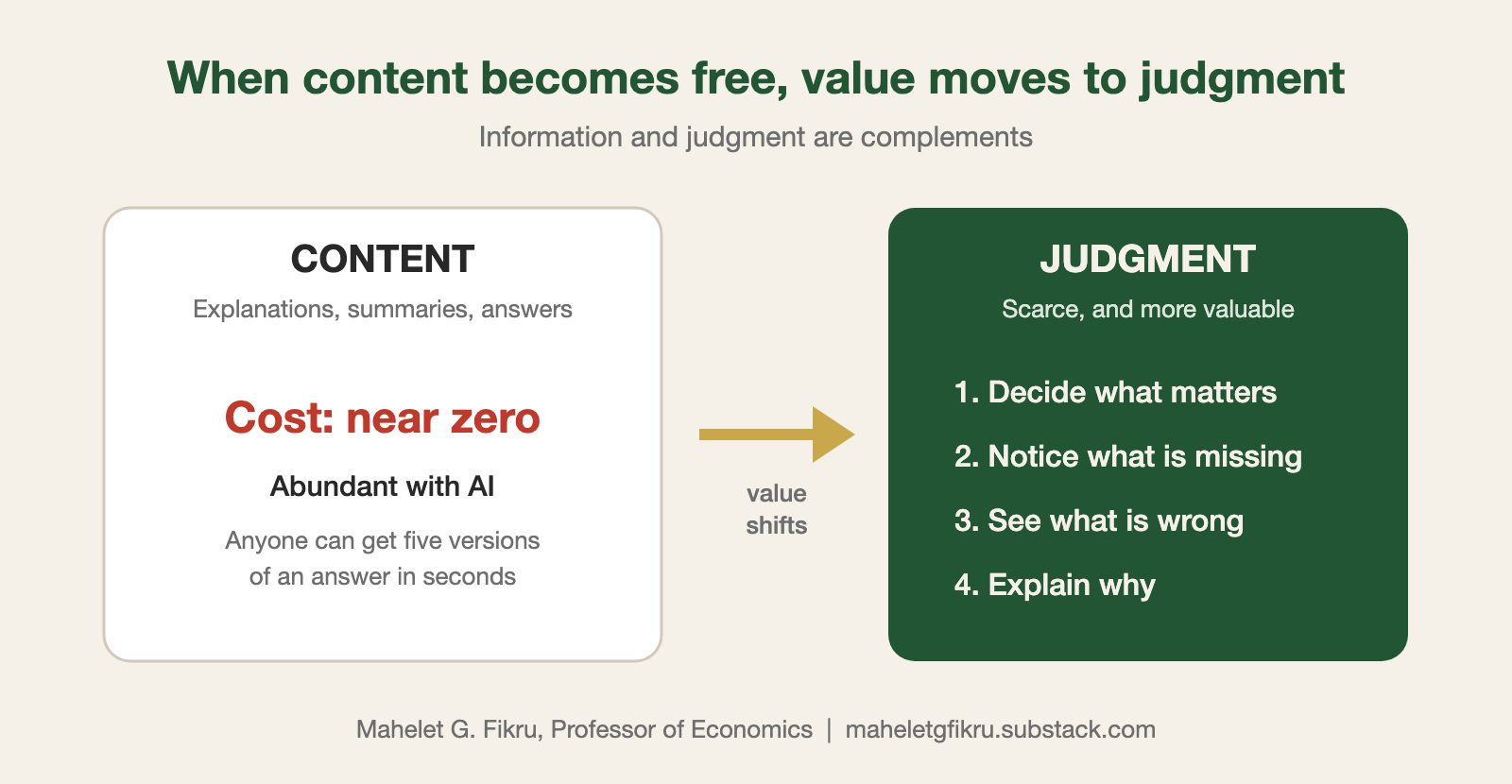
Information and judgment are complements: when the cost of content approaches zero, value shifts toward judgment.
When the price of one input falls, the value does not disappear. It moves to the complement. If everyone can produce an answer, the scarce thing becomes knowing which answer is right, which one fits the situation, what it leaves out, and what to do next. That is judgment.
AI may make one part of education abundant: the delivery of content. That makes the other part, the formation of judgment, more valuable, not less.
The evidence points in the same direction. In a field experiment with nearly 1,000 high school math students, Bastani and colleagues (2025, PNAS) found that students with unrestricted access to a ChatGPT-style tutor performed 48% better on practice problems. When the access was removed, they scored 17% worse on the exam than students who never had it. The tool supplied answers. It did not build the judgment the exam required.
What judgment actually looks like: four skills
“Judgment” can sound vague, so let me be concrete. In my note, I described four things. I still think they are the right four.
1. Deciding what matters. Every question has more information around it than anyone can use. Judgment is choosing the few facts, assumptions, or data points that actually drive the answer. In economics, this is the difference between listing every factor that affects a price and identifying the two that explain most of the change.
2. Noticing what is missing. AI is very good at producing a complete-looking answer. It is much less reliable at telling you what it left out. Judgment is asking: whose costs are not in this analysis? What happens in the long run? Which group was not in the sample?
3. Seeing what is wrong. A fluent argument can still rest on a bad assumption, a misread number, or a leap in logic. Judgment is the ability to read a polished paragraph and say, “This step does not follow.”
4. Explaining why. This is the part that turns an opinion into judgment. It is not enough to say an argument is weak. You have to show the reasoning, so someone else can check it, challenge it, or learn from it.
None of these is about producing content. All four are about evaluating it. That is exactly the work AI has made more important.
What this means for teaching: make judgment the outcome
If judgment is a scarce skill, then it has to be the thing we design for and assess in the classroom. This is the idea behind the last part of LIFT, the framework I use in my own courses. The “T” stands for Thinking as the Outcome. When demonstrated reasoning is what we grade, AI’s ability to produce fluent answers becomes far less disruptive, because fluent answers are not what we are grading.
In practice, that shifts a few things:
Grade the reasoning, not just the result. Ask students to explain why they chose one approach over another, what they considered and rejected, and where they are unsure.
Ask students to find what is missing. Give them an AI-generated answer and ask them to critique it: what does it assume, what does it leave out, and where would it fail?
Make disagreement part of the assignment. Ask students to take a position and then respond to the strongest objection to it.
Watch thinking change. Some of the most revealing student work shows a mind changing halfway through. That is much harder to fake than a finished product.
None of this requires banning AI. It requires being clear about what we are actually trying to teach. I have written more about this in “How to Test for Real Understanding When AI Makes Every Answer Sound Right.”
What this means for students and lifelong learners
If you are a student, here is the uncomfortable part. AI can make your work look finished before your thinking is. It is easy to confuse the two. I saw exactly this in my own class, which I wrote about in “They All Got A’s. None of Them Learned Anything.”
A few habits help:
Decide before you ask AI. Write down what you think the answer is, even roughly, before you ask AI. Then compare. The gap is where your learning is. Soulful Learning with AI has developed a trademarked framework exactly for this.
Ask what is missing. After you get an answer from AI, ask yourself, not the tool, what it did not consider.
Be able to defend every choice. If you cannot explain why a sentence, a number, or an assumption is in your work, it is not really yours yet.
Look for people who push back. Andrew Errant’s professors who “challenged [him] as [his] ideas were evolving” describe the most valuable thing a learning community offers. Seek it out, in class, in office hours, or in the comments.
Used this way, AI does accelerate learning, just as Don Southerton said. It becomes a sparring partner for your judgment rather than a substitute for it.
This is not an anti-AI argument. I use AI in my work, and my students will use it throughout their careers. Nor is it an argument that content no longer matters. Good information still matters enormously. It is just no longer the bottleneck, and when something stops being the bottleneck, the attention and the value move to whatever is.
Frequently asked questions
What does “the age of content scarcity is over” mean?
It means information, explanations, and fluent writing are no longer hard to get. Generative AI produces them almost instantly and at almost no cost. What remains scarce is the judgment to decide which information matters, what is missing, and what is wrong.
Why is judgment more valuable in the age of AI?
Because information and judgment are complements. When AI makes information nearly free, people use far more of it, and the ability to evaluate it becomes the bottleneck. Value moves to the scarce complement.
Can AI replace teachers?
AI can replace much of the content delivery. It cannot fully take responsibility for judging a student’s reasoning, explaining why an argument fails, or mentoring a student while their ideas are still forming. Those are the parts of teaching that become more important.
How can teachers assess judgment instead of AI-generated answers?
Grade the reasoning rather than the final product: ask students to justify choices, critique an AI-generated answer, respond to the strongest objection to their position, and show how their thinking changed.
Should professors ban AI in class to protect judgment?
I do not believe so. Banning AI mostly shifts where students use it. Designing assignments where reasoning is the thing being graded does more to build judgment than any ban.
The scarce thing
As my readers put it: The age of content scarcity is over. Judgment is what is scarce now.
I would love to hear where you disagree. That, after all, is the point. Leave a comment, and if this changed how you think about teaching or learning with AI, restack it or share it with a colleague.
Related reading from M G Fikru:
My University Prepared Me for the Pandemic. Not for AI. (the LIFT framework)
How to Test for Real Understanding When AI Makes Every Answer Sound Right
Mahelet G. Fikru is a Professor at Missouri University of Science and Technology, where she has taught economics for nearly fifteen years. She writes about energy, natural resources, technology, and how AI is changing learning.
The idea that information and judgment are complements is a particularly useful way to frame this shift.
I'd add that judgment develops through practice, not just exposure to more information. A person can read several excellent explanations and still struggle to recognise when one doesn't fit the situation in front of them.
That's why I find the habit of forming an initial view before asking AI so valuable. It gives us something of our own to compare against the answer, question, and improve.
The real opportunity isn't simply to make information abundant. It's to use that abundance to help people become better at evaluating evidence and making decisions independently.
How do you think we can make that kind of growth visible beyond the classroom?
The complements frame settles a question your component 3 quietly raises: why no school ever graded 'seeing what is wrong.' Grading it needs a standing supply of fluent, confident, wrong material to plant in front of students, and producing that by hand was slow, skilled work no examination board could commission at scale - so mass schooling ran a century with the hardest skill off the ledger. Cheap generation just solved the supply problem, so the error-hunt is finally scoreable: seed a packet with plausible wrong answers, count the catches, and weight the false alarms, since someone who challenges every sentence has demonstrated nothing. I trace that selection history, up to the Dell'Acqua result where assisted consultants landed 19 points worse once the fluent answer sat outside the model's competence, in Before the Answer Is Known: https://seldondance.substack.com/p/before-the-answer-is-known #AIEducation #CriticalThinking