

Short answer: AI does not make people lazy thinkers by itself. The harm comes when AI does the reasoning that a task was designed to build. When AI handles routine work or explains and checks your thinking, it can support learning. When it hands you the finished answer, it replaces learning.
What does the research say about AI and student learning?
The clearest evidence comes from a field experiment involving nearly 1,000 high school math students. Bastani et al. (2025, PNAS) found that access to a standard ChatGPT-style tool increased performance on practice problems by 48 percent. But when access was removed, those students scored 17 percent lower on the exam than students who never had it. A tutor version designed to give hints rather than answers increased practice performance by 127 percent without the exam penalty.
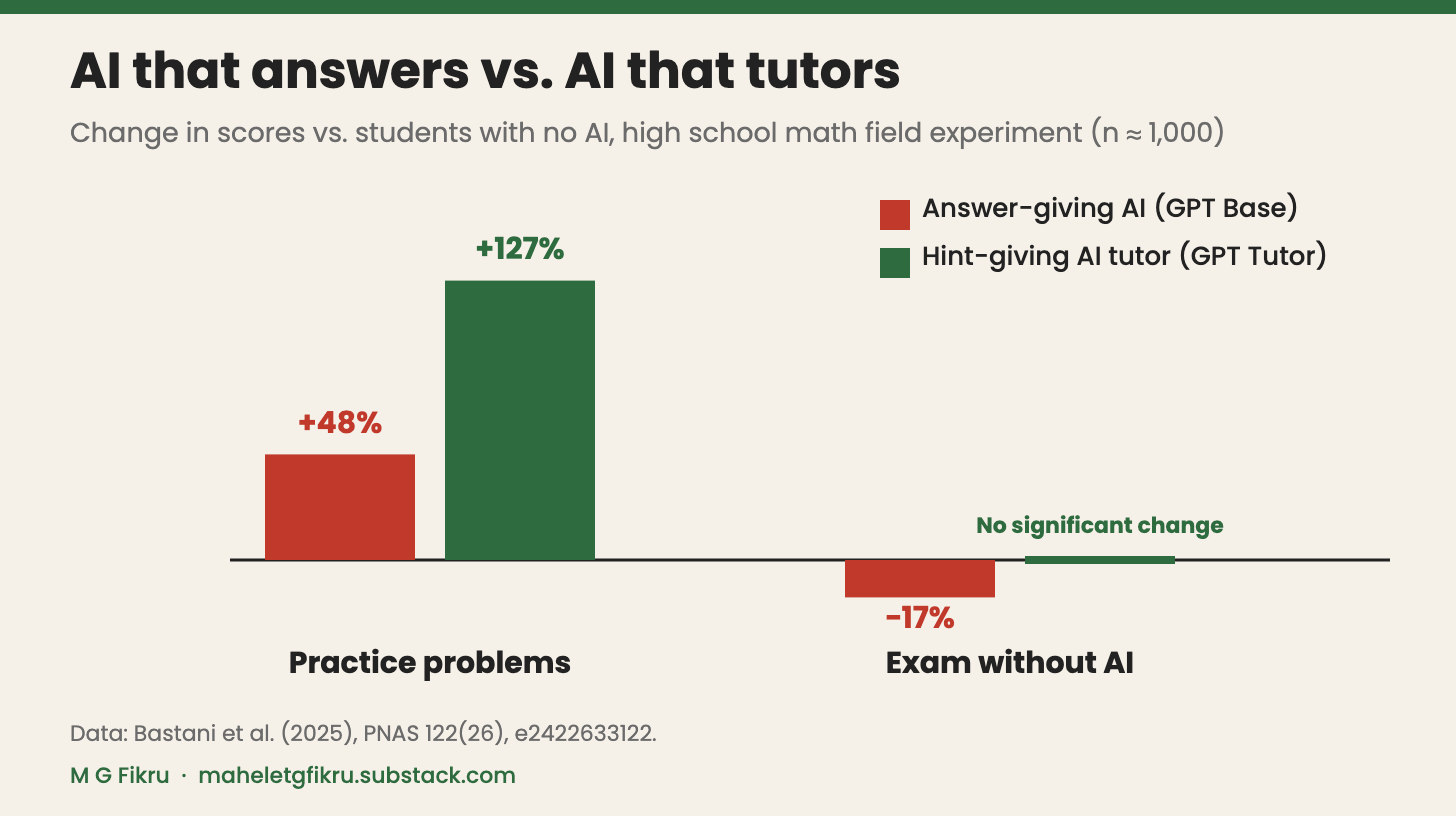
The difference was not the technology. It was who did the thinking.
Survey research points the same way. In a study of 666 participants, Gerlich (2025, Societies) found that frequent AI use was associated with lower critical-thinking scores, a link explained by cognitive offloading, which means handing mental work to the tool.
I see this in my own classroom. In my environmental economics course, about 18 percent of first-week reflections in 2022 listed the same combination of environmental problems that ChatGPT typically returns. By 2023, that share was 48 percent, and it was still 45 percent in 2025. I wrote about those three years of data in Teaching Economics in the Age of AI.
How I use AI as an economics professor
I use AI every week, for tasks where my judgment stays in charge.
Weekly reminder emails. I gave an AI tool my syllabus. Every Friday, it drafts a reminder email for students covering what is due that weekend, what is coming next week, and what to look forward to. I review the draft and then post it to our learning management system. The AI saves me time on formatting. I still decide what students need to hear.
Interactive worksheets. I also use AI to build interactive worksheets where students shift a market, adjust inputs, and see a concept respond, while they still do the reasoning. I collect them in Let's Do Classwork!
In both cases, AI handles the routine work, and the thinking stays with a person.
A simple test: who did the thinking?
Before you use AI on an assignment, ask one question: Is this the step I am supposed to learn?
Use AI to explain a concept in a different way, quiz yourself, or check your reasoning after you have tried.
Do not use AI to produce the answer to a problem you are expected to solve yourself.
Using AI to understand why a firm maximizes profit where marginal revenue equals marginal cost supports learning. Using AI to solve the assigned profit-maximization problem replaces the need to solve it. For a classroom example of this line in practice, see They All Got A's. None of Them Learned Anything.
Frequently asked questions
Does using ChatGPT make students worse at thinking?
Not by itself. Students lose skills when AI completes the reasoning a task was meant to build. In a field experiment with nearly 1,000 students, answer-giving AI lowered exam scores by 17 percent, while a hint-based tutor did not.
What is cognitive offloading?
Cognitive offloading means handing mental work to a tool. Some offloading is useful, like using a calculator. It becomes a problem when the offloaded step is the skill you are supposed to learn.
How can students use AI without becoming lazy thinkers?
Ask one question first: is this the step I am supposed to learn? If yes, attempt it yourself, then use AI to explain, quiz you, or check your work.
Should professors ban AI in their courses?
In my experience, redesigning assignments works better than banning AI. Students do the reasoning in class, and AI handles routine tasks or gives feedback.
Educators: What is one task you hand to AI, and one you never will? Share it in the comments.
Know someone confused about AI use in education? Share this post with them, whether a student, a parent, or a fellow educator. If it resonated, please like and restack it so it reaches more people asking the same question.
Read more on teaching and learning with AI:
Teaching in the AI Age: Why Flipped Classrooms Are Working Better Than Ever
Turning AI answers into a learning tool starts with intentional assignment redesign
Mahelet G. Fikru is a professor of economics at Missouri University of Science and Technology with 15 years of teaching and research experience.
That true currently our global system of education is depends on Ai thinking that control our mentality and IQ it's a big issues to be considered and talking about that ,thank you for your description.
An incredibly important and refreshingly nuanced perspective on AI in education! It’s not about ‘bans,’ but rather about the right division of roles: AI can serve as a tool for routine tasks and feedback, while the human brain remains in the driver’s seat. This is exactly the kind of approach we need!