

Across the U.S., mining communities sit at the source of mineral wealth, but the highest value is often captured elsewhere—through refining, processing, and advanced manufacturing that take place outside these communities.
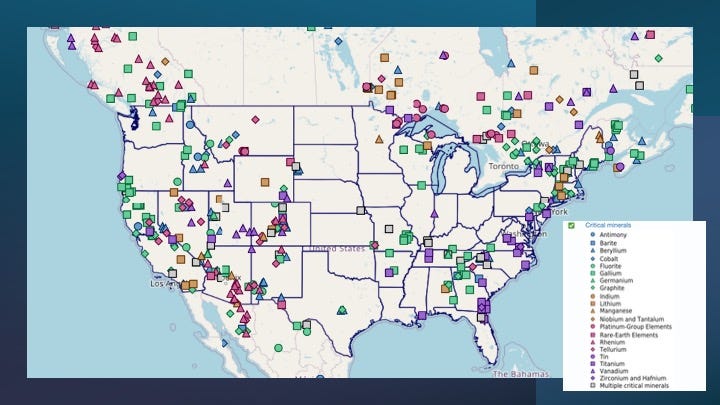
Mining communities are endowed with non-fuel mineral deposits that are key for a diverse set of manufacturing industries, including electronics, transportation, and energy technology. Copper, iron ore, and aluminum are widely used across applications, while nickel and lithium are essential for battery systems. States like Arizona (copper), Nevada (copper), and Michigan (iron ore) rank among the top 10 in the value of non-fuel mineral production.
Despite this resource base, the U.S. has historically been a net importer of both raw and refined materials. Demand continues to outpace the rate at which minerals can be profitably extracted and refined. More recently, national priorities have shifted toward reducing reliance on imports and building a resilient domestic extraction and refining industry. These goals have elevated domestic mining as a strategy for mineral sourcing. Alternatives such as recycling and recovering used metals are also being advocated, though to a lesser extent.
Local Tradeoffs
Domestic mining inevitably involves (re)opening operations in local communities, bringing both opportunities and social challenges.
On one hand, mining projects can create jobs, improve infrastructure, and generate local tax revenue.
On the other hand, they may introduce disruptions—air and noise pollution, competition for scarce resources such as water, changes in land use, and a transient (and sometimes unwelcome) labor force.
When perceived risks outweigh benefits, communities often mobilize opposition that can delay or block projects.
In contrast, smaller or rural communities may welcome mining projects because the benefits carry more weight. Where alternative economic opportunities are limited, mining may be seen as one of the few viable paths for development. This has sometimes led to a YIMBY dynamic—Yes-In-My-Backyard—where proximity to a proposed site increases support.
The Same Pattern, Different Locations
This pattern mirrors conditions in many mineral-rich countries in the Global South, where resource endowments position them primarily as suppliers of raw, unrefined materials (e.g., the Democratic Republic of Congo). These countries typically do not engage in higher-value refining or manufacturing and therefore capture only a small share of the value generated along the global value chain. In some cases, mining sites are owned by foreign entities through foreign direct investment, meaning profits are repatriated rather than retained locally. The result is limited economic gain alongside full exposure to the external costs of extraction.
A similar dynamic can be observed in U.S. mining towns. These communities are often sparsely populated, economically less diversified, and tied to operations owned by out-of-state corporations or investors who capture most of the economic profit. High-value activities—refining and advanced manufacturing—tend to occur elsewhere or abroad.
For example, in 2024, Michigan exported all 8,000 tons of nickel produced at the Eagle Mine in concentrate form to smelters in Canada and other countries.
Closing the Value Gap
Mining communities, in the U.S. or elsewhere, need not remain confined to the lowest-value stage of extraction while higher-value activities occur elsewhere.
One way to close this gap is to co-locate mining with advanced manufacturing, allowing host communities to participate further along the value chain. Another is to strengthen the ability of mineral-rich communities to negotiate higher royalties and secure direct monetary or non-monetary benefits from mining projects.
These approaches could allow communities to capture a greater share of the economic value while fostering broader support for domestic extraction.
Your Turn
If mining happens locally, should value creation stay local too? Or is it enough for communities to host extraction while the higher-value gains happen elsewhere? Let me know your thoughts in the comments.
As to your question, would the mining companies be local or multinational - that changes the answer considerably
Donald Trump's plan for Gaza (can't find it right this mo) stated 'Benefit to the US $1.3 trillion in rare earth minerals.' if I remember correctly