

When the pandemic arrived, my university did not simply tell faculty to “figure it out.”
In my case, I spent about a year receiving training on online teaching. I completed two formal training programs and earned two certificates. The institution purchased platforms such as Zoom and Panopto. We received guidance on best practices, what to do and what not to do, and even clarification on issues that many faculty were uncertain about, such as whether students could be required to turn on their cameras and what legal considerations applied.
The message was clear: online education represented a major disruption, and the institution had a responsibility to help educators adapt.
My experience with AI has been different.
When AI arrived, everyone responded differently
When generative AI entered the classroom, there was no comparable institutional response. The guidance I received was limited. Faculty were told to use AI detectors, often without institutions purchasing those tools or providing training on their strengths and limitations. We were told to discuss AI at the department level and do what made sense for our disciplines.
In practice, the message often felt like "figure it out."
As a result, I observed a wide range of responses among educators. Some reacted in fear and focused on preventing the use of AI whenever possible. Others largely ignored it and continued teaching as usual, relying heavily on take-home assignments and assessments even as students increasingly submitted those same questions to ChatGPT and received fluent answers. Some faculty embraced AI and began using it to help generate assignments, quizzes, and exams. Many institutions adopted traffic-light policies—green for unrestricted AI use, yellow for limited use, and red for no AI use.
While these approaches provide a starting point, they do not amount to a coherent institutional strategy.
Higher education needs a more structured approach while still allowing flexibility at the departmental and individual faculty levels.
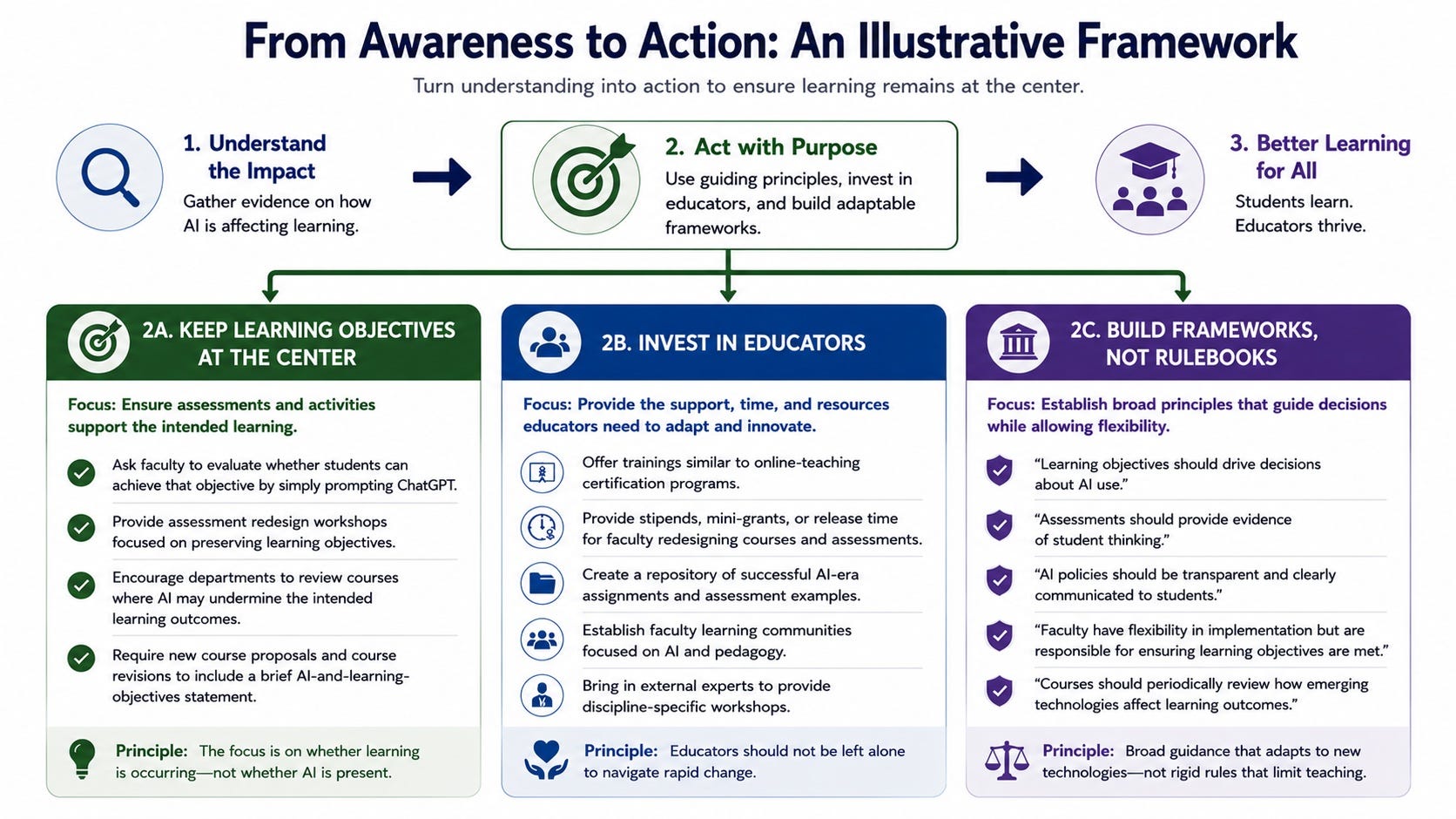
Step 1: Understand AI’s impact on student learning
The first step is understanding what AI is actually doing to learning within our institutions.
Universities should systematically document AI’s impact by gathering information from both faculty and students. Educators should be asked how AI has affected their teaching, challenged their assessments, and influenced their pedagogical decisions. Students should be asked how AI affects their learning, what concerns they have, how they use these tools, and what they expect from their instructors.
Before developing solutions, institutions need a clear understanding of the problems they are trying to solve.
For example, are students completing assignments without understanding the underlying concepts? Are traditional assessments still measuring what educators believe they are measuring? Which learning objectives are most vulnerable to disruption? Where is AI creating opportunities for deeper learning, and where is it creating risks?
Without answering these questions, institutions are responding to AI based largely on assumptions.
Step 2: Move from awareness to action
Understanding the problem is only the first step. Once institutions have documented how AI is affecting learning, they need a framework for responding to it—a framework for action. In my view, that response should focus on three areas:
Keep learning objectives at the center
Invest in educators
Build frameworks, not rulebooks
I am not advocating for rigid mandates or one-size-fits-all policies. Different disciplines have different learning goals, and faculty need flexibility to design courses that fit their contexts. However, institutions can provide a common framework that helps guide decision-making.
Keep learning objectives at the center
One possible starting point is learning objectives.
If the purpose of an assessment is to evaluate a particular learning objective, educators should be encouraged to ask whether the current design still allows that objective to be achieved in an environment where AI is readily available. If AI use prevents students from demonstrating the intended learning, then the assessment may need to be redesigned.
The focus should not be on whether AI is present. The focus should be on whether learning is occurring.
This type of framework would not dictate specific assignments or teaching methods. Instead, it would provide a shared principle that departments and faculty can adapt to their own needs.
Invest in educators
Institutions must invest in educators if they expect meaningful change. During the transition to online learning, universities invested resources, training, and time. Faculty were given opportunities to learn new approaches and experiment with new teaching methods. Incentives were aligned with institutional expectations.
A similar investment is needed today.
If universities expect faculty to redesign courses, rethink assessments, and adapt to rapidly evolving technologies, they should provide the training, resources, examples, and support necessary to do so. Faculty should be given opportunities to experiment, learn from one another, and develop approaches that work in their own classrooms. One example from my own teaching is Let’s Do Classwork!, a free set of interactive economics labs I built from my classroom exercises with the help of AI.
Educators should not be left alone to navigate these changes.
Build frameworks, not rulebooks
What is needed is not a detailed rulebook for AI. The technology will continue to evolve, and today’s solutions may not fit tomorrow’s challenges. Instead, institutions need broad frameworks that help educators make decisions when new technologies emerge.
The goal is to ensure that learning remains at the center of education, even as the technologies surrounding it continue to change.
Key takeaways
During the transition to online learning, institutions invested in helping educators adapt. In the AI era, many educators have been left to navigate the changes on their own.
Universities do not need all the answers. AI is evolving too quickly for any institution to develop a perfect response. But institutions can begin by building systems that help educators respond to change. In my view, understanding AI’s impact on learning, investing in educators, and creating adaptable frameworks are important first steps.
The goal is not to manage AI. The goal is to ensure that learning remains at the heart of education.
Related: The Age of Content Scarcity Is Over. Judgment Is What’s Scarce Now.
I was hoping to see some specific suggested rules for consideration. Here are 10 that I came up with using Claude and specific prompting by me:
1. No single AI detector score may serve as the sole basis for an academic integrity finding. Require corroboration from drafting history, an oral explanation, or another independent source of evidence.
2. Any grade-determining, high-stakes assessment (final exam, capstone, thesis defense) includes a short structured oral component, not an unstructured one.
3. If a detection tool is purchased, faculty receive mandatory training on its documented false positive rate and its bias against non-native English writers before the tool is authorized for use in any integrity proceeding.
4. Require disclosure of AI use on submitted work, paired with an explicit institutional commitment that disclosure alone never triggers increased scrutiny or suspicion.
5. Set one university-wide default for AI-free contexts, such as proctored in-class exams and licensure-critical assessments, and leave everything outside that default to department-level policy.
6. Require version history or drafting evidence, such as document edit logs, for major written assignments as a lower-cost alternative to a full oral defense.
7. Establish an appeals process specific to AI-related allegations, with a standard of evidence higher than a single detector score.
8. Before restricting AI use on any assessment, require the instructor to document whether the assessment still measures its stated learning objective when AI is available. Redesign before you restrict.
9. Fund faculty release time or stipends for assessment redesign, matching the investment model institutions used for the online-learning transition, rather than issuing redesign expectations unfunded.
10. Review the AI policy on a fixed annual cycle, since detector accuracy and model capability move faster than most governance calendars.
Must-haves: 1, 3, and 2.
Rule 1 is non-negotiable because the accuracy data is not marginal. A tool with a documented 61% false positive rate for a specific student population is not a close call, it is a liability and a fairness problem. Rule 3 follows directly from that same data. No institution should deploy a detection tool without first telling faculty what its actual error profile is, especially the ESL bias. Rule 2 is the one constructive redesign with real evidence behind it. Oral defense is not a theory, it has measured reliability numbers and multiple institutions running it at scale.
I appreciate the thoughtful article and proposed framework, but why let administrators off the hook? In the U.S., the cost of higher education is through the roof. Whatever happened to **holding leadership accountable**?